
Borrmann Ⅳ型胃癌中包膜外淋巴结转移的预后影响及意义
Prognostic impact and implications of extracapsular lymph node spread in Borrmann type IV gastric cancer.
作者信息
Dong Rui-Zeng, Guo Jian-Min, Zhang Ze-Wei, Zhou Yi-Min, Su Ying
机构信息
Department of Abdominal Surgery, Zhejiang Cancer Hospital, Hangzhou, People's Republic of China.
Department of Pathology, Zhejiang Cancer Hospital, Hangzhou, People's Republic of China.
出版信息
Oncotarget. 2017 Jun 7;8(57):97593-97601. doi: 10.18632/oncotarget.18400. eCollection 2017 Nov 14.
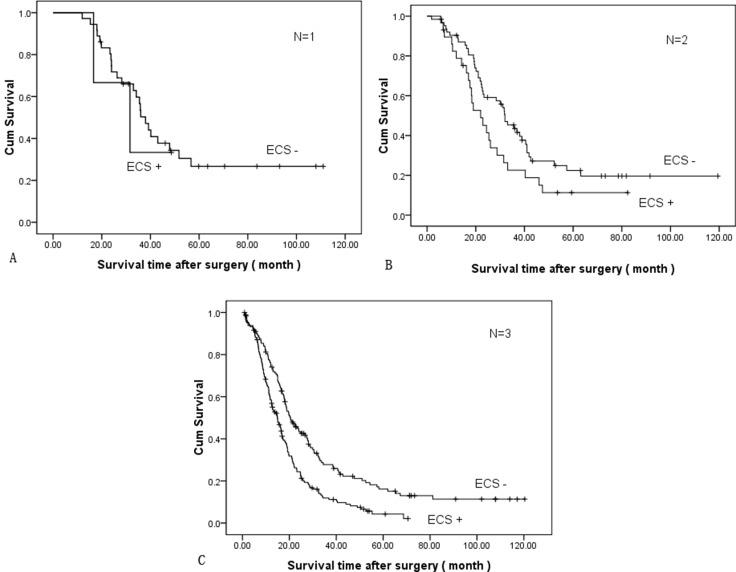
The purpose of this study was to evaluate the relationship between extracapsular lymph node spread (ECS) and clinicopathology and its influence on the prognosis in patients with Borrmann type IV gastric cancer. Between 2002 and 2014, clinical data were reviewed from 486 patients with Borrmann type IV gastric cancer who underwent curative resection. Of the 486 patients, lymph node metastasis was found in 456. ECS was detected in 213 (46.7%) patients with lymph node metastasis. A positive lymph node with ECS was significantly correlated with the N category, lymphatic/venous invasion, tumor location, and TNM stage. For the whole patients, the mean OS was 34.7 months, and the 5-year OS rate was 15.5%. The 5-year OS rate of node-negative patients was 48%, for node-positive patients without ECS 18.7%, and for node-positive patients with ECS 5.7% ( = 0.000). In a multivariate analysis, adjusted for tumor location, lymphatic/venous invasion, body mass index (BMI), and TNM stages, ECS remained an independent prognostic factor. For patients with the same N category and TNM stage, those with ECS still had a worse survival rate. Recurrent sites were confirmed in 367 patients. The most frequent recurrent site was the peritoneum. There was a significant difference between ECS+ ( = 150) and ECS- ( = 142) patients ( = 0.008). Our results suggested that ECS was an independent prognostic value for Borrmann type IV gastric cancer patients with curative resection and a subgroup indicated a significantly worse long-term survival for patients with the same N or TNM stages. ECS+ was an adverse factor for peritoneal metastasis.
本研究旨在评估Borrmann Ⅳ型胃癌患者的包膜外淋巴结转移(ECS)与临床病理特征之间的关系及其对预后的影响。回顾2002年至2014年间486例行根治性切除术的Borrmann Ⅳ型胃癌患者的临床资料。486例患者中,456例发现有淋巴结转移。213例(46.7%)有淋巴结转移的患者检测到ECS。存在ECS的阳性淋巴结与N分期、淋巴管/血管侵犯、肿瘤位置及TNM分期显著相关。所有患者的中位总生存期(OS)为34.7个月,5年OS率为15.5%。淋巴结阴性患者的5年OS率为48%,无ECS的淋巴结阳性患者为18.7%,有ECS的淋巴结阳性患者为5.7%(P = 0.000)。多因素分析中,校正肿瘤位置、淋巴管/血管侵犯、体重指数(BMI)及TNM分期后,ECS仍是独立的预后因素。对于N分期和TNM分期相同的患者,有ECS者的生存率仍较差。367例患者确认了复发部位。最常见的复发部位是腹膜。ECS阳性(n = 150)和ECS阴性(n = 142)患者之间存在显著差异(P = 0.008)。我们的结果表明,ECS对行根治性切除术的Borrmann Ⅳ型胃癌患者具有独立的预后价值,并且在N分期或TNM分期相同情况下,有ECS的亚组患者长期生存率明显更差。ECS阳性是腹膜转移的不良因素。


 Zotero 插件