Straub Mary H, Roy Austin N, Martin Amanda, Sholty Kathleen E, Stephenson Nicole, Foley Janet E
Department of Veterinary Medicine and Epidemiology, School of Veterinary Medicine, University of California, Davis, California, United States of America.
Museum of Wildlife and Fish Biology, University of California, Davis, California, United States of America.
PLoS One. 2017 Dec 12;12(12):e0189352. doi: 10.1371/journal.pone.0189352. eCollection 2017.
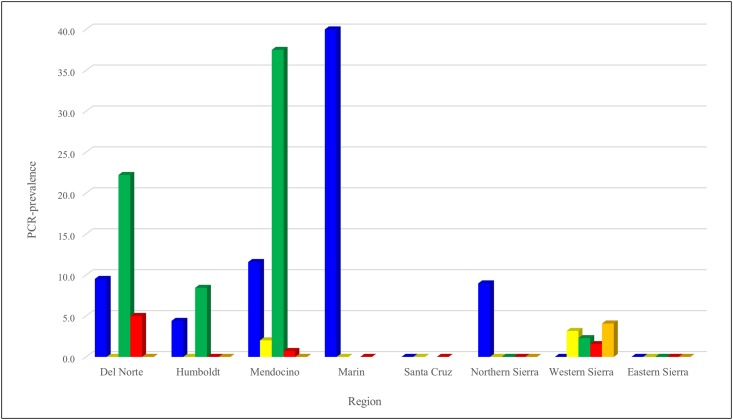
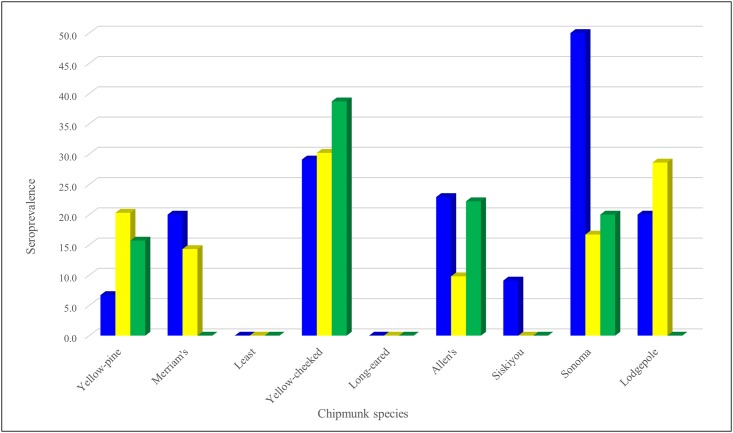
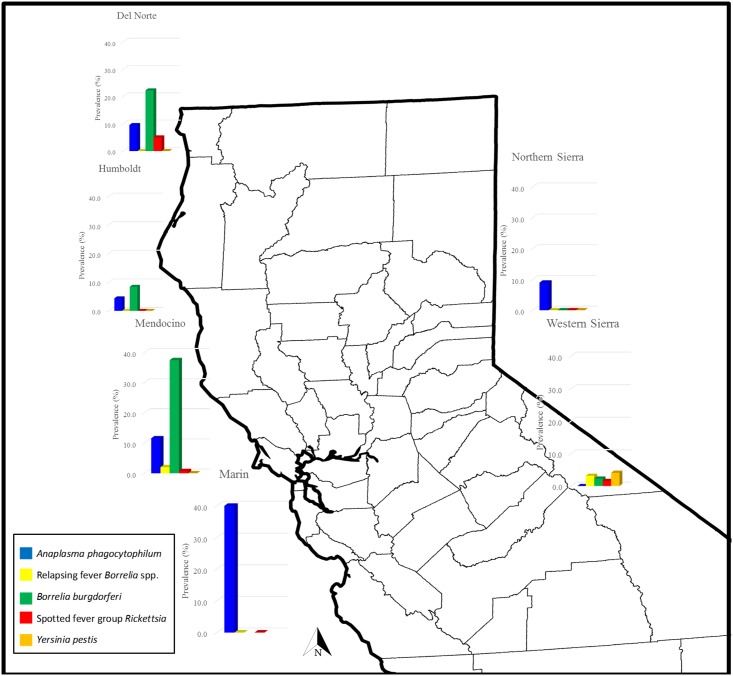
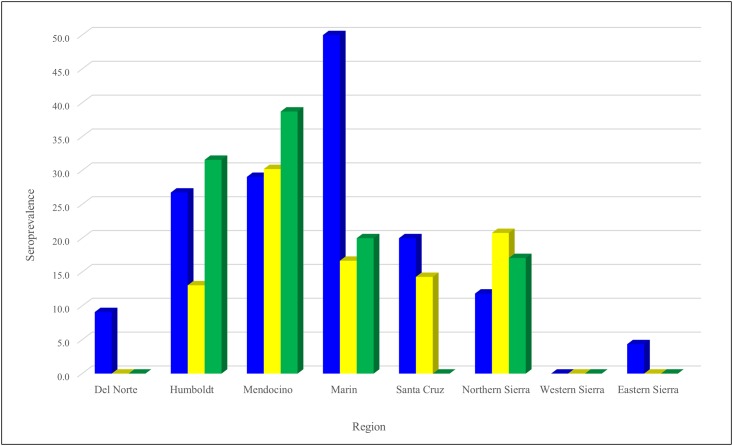
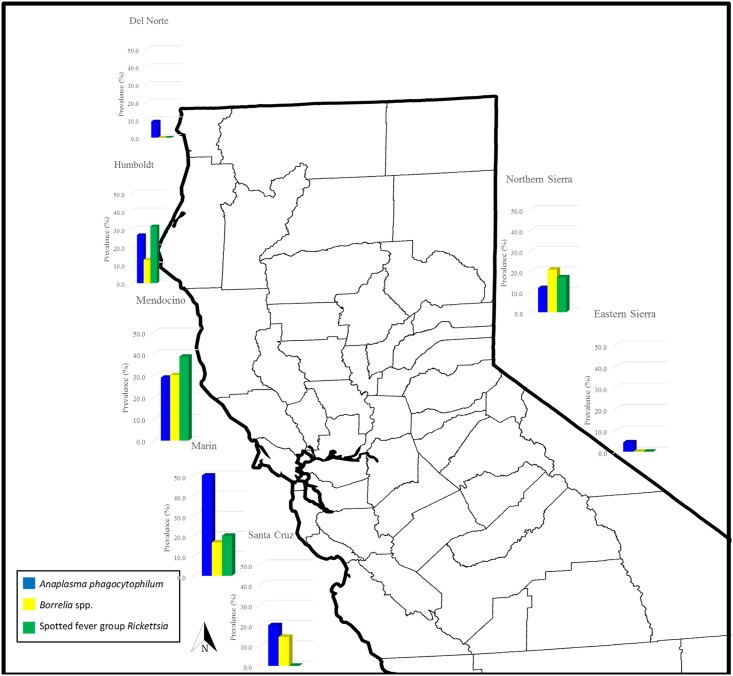
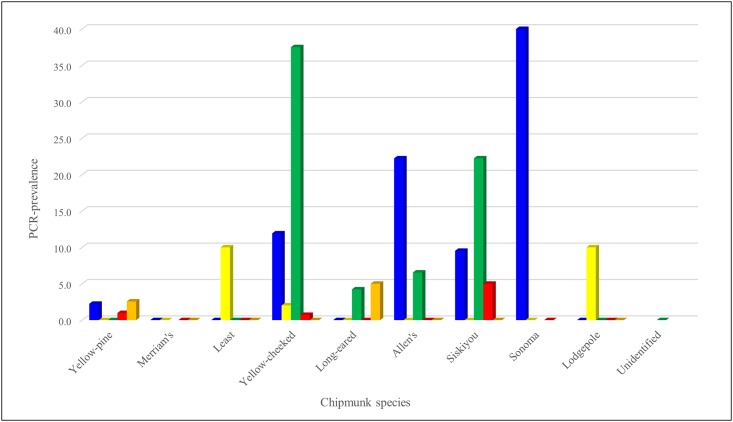
California, with 13 chipmunk (Tamias) species, has more than any other state or country, occupying habitats ranging from chaparral to the high peaks of the Sierra Nevada. Chipmunks host zoonotic pathogens including Yersinia pestis, Anaplasma phagocytophilum, relapsing fever (RF) Borrelia spp., Borrelia burgdorferi, and spotted fever group (SFG) Rickettsia species. Chipmunk species are often not differentiated by public health workers, yet different species utilize different ecological niches and may have intrinsically different capacities for maintaining vector-borne pathogens and infecting vectors. We surveyed over 700 individuals from nine species of chipmunks throughout California for exposure to and infection by Y. pestis, A. phagocytophilum, RF Borrelia spp., Borrelia burgdorferi, and SFG Rickettsia species. DNA of all five pathogens was found and all chipmunks except Merriam's chipmunk (T. merriami) were PCR-positive for at least one of the pathogens. Anaplasma phagocytophilum was most common (40.0%, 2/5) in Sonoma chipmunks (T. sonomae) from Marin county and B. burgdorferi most common (37.5%, 27/72) in redwood chipmunks (T. ochrogenys) from Mendocino county. RF Borrelia spp. was detected in 2% (6/297) of redwood chipmunks in Mendocino county and 10% (1/10) of both least (T. minimus) and lodgepole (T. speciosus) chipmunks in the western Sierra. Exposure to SFG Rickettsia spp. was found in the Northern Coastal region (Del Norte, Humboldt and Mendocino counties) and in the northern and western Sierra in several species of chipmunks. Y. pestis infection was found only in the western Sierra-in a yellow-pine (T. amoenus) and a long-eared (T. quadrimaculatus) chipmunk. Though more data are needed to thoroughly understand the roles that different chipmunk species play in disease transmission, our findings suggest that some chipmunk species may be more important to the maintenance of vector-borne diseases than others within each geographic area.
加利福尼亚州有13种花栗鼠(金花鼠属),比其他任何州或国家都多,其栖息地范围从丛林到内华达山脉的高峰。花栗鼠携带人畜共患病病原体,包括鼠疫耶尔森菌、嗜吞噬细胞无形体、回归热(RF)疏螺旋体属、伯氏疏螺旋体和斑点热群(SFG)立克次体物种。公共卫生工作者通常无法区分花栗鼠的物种,但不同的物种利用不同的生态位,并且在维持媒介传播病原体和感染媒介方面可能具有本质上不同的能力。我们对加利福尼亚州九种花栗鼠的700多个个体进行了调查,以检测它们是否接触以及感染了鼠疫耶尔森菌、嗜吞噬细胞无形体、RF疏螺旋体属、伯氏疏螺旋体和SFG立克次体物种。发现了所有五种病原体的DNA,除了梅里亚姆花栗鼠(金花鼠)外,所有花栗鼠对至少一种病原体的PCR检测均呈阳性。嗜吞噬细胞无形体在马林县的索诺马花栗鼠(金花鼠)中最为常见(40.0%,2/5),伯氏疏螺旋体在门多西诺县的红木花栗鼠(金花鼠)中最为常见(37.5%,27/72)。在门多西诺县的2%(6/297)红木花栗鼠以及西内华达山脉的最小花栗鼠(金花鼠)和 lodgepole 花栗鼠(金花鼠)的10%(1/10)中检测到RF疏螺旋体属。在北海岸地区(德尔诺特、洪堡和门多西诺县)以及内华达山脉北部和西部的几种花栗鼠中发现了接触SFG立克次体物种的情况。仅在西内华达山脉的黄松花栗鼠(金花鼠)和长耳花栗鼠(金花鼠)中发现了鼠疫耶尔森菌感染。尽管需要更多数据来彻底了解不同花栗鼠物种在疾病传播中所起的作用,但我们的研究结果表明,在每个地理区域内,某些花栗鼠物种可能比其他物种在维持媒介传播疾病方面更为重要。