Helsen Kenny, Acharya Kamal P, Brunet Jörg, Cousins Sara A O, Decocq Guillaume, Hermy Martin, Kolb Annette, Lemke Isgard H, Lenoir Jonathan, Plue Jan, Verheyen Kris, De Frenne Pieter, Graae Bente J
Department of Biology, Norwegian University of Science and Technology, Høgskoleringen 5, 7034, Trondheim, Norway.
Southern Swedish Forest Research Centre, Swedish University of Agricultural Sciences, Box 49, 230 53, Alnarp, Sweden.
BMC Ecol. 2017 Dec 12;17(1):38. doi: 10.1186/s12898-017-0151-y.
The importance of intraspecific trait variation (ITV) is increasingly acknowledged among plant ecologists. However, our understanding of what drives ITV between individual plants (ITV) at the population level is still limited. Contrasting theoretical hypotheses state that ITV can be either suppressed (stress-reduced plasticity hypothesis) or enhanced (stress-induced variability hypothesis) under high abiotic stress. Similarly, other hypotheses predict either suppressed (niche packing hypothesis) or enhanced ITV (individual variation hypothesis) under high niche packing in species rich communities. In this study we assess the relative effects of both abiotic and biotic niche effects on ITV of four functional traits (leaf area, specific leaf area, plant height and seed mass), for three herbaceous plant species across a 2300 km long gradient in Europe. The study species were the slow colonizing Anemone nemorosa, a species with intermediate colonization rates, Milium effusum, and the fast colonizing, non-native Impatiens glandulifera.
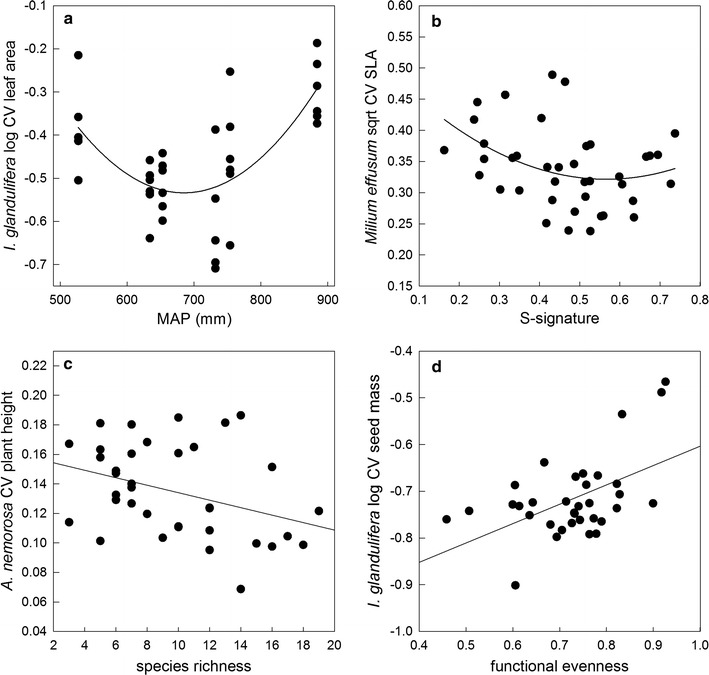
Climatic stress consistently increased ITV across species and traits. Soil nutrient stress, on the other hand, reduced ITV for A. nemorosa and I. glandulifera, but had a reversed effect for M. effusum. We furthermore observed a reversed effect of high niche packing on ITV for the fast colonizing non-native I. glandulifera (increased ITV), as compared to the slow colonizing native A. nemorosa and M. effusum (reduced ITV). Additionally, ITV in the fast colonizing species tended to be highest for the vegetative traits plant height and leaf area, but lowest for the measured generative trait seed mass.
This study shows that stress can both reduce and increase ITV, seemingly supporting both the stress-reduced plasticity and stress-induced variability hypotheses. Similarly, niche packing effects on ITV supported both the niche packing hypothesis and the individual variation hypothesis. These results clearly illustrates the importance of simultaneously evaluating both abiotic and biotic factors on ITV. This study adds to the growing realization that within-population trait variation should not be ignored and can provide valuable ecological insights.
种内性状变异(ITV)的重要性在植物生态学家中日益得到认可。然而,我们对种群水平上驱动个体植物间ITV的因素的理解仍然有限。相互矛盾的理论假说指出,在高非生物胁迫下,ITV可能被抑制(胁迫降低可塑性假说)或增强(胁迫诱导变异性假说)。同样,其他假说预测,在物种丰富的群落中,高生态位填充下ITV要么被抑制(生态位填充假说),要么增强(个体变异假说)。在本研究中,我们评估了非生物和生物生态位效应对欧洲2300公里长梯度上三种草本植物物种的四个功能性状(叶面积、比叶面积、株高和种子质量)的ITV的相对影响。研究物种包括缓慢扩散的银莲花、扩散速率中等的粟草以及快速扩散的非本地凤仙花。
气候胁迫一致地增加了各物种和性状的ITV。另一方面,土壤养分胁迫降低了银莲花和凤仙花的ITV,但对粟草有相反的影响。此外,与缓慢扩散的本地银莲花和粟草(ITV降低)相比,我们观察到高生态位填充对快速扩散的非本地凤仙花的ITV有相反的影响(ITV增加)。此外,快速扩散物种的ITV在营养性状株高和叶面积上往往最高,但在测量的生殖性状种子质量上最低。
本研究表明,胁迫既能降低也能增加ITV,似乎同时支持胁迫降低可塑性假说和胁迫诱导变异性假说。同样,生态位填充对ITV的影响同时支持生态位填充假说和个体变异假说。这些结果清楚地说明了同时评估非生物和生物因素对ITV的重要性。本研究进一步促使人们认识到,种群内性状变异不应被忽视,并且可以提供有价值的生态学见解。