Rimpeekool Wimalin, Yiengprugsawan Vasoontara, Kirk Martyn, Banwell Cathy, Seubsman Sam-Ang, Sleigh Adrian
National Centre for Epidemiology & Population Health, Research School of Population Health, Australian National University, Canberra, Australia.
School of Human Ecology, Sukhothai Thammathirat Open University, Nonthaburi, Thailand.
PLoS One. 2017 Dec 13;12(12):e0189574. doi: 10.1371/journal.pone.0189574. eCollection 2017.
Nutrition labels have been promoted for nearly two decades in Thailand to educate people about healthy eating and to combat nutrient-related non-communicable diseases (NCDs). But little is known about how nutrition labels are experienced and whether they are linked with better health. Our objective was to investigate the associations between nutrition label experience, obesity and nutrient-related NCDs in Thai consumers.
A cross-sectional study was undertaken with a nationwide cohort of 42,750 distance learning Thai adult students enrolled in an Open University in 2013. We measured exposure as nutrition label experience (read, understand, use). Health outcomes were high blood pressure, high blood lipids, and high Body Mass Index (overweight at risk and obesity). Multivariate logistic regression was used to determine the association between nutrition label experience and health outcome adjusting for sociodemographic attributes, physical activity, smoking, and alcohol intake.
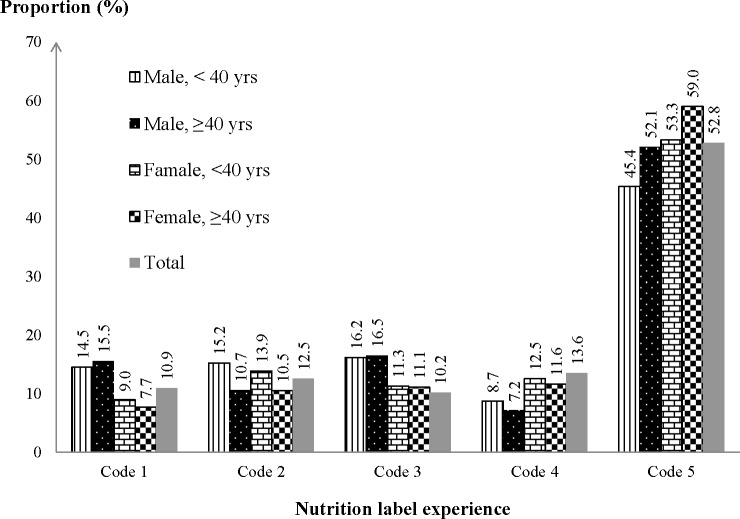
Frequent nutrition label use varied by cohort attributes and health outcomes and was least for those with low physical activity and high blood pressure. Being male, older, an urban resident or with low physical activity was associated with increasing high blood pressure and high blood lipids. Compared to those who read, understand and use nutrition labels, participants who did not (read, understand, and use), were more likely to report high blood pressure (Adjusted Odds Ratio 1.33; 1.17-1.51), high blood lipids (AOR 1.26; 1.14-1.39), and obesity (AOR 1.23; 1.13-1.33), but were not more likely to be overweight at risk (AOR 1.06; 0.97-1.16).
We found cross-sectional associations between low nutrition label experience and increased likelihood of high blood pressure, high blood lipids, and obesity among Thai adults. Nutrition label education should be promoted as part of a public health approach to appropriate food choices and better lifestyles to reduce obesity and nutrient-related NCDs.
在泰国,营养标签已推广近二十年,旨在教育人们健康饮食并应对与营养相关的非传染性疾病(NCDs)。但对于人们如何体验营养标签以及它们是否与更健康的状况相关,我们知之甚少。我们的目标是调查泰国消费者的营养标签体验、肥胖与营养相关非传染性疾病之间的关联。
对2013年注册于一所开放大学的42750名泰国成年远程学习学生进行了一项全国性队列的横断面研究。我们将接触程度衡量为营养标签体验(阅读、理解、使用)。健康结果包括高血压、高血脂和高体重指数(有超重风险和肥胖)。使用多因素逻辑回归来确定营养标签体验与健康结果之间的关联,并对社会人口学特征、身体活动、吸烟和饮酒情况进行调整。
营养标签的频繁使用因队列特征和健康结果而异,体力活动水平低和患有高血压的人群使用频率最低。男性、年龄较大、城市居民或体力活动水平低与高血压和高血脂患病率增加相关。与阅读、理解并使用营养标签的参与者相比,未(阅读、理解和使用)营养标签的参与者更有可能报告患有高血压(调整后的优势比为1.33;1.17 - 1.51)、高血脂(AOR为1.26;1.14 - 1.39)和肥胖(AOR为1.23;1.13 - 1.33),但超重风险增加的可能性并不更高(AOR为1.06;0.97 - 1.16)。
我们发现泰国成年人中营养标签体验不足与高血压、高血脂和肥胖可能性增加之间存在横断面关联。应推广营养标签教育,将其作为公共卫生方法的一部分,以促进合理的食物选择和更好的生活方式,从而减少肥胖和营养相关的非传染性疾病。