Inwani Irene, Chhun Nok, Agot Kawango, Cleland Charles M, Buttolph Jasmine, Thirumurthy Harsha, Kurth Ann E
Kenyatta National Hospital, University of Nairobi, Nairobi, Kenya.
Yale University School of Nursing, Orange, CT, United States.
JMIR Res Protoc. 2017 Dec 13;6(12):e179. doi: 10.2196/resprot.8200.
Sub-Saharan Africa is the region with the highest HIV burden. Adolescent girls and young women (AGYW) in the age range of 15 to 24 years are twice as likely as their male peers to be infected, making females in sub-Saharan Africa the most at-risk group for HIV infection. It is therefore critical to prioritize access to HIV testing, prevention, and treatment for this vulnerable population.
Using an implementation science framework, the purpose of this research protocol was to describe the approaches we propose to optimize engagement of AGYW in both the HIV prevention and care continuum and to determine the recruitment and testing strategies that identify the highest proportion of previously undiagnosed HIV infections.
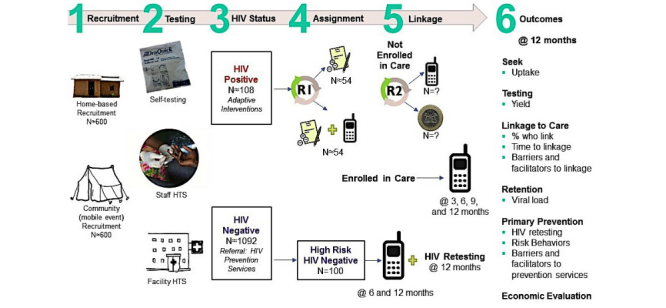
We will compare two seek recruitment strategies, three test strategies, and pilot adaptive linkage to care interventions (sequential multiple assignment randomized trial [SMART] design) among AGYW in the age range of 15 to 24 years in Homa Bay County, western Kenya. AGYW will be recruited in the home or community-based setting and offered three testing options: oral fluid HIV self-testing, staff-aided rapid HIV testing, or referral to a health care facility for standard HIV testing services. Newly diagnosed AGYW with HIV will be enrolled in the SMART trial pilot to determine the most effective way to support initial linkage to care after a positive diagnosis. They will be randomized to standard referral (counseling and a referral note) or standard referral plus SMS text message (short message service, SMS); those not linked to care within 2 weeks will be rerandomized to receive an additional SMS text message or a one-time financial incentive (approximately US $4). We will also evaluate a primary prevention messaging intervention to support identified high-risk HIV-negative AGYW to reduce their HIV risk and adhere to HIV retesting recommendations. We will also conduct analyses to determine the incremental cost-effectiveness of the seek, testing and linkage interventions.
We expect to enroll 1200 participants overall, with a random selection of 100 high-risk HIV-negative AGYW for the SMS prevention intervention (HIV-negative cohort) and approximately 108 AGYW who are living with HIV for the SMART design pilot of adaptive linkage to care interventions (HIV-positive cohort). We anticipate that the linkage to care interventions will be feasible and acceptable to implement. Lastly, the use of SMS text messages to engage participants will provide pilot data to the Kenyan government currently exploring a national platform to track and support linkage, adherence to treatment, retention, and prevention interventions for improved outcomes.
Lessons learned will inform best approaches to identify new HIV diagnoses to increase AGYW's uptake of HIV prevention, testing, and linkage to care services in a high HIV-burden African setting.
ClinicalTrials.gov NCT02735642; https://clinicaltrials.gov/ct2/show/NCT02735642 (Archived by WebCite at http://www.webcitation.org/6vgLLHLC9).
撒哈拉以南非洲是艾滋病毒负担最重的地区。15至24岁的少女和年轻女性感染艾滋病毒的可能性是同龄男性的两倍,这使得撒哈拉以南非洲的女性成为艾滋病毒感染风险最高的群体。因此,将艾滋病毒检测、预防和治疗的机会优先提供给这一弱势群体至关重要。
本研究方案采用实施科学框架,旨在描述我们提议的优化少女和年轻女性参与艾滋病毒预防及护理连续过程的方法,并确定能识别出比例最高的既往未诊断艾滋病毒感染病例的招募和检测策略。
我们将在肯尼亚西部霍马湾县15至24岁的少女和年轻女性中比较两种招募策略、三种检测策略,并试点适应性护理联系干预措施(序贯多重分配随机试验[SMART]设计)。少女和年轻女性将在家庭或社区环境中招募,并提供三种检测选择:口服液体艾滋病毒自我检测、工作人员辅助的快速艾滋病毒检测,或转介至医疗机构进行标准艾滋病毒检测服务。新诊断出感染艾滋病毒的少女和年轻女性将参加SMART试验试点,以确定在阳性诊断后支持首次护理联系的最有效方法。她们将被随机分为标准转介组(咨询和转介便条)或标准转介加短信组(短信服务,SMS);在2周内未与护理机构联系的将重新随机分组,接受额外的短信或一次性经济激励(约4美元)。我们还将评估一项初级预防信息干预措施,以支持已确定的艾滋病毒阴性高风险少女和年轻女性降低其艾滋病毒感染风险并遵守艾滋病毒复测建议。我们还将进行分析,以确定招募、检测和联系干预措施的增量成本效益。
我们预计总共招募1200名参与者,随机选择100名艾滋病毒阴性高风险少女和年轻女性进行短信预防干预(艾滋病毒阴性队列),约108名感染艾滋病毒的少女和年轻女性参加适应性护理联系干预措施的SMART设计试点(艾滋病毒阳性队列)。我们预计护理联系干预措施实施起来将是可行且可接受的。最后,使用短信吸引参与者将为肯尼亚政府提供试点数据,该政府目前正在探索一个国家平台,以跟踪和支持护理联系、治疗依从性、留存率及预防干预措施,以改善结果。
所吸取的经验教训将为识别新的艾滋病毒诊断病例的最佳方法提供参考,以增加在艾滋病毒负担高的非洲环境中少女和年轻女性对艾滋病毒预防、检测及护理联系服务的接受度。
ClinicalTrials.gov NCT02735642;https://clinicaltrials.gov/ct2/show/NCT02735642(由WebCite存档于http://www.webcitation.org/6vgLLHLC9)