Hsueh Wen-Chi, Nair Anup K, Kobes Sayuko, Chen Peng, Göring Harald H H, Pollin Toni I, Malhotra Alka, Knowler William C, Baier Leslie J, Hanson Robert L
From the Phoenix Epidemiology and Clinical Research Branch, National Institute of Diabetes and Digestive and Kidney Diseases, National Institutes of Health, AZ (W.-C.H., A.K.N., S.K., P.C., A.M., W.C.K., L.J.B., R.L.H.); South Texas Diabetes and Obesity Institute, University of Texas Rio Grande Valley School of Medicine, San Antonio (H.H.H.G.); Departments of Medicine and Epidemiology and Public Health, University of Maryland School of Medicine, Baltimore (T.I.P.); and Illumina Inc, San Diego, CA (A.M.).
Circ Cardiovasc Genet. 2017 Dec;10(6). doi: 10.1161/CIRCGENETICS.117.001809.
Identity-by-descent mapping using empirical estimates of identity-by-descent allele sharing may be useful for studies of complex traits in founder populations, where hidden relationships may augment the inherent genetic information that can be used for localization.
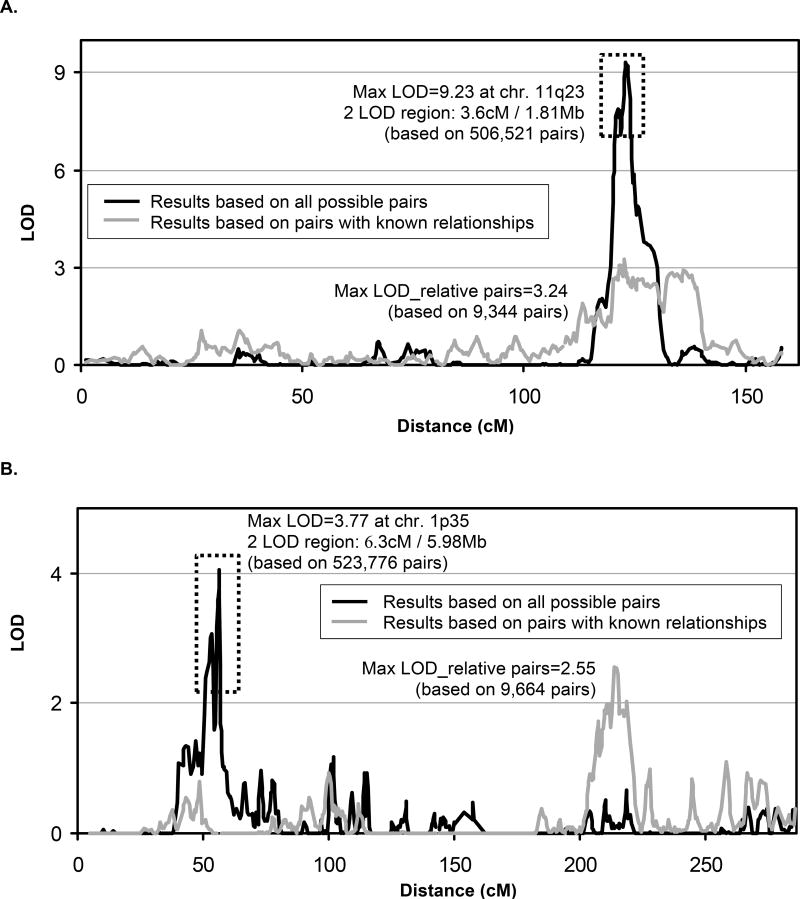
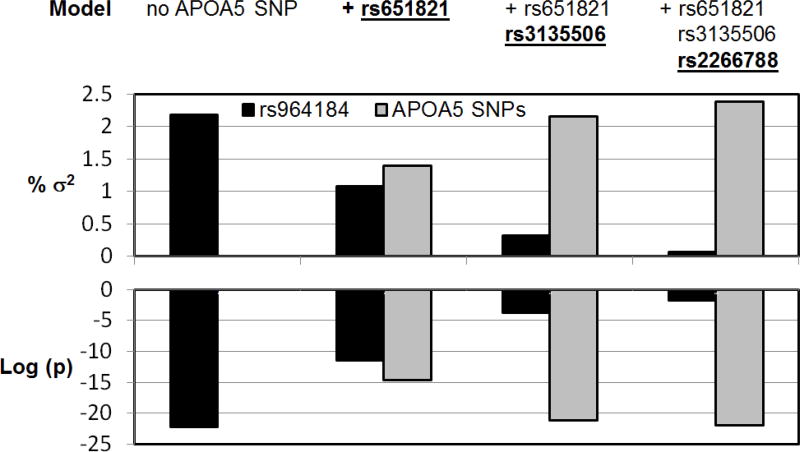
Through identity-by-descent mapping, using ≈400 000 single-nucleotide polymorphisms (SNPs), of serum lipid profiles, we identified a major linkage signal for triglycerides in 1007 Pima Indians (LOD=9.23; =3.5×10 on chromosome 11q). In subsequent fine-mapping and replication association studies in ≈7500 Amerindians, we determined that this signal reflects effects of a loss-of-function Ala43Thr substitution in (rs147210663) and 3 established functional SNPs in . The association with rs147210663 was particularly strong; each copy of the Thr allele conferred 42% lower triglycerides (β=-0.92±0.059 SD unit; =9.6×10 in 4668 Pimas and 2793 Southwest Amerindians combined). The Thr allele is extremely rare in most global populations but has a frequency of 2.5% in Pimas. We further demonstrated that 3 SNPs with established functional impact could explain the association with the most well-replicated SNP (rs964184) for triglycerides identified by genome-wide association studies. Collectively, these 4 SNPs account for 6.9% of variation in triglycerides in Pimas (and 4.1% in Southwest Amerindians), and their inclusion in the original linkage model reduced the linkage signal to virtually null.
constitutes a major locus for serum triglycerides in Amerindians, especially the Pimas, and these results provide an empirical example for the concept that population-based linkage analysis is a useful strategy to identify complex trait variants.
利用通过血缘等位基因共享的经验估计进行血缘映射,对于奠基者群体中复杂性状的研究可能有用,在这些群体中,隐藏的亲缘关系可能会增加可用于定位的固有遗传信息。
通过对约40万个单核苷酸多态性(SNP)进行血缘映射,研究血清脂质谱,我们在1007名皮马印第安人中确定了一个甘油三酯的主要连锁信号(对数优势比=9.23;位于11号染色体q区,P = 3.5×10)。在随后对约7500名美洲印第安人的精细定位和复制关联研究中,我们确定该信号反映了PNPLA3基因中一个功能缺失的丙氨酸43苏氨酸替代(rs147210663)以及PNPLA3基因中3个已确定的功能性SNP的作用。与rs147210663的关联尤为强烈;苏氨酸等位基因的每个拷贝使甘油三酯降低42%(β=-0.92±0.059标准差单位;在4668名皮马人和2793名西南美洲印第安人合并样本中,P = 9.6×10)。苏氨酸等位基因在大多数全球人群中极为罕见,但在皮马人中频率为2.5%。我们进一步证明,3个具有已确定功能影响的PNPLA3基因SNP可以解释与全基因组关联研究中确定的甘油三酯最具重复性的SNP(rs964184)的关联。总体而言,这4个SNP占皮马人甘油三酯变异的6.9%(在西南美洲印第安人中占4.1%),将它们纳入原始连锁模型后,连锁信号几乎降至零。
PNPLA3基因是美洲印第安人尤其是皮马人血清甘油三酯的主要位点,这些结果为基于群体的连锁分析是识别复杂性状变异的有用策略这一概念提供了一个实证例子。