Clayton Kalum, Vallejo Andres F, Davies James, Sirvent Sofia, Polak Marta E
Systems Immmunology Group, Clinical and Experimental Sciences, Sir Henry Wellcome Laboratories, Faculty of Medicine, University of Southampton, Southampton, United Kingdom.
Front Immunol. 2017 Nov 29;8:1676. doi: 10.3389/fimmu.2017.01676. eCollection 2017.
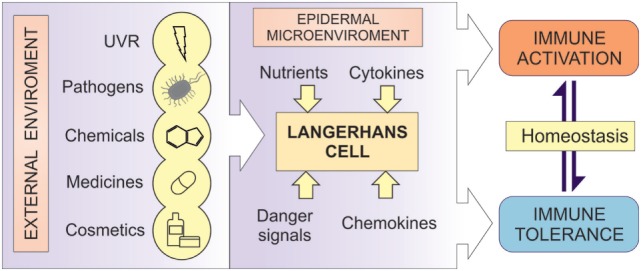
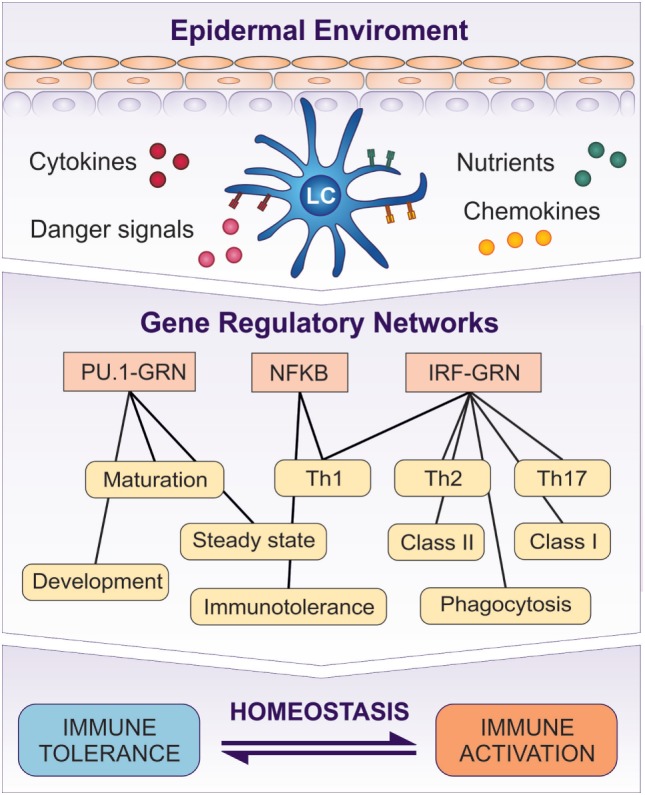
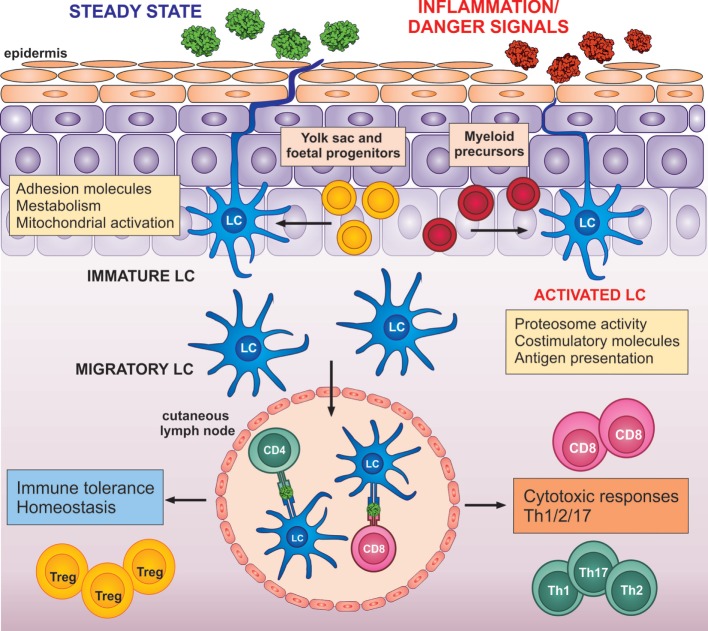
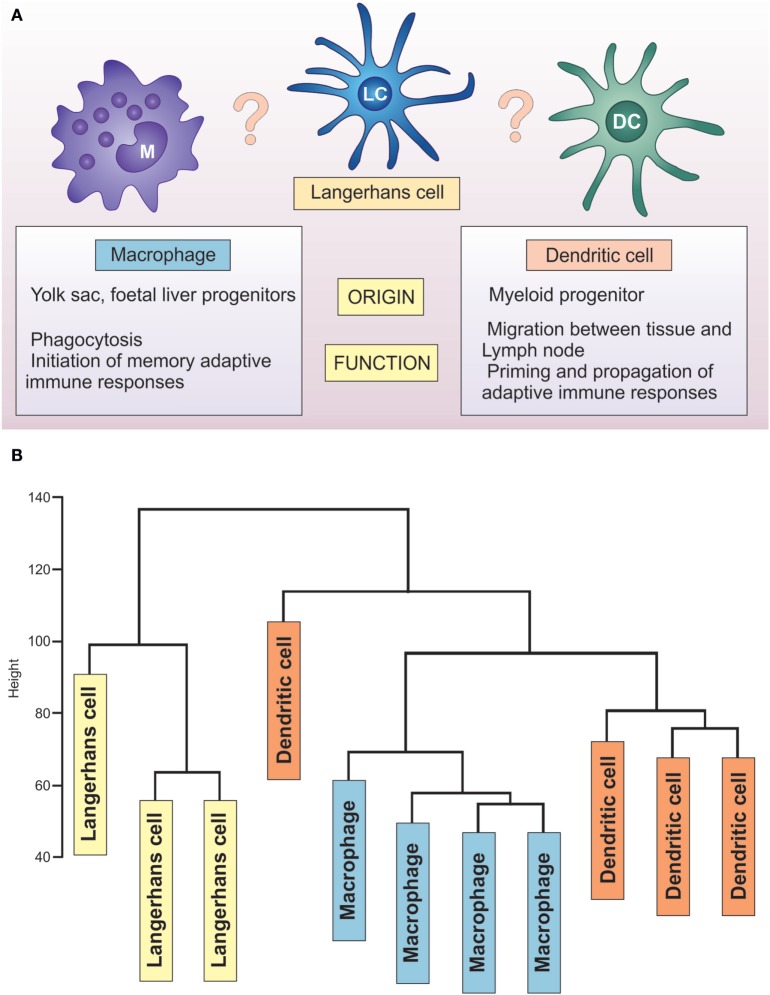
Langerhans cells (LCs) reside in the epidermis as a dense network of immune system sentinels. These cells determine the appropriate adaptive immune response (inflammation or tolerance) by interpreting the microenvironmental context in which they encounter foreign substances. In a normal physiological, "non-dangerous" situation, LCs coordinate a continuous state of immune tolerance, preventing unnecessary and harmful immune activation. Conversely, when they sense a danger signal, for example during infection or when the physical integrity of skin has been compromised as a result of a trauma, they instruct T lymphocytes of the adaptive immune system to mount efficient effector responses. Recent advances investigating the molecular mechanisms underpinning the cross talk between LCs and the epidermal microenvironment reveal its importance for programming LC biology. This review summarizes the novel findings describing LC origin and function through the analysis of the transcriptomic programs and gene regulatory networks (GRNs). Review and meta-analysis of publicly available datasets clearly delineates LCs as distinct from both conventional dendritic cells (DCs) and macrophages, suggesting a primary role for the epidermal microenvironment in programming LC biology. This concept is further supported by the analysis of the effect of epidermal pro-inflammatory signals, regulating key GRNs in human and murine LCs. Applying whole transcriptome analyses and analysis has advanced our understanding of how LCs receive, integrate, and process signals from the steady-state and diseased epidermis. Interestingly, in homeostasis and under immunological stress, the molecular network in LCs remains relatively stable, reflecting a key evolutionary need related to tissue localization. Importantly, to fulfill their key role in orchestrating antiviral adaptive immune responses, LC share specific transcriptomic modules with other DC types able to cross-present antigens to cytotoxic CD8 T cells, pointing to a possible evolutionary convergence mechanism. With the development of more advanced technologies allowing delineation of the molecular networks at the level of chromatin organization, histone modifications, protein translation, and phosphorylation, future "omics" investigations will bring in-depth understanding of the complex molecular mechanisms underpinning human LC biology.
朗格汉斯细胞(LCs)作为免疫系统哨兵的密集网络存在于表皮中。这些细胞通过解读它们遇到外来物质的微环境来决定适当的适应性免疫反应(炎症或耐受)。在正常生理的“无危险”情况下,LCs协调免疫耐受的持续状态,防止不必要和有害的免疫激活。相反,当它们感知到危险信号时,例如在感染期间或皮肤因创伤而物理完整性受损时,它们会指示适应性免疫系统的T淋巴细胞做出有效的效应反应。最近对LCs与表皮微环境之间相互作用的分子机制的研究进展揭示了其对LC生物学编程的重要性。本综述通过分析转录组程序和基因调控网络(GRNs)总结了描述LC起源和功能的新发现。对公开可用数据集的综述和荟萃分析清楚地将LCs与传统树突状细胞(DCs)和巨噬细胞区分开来,表明表皮微环境在LC生物学编程中起主要作用。对调节人和小鼠LCs中关键GRNs的表皮促炎信号作用的分析进一步支持了这一概念。应用全转录组分析推进了我们对LCs如何接收、整合和处理来自稳态和患病表皮的信号的理解。有趣的是,在稳态和免疫应激下,LCs中的分子网络保持相对稳定,反映了与组织定位相关的关键进化需求。重要的是,为了在协调抗病毒适应性免疫反应中发挥关键作用,LCs与其他能够将抗原交叉呈递给细胞毒性CD8 T细胞的DC类型共享特定的转录组模块,这指向了一种可能的进化趋同机制。随着更先进技术的发展,能够在染色质组织、组蛋白修饰、蛋白质翻译和磷酸化水平描绘分子网络,未来的“组学”研究将深入了解支撑人类LC生物学的复杂分子机制。