Ponge Jean-François, Zuccon Dario, Elias Marianne, Pavoine Sandrine, Henry Pierre-Yves, Théry Marc, Guilbert Éric
Muséum National d'Histoire Naturelle Mécanismes adaptatifs et évolution (MECADEV UMR 7179) Sorbonne Universités, MNHN, CNRS Brunoy France.
Muséum National d'Histoire Naturelle Service de Systématique Moléculaire Paris France.
Ecol Evol. 2017 Oct 21;7(23):9935-9953. doi: 10.1002/ece3.3420. eCollection 2017 Dec.
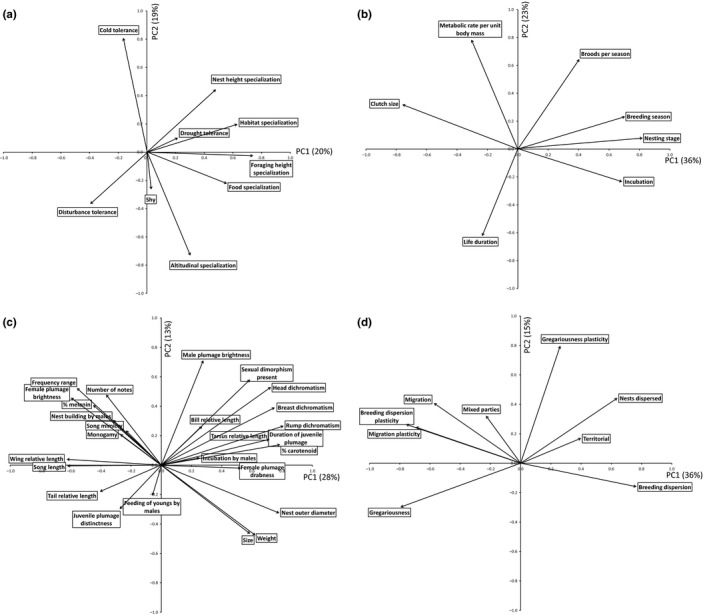
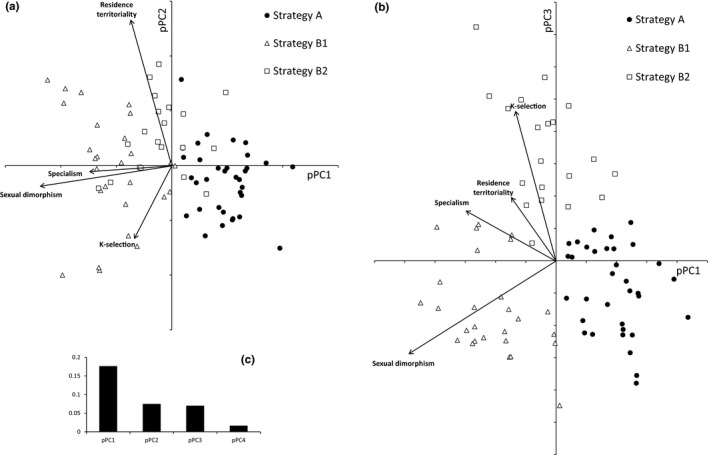
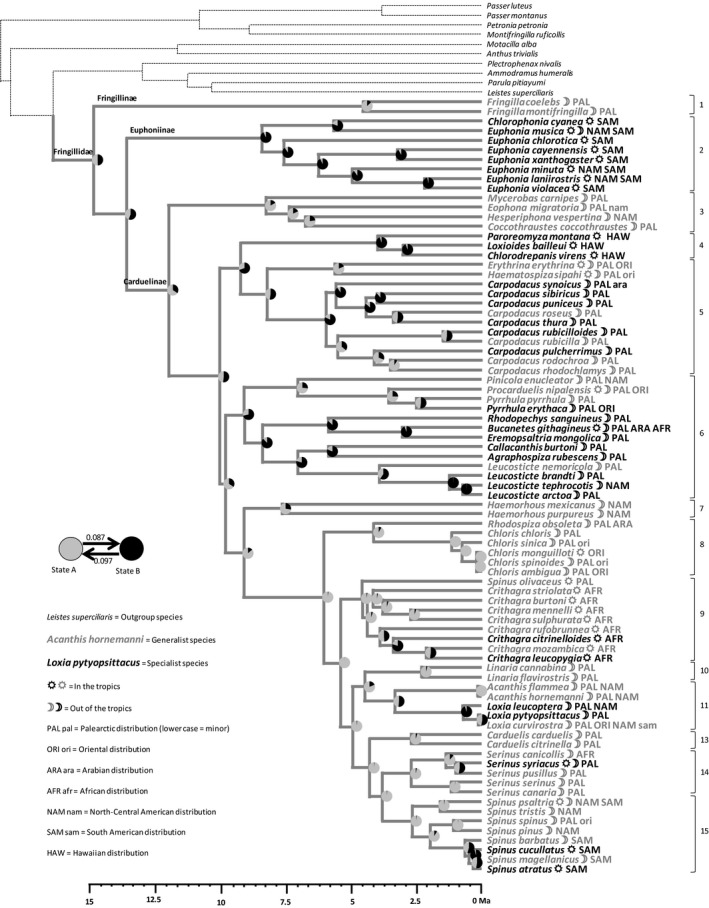
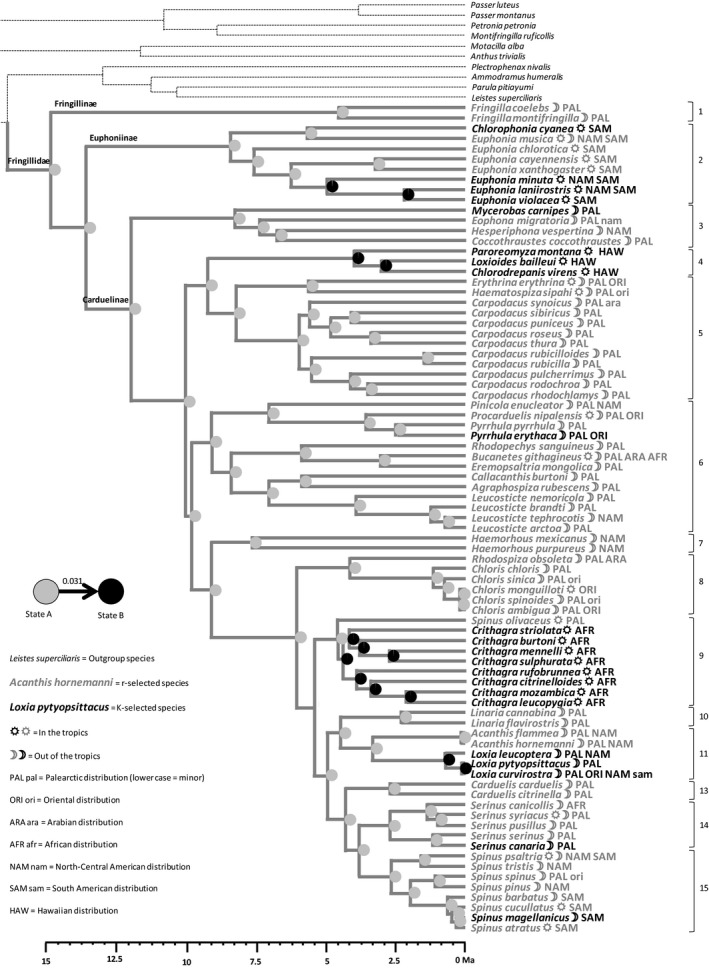
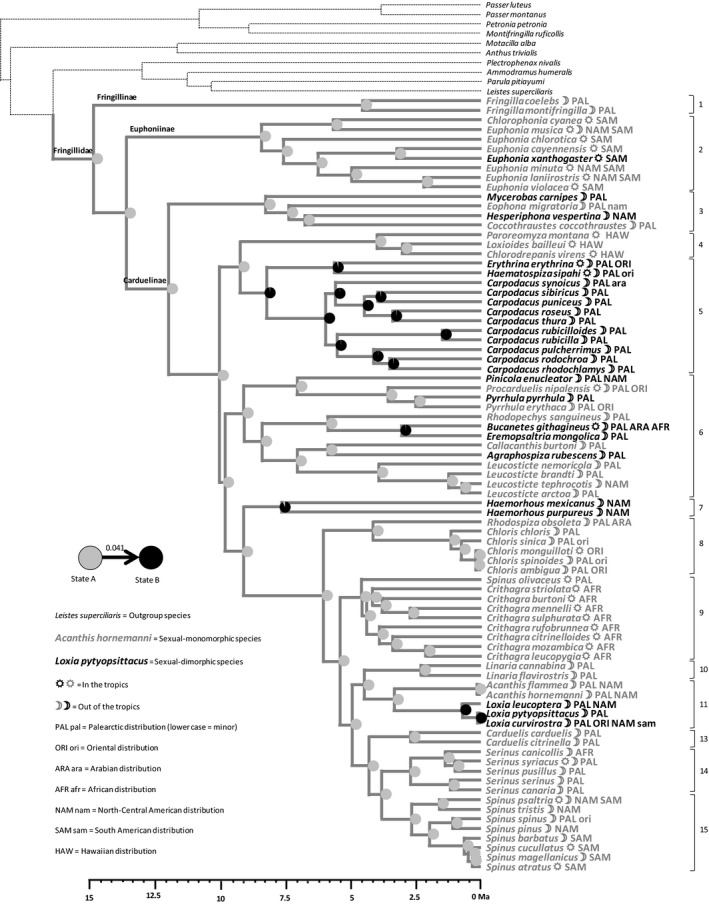
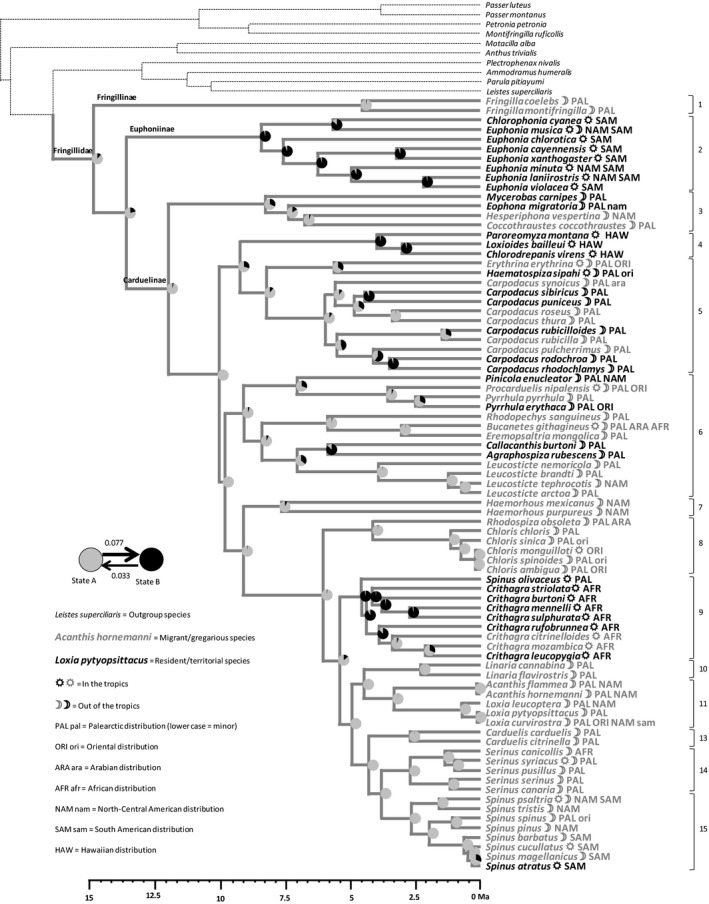
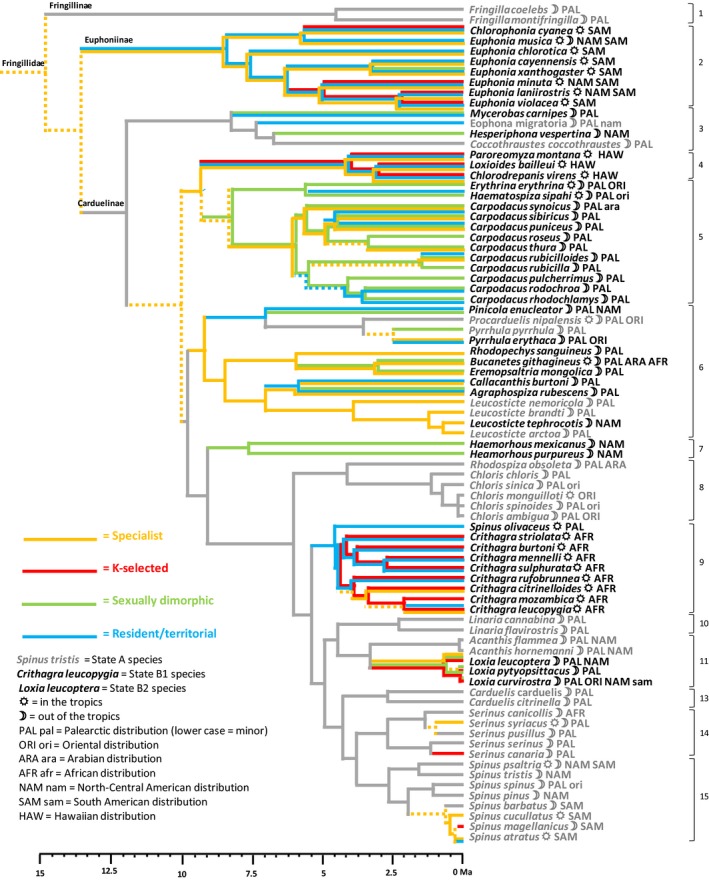
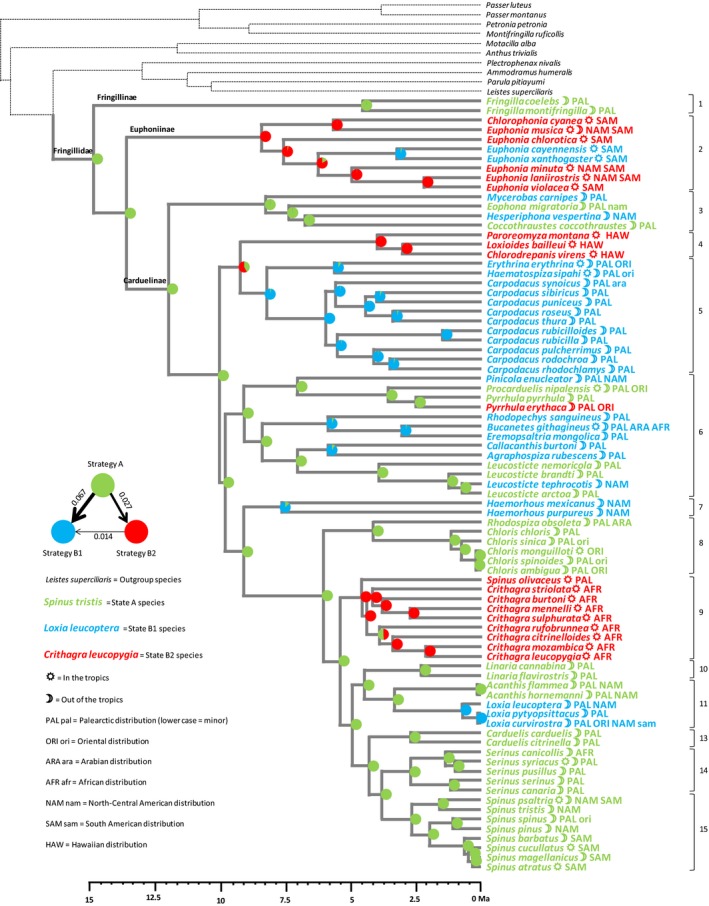
Species traits have been hypothesized by one of us (Ponge, 2013) to evolve in a correlated manner as species colonize stable, undisturbed habitats, shifting from "ancestral" to "derived" strategies. We predicted that generalism, r-selection, sexual monomorphism, and migration/gregariousness are the ancestral states (collectively called strategy A) and evolved correlatively toward specialism, K-selection, sexual dimorphism, and residence/territoriality as habitat stabilized (collectively called B strategy). We analyzed the correlated evolution of four syndromes, summarizing the covariation between 53 traits, respectively, involved in ecological specialization, r-K gradient, sexual selection, and dispersal/social behaviors in 81 species representative of Fringillidae, a bird family with available natural history information and that shows variability for all these traits. The ancestrality of strategy A was supported for three of the four syndromes, the ancestrality of generalism having a weaker support, except for the core group Carduelinae (69 species). It appeared that two different B-strategies evolved from the ancestral state A, both associated with highly predictable environments: one in poorly seasonal environments, called B1, with species living permanently in lowland tropics, with "slow pace of life" and weak sexual dimorphism, and one in highly seasonal environments, called B2, with species breeding out-of-the-tropics, migratory, with a "fast pace of life" and high sexual dimorphism.
我们其中一人(庞热,2013年)曾提出假说,认为物种特征会以一种相关的方式演变,随着物种在稳定、未受干扰的栖息地中定殖,从“祖先”策略转变为“衍生”策略。我们预测,泛化、r-选择、性别单态性和迁移/群居是祖先状态(统称为策略A),并随着栖息地稳定而相关地演变为特化、K-选择、性别二态性和定居/领地性(统称为策略B)。我们分析了四种综合征的相关演变,分别总结了雀科81个具有可用自然历史信息且在所有这些特征上都表现出变异性的物种中,涉及生态特化、r-K梯度、性选择以及扩散/社会行为的53个性状之间的协变。对于四种综合征中的三种,策略A的祖先性得到了支持,泛化的祖先性支持较弱,但核心类群燕雀亚科(69个物种)除外。似乎有两种不同的策略B从祖先状态A演变而来,它们都与高度可预测的环境相关:一种在季节性较差的环境中,称为B1,物种永久生活在低地热带地区,具有“缓慢的生活节奏”和较弱的性别二态性;另一种在季节性较强的环境中,称为B2,物种在热带以外地区繁殖、具有迁徙性,具有“快速的生活节奏”和高度的性别二态性。