Heudorf Ursel, Gasteyer Stefanie, Müller Maria, Serra Nicole, Westphal Tim, Reinheimer Claudia, Kempf Volkhard
Public Health Department of the City of Frankfurt/Main, Germany.
Institute for Medical Microbiology and Infection Control, University Hospital Frankfurt, Frankfurt/Main, Germany.
GMS Hyg Infect Control. 2017 Nov 30;12:Doc20. doi: 10.3205/dgkh000305. eCollection 2017.
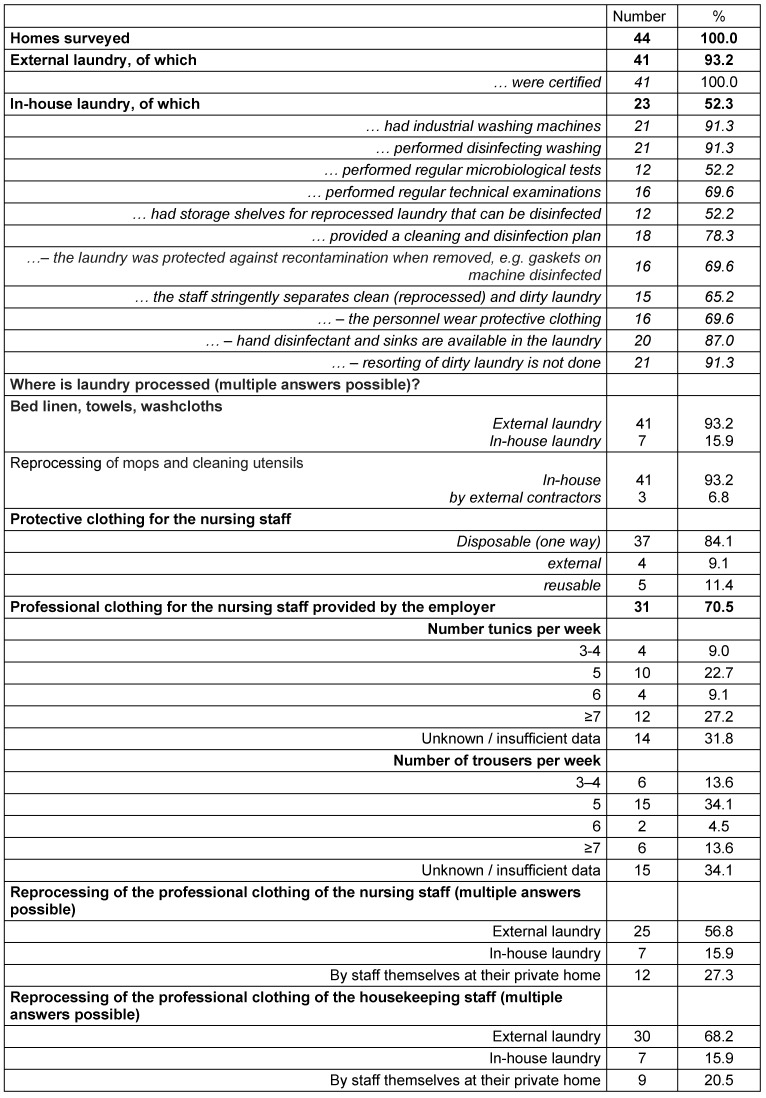
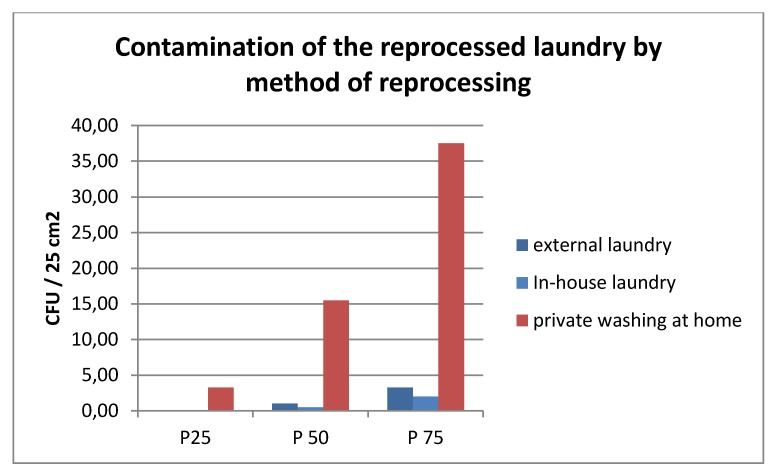
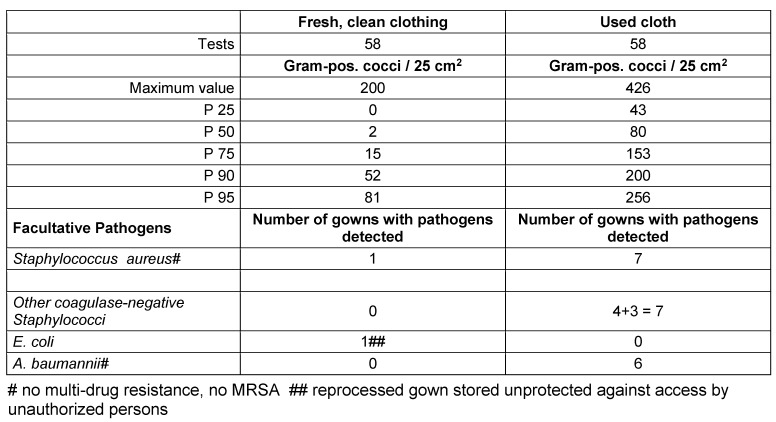
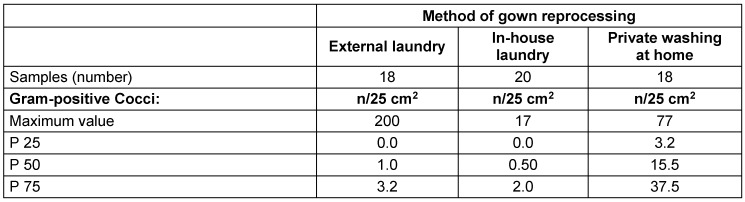
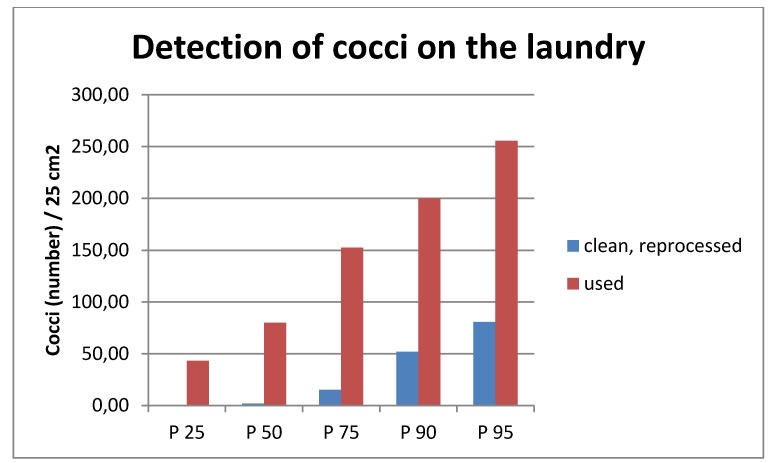
In accordance with the German Infection Protection Act, the treatment and handling of laundry was checked by the Public Health Department in 2016 in all Frankfurt nursing homes with special focus on the staff's clothing. On-site visits and surveys were conducted in all 44 nursing homes in Frankfurt/Main, Germany, and random microbiological examinations of 58 reprocessed and 58 already worn protective gowns were performed to determine the numbers of the colony forming units (cfu) and microbiological differentiation of the pathogen species. 41 (93%) of the 44 homes tested had contracted a certified laundry service. 23 (52%) of the homes also ran a laundry of their own; in 21 of these, laundry was reprocessed and disinfected in an industrial washing machine. Regular technical or microbiological tests were carried out in 16 or 12 of the home-owned laundries, respectively. Only 31 homes (70%) provided uniforms for their employees. The staff's clothing was processed in 25 homes by the external laundry, in 9 homes by the internal laundry, and in 12 homes, the nursing staff had to do this privately at their own home. Used coats exhibited significantly higher contamination than freshly prepared ones (median: 80 vs. 2 cfu/25 cm; P 95 percentile: 256 cfu vs. 81 cfu/25 cm). Clothing prepared in private homes showed significantly higher contamination rates than those washed in the certified external laundry or in the nursing homes themselves (Median: 16 cfu/25 cm vs. 0.5-1 cfu/25 cm). Considering various publications on pathogen transfers and outbreaks due to contaminated laundry in medical facilities, the treatment of laundry, in particular the uniforms, must be given more attention, also in nursing homes for the elderly. The private reprocessing of occupational clothing by the employees at home must be rejected on hygienic principles, and is furthermore prohibited by law in Germany.
根据德国《感染保护法》,2016年公共卫生部门对法兰克福所有养老院的洗衣处理情况进行了检查,特别关注工作人员的衣物。对德国美因河畔法兰克福的所有44家养老院进行了实地考察和调查,并对58件经过再处理的防护服和58件已穿用过的防护服进行了随机微生物检查,以确定菌落形成单位(cfu)数量和病原体种类的微生物鉴别。44家接受测试的养老院中有41家(93%)与经过认证的洗衣服务机构签订了合同。23家(52%)养老院也有自己的洗衣房;其中21家的洗衣房在工业洗衣机中进行再处理和消毒。分别有16家或12家自有洗衣房进行定期的技术或微生物检测。只有31家(70%)养老院为员工提供制服。25家养老院的工作人员衣物由外部洗衣房处理,9家由内部洗衣房处理,12家养老院的护理人员必须自行在家处理。用过的外套污染程度明显高于新准备的外套(中位数:80 vs. 2 cfu/25 cm;P 95百分位数:256 cfu vs. 81 cfu/25 cm)。在家中准备的衣物污染率明显高于在经过认证的外部洗衣房或养老院自身清洗的衣物(中位数:16 cfu/25 cm vs. 0.5 - 1 cfu/25 cm)。考虑到各种关于医疗设施中因受污染衣物导致病原体传播和爆发的出版物,洗衣处理,尤其是制服的处理,在老年护理院中也必须得到更多关注。从卫生原则出发,员工在家中对职业服装进行私自再处理必须被拒绝,而且在德国法律上也是被禁止的。