Centre for Research in Mathematics, Western Sydney University, Sydney, Australia.
School of Computing Sciences, University of East Anglia, Norwich, UK.
Bull Math Biol. 2018 Feb;80(2):404-416. doi: 10.1007/s11538-017-0381-3. Epub 2017 Dec 13.
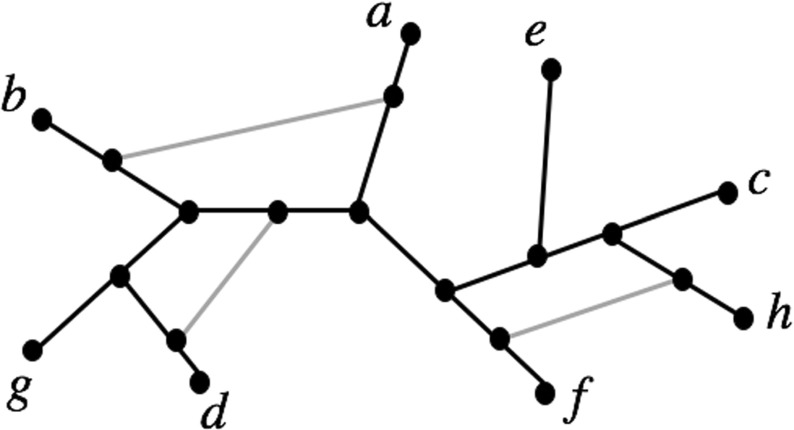
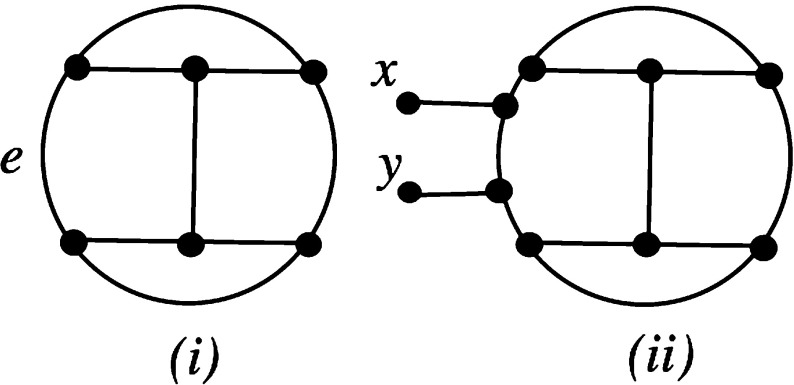
Phylogenetic networks are a generalization of phylogenetic trees that are used to represent non-tree-like evolutionary histories that arise in organisms such as plants and bacteria, or uncertainty in evolutionary histories. An unrooted phylogenetic network on a non-empty, finite set X of taxa, or network, is a connected, simple graph in which every vertex has degree 1 or 3 and whose leaf set is X. It is called a phylogenetic tree if the underlying graph is a tree. In this paper we consider properties of tree-based networks, that is, networks that can be constructed by adding edges into a phylogenetic tree. We show that although they have some properties in common with their rooted analogues which have recently drawn much attention in the literature, they have some striking differences in terms of both their structural and computational properties. We expect that our results could eventually have applications to, for example, detecting horizontal gene transfer or hybridization which are important factors in the evolution of many organisms.
系统发生网络是系统发生树的一种推广,用于表示植物和细菌等生物中出现的非树状进化历史或进化历史的不确定性。非空有限分类单元集 X 上的无根系统发生网络或网络是一个连通的简单图,其中每个顶点的度数为 1 或 3,叶集为 X。如果基础图是一棵树,则它被称为系统发生树。在本文中,我们考虑基于树的网络的性质,即可以通过向系统发生树添加边来构建的网络。我们表明,尽管它们与最近在文献中引起广泛关注的有根类似物具有一些共同的性质,但它们在结构和计算性质方面存在一些显著的差异。我们预计我们的结果最终可能会应用于例如检测水平基因转移或杂交,这是许多生物体进化的重要因素。