Martorelli Cínthia Ribas, Kogika Márcia Mery, Chacar Fernanda Chicharo, Caragelasco Douglas Segalla, de Campos Fonseca Pinto Ana Carolina Brandão, Lorigados Carla Aparecida Batista, Andrade Lúcia Conceição
Department of Veterinary Internal Medicine, School of Veterinary Medicine and Animal Science, University of São Paulo, Av. Prof. Dr. Orlando Marques de Paiva, 87, São Paulo, SP 05508-270, Brazil.
Division of Nephrology, School of Medicine, University of São Paulo, Av. Dr. Arnaldo, 455, São Paulo, SP 01246-903, Brazil.
Vet Sci. 2017 Dec 14;4(4):67. doi: 10.3390/vetsci4040067.
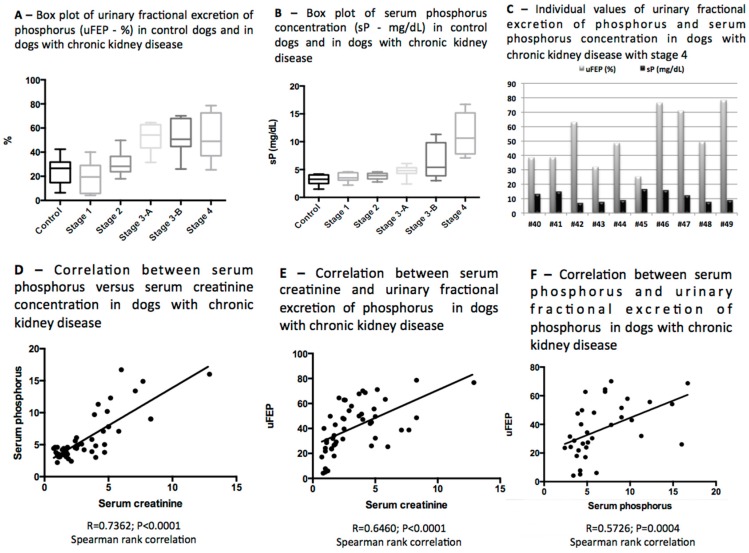
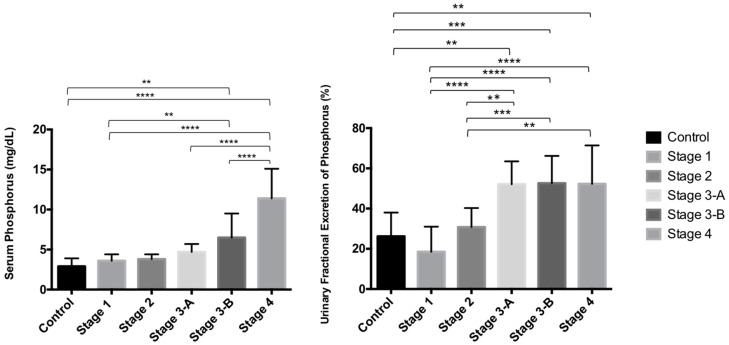
The increase of urinary fractional excretion of phosphorus (uFEP) may indicate phosphorus retention before the onset of hyperphosphatemia in the early stages of chronic kidney disease (CKD). The hypothesis of this study is whether uFEP may increase during the early stage of CKD as a compensatory mechanism to prevent hyperphosphatemia as well as whether hyperphosphatemia in the late stages is associated with increase or decrease in uFEP in dogs with naturally occurring CKD; therefore, the aim of this study was to determine the uFEP in CKD dogs with different stages. Forty-nine CKD dogs were included, and they were divided into stage 1 (serum creatinine < 1.4 mg/dL), stage 2 (serum creatinine 1.5 to 2.0 mg/dL), stage 3 (serum creatinine 2.1 to 5.0 mg/dL) and stage 4 (serum creatinine > 5.0 mg/dL), according to the IRIS staging criteria. The stage 3 was subdivided into stage 3-A (serum creatinine 2.1 to 3.5 mg/dL) and stage 3-B (serum creatinine 3.6 to 5.0 mg/dL). The control group comprised 10 dogs, and uFEP ≤ 40% was considered as normal. A progressive increase in uFEP along the progression of CKD was found. However, similar results of uFEP levels were observed in late CKD, since there were no differences between stages 3 (A, B) and 4. Interestingly, some CKD dogs with stage 4 showed normal or reduced uFEP, besides hyperphosphatemia; conversely, some dogs in early CKD had increased uFEP values and normophosphatemia. Our findings suggest that uFEP may act as a compensatory mechanism to avoid the onset of hyperphosphatemia in early CKD, but not in later stages. uFEP assessment may be considered as an additional tool for the diagnostic and monitoring of phosphate disorders in dogs with CKD, since it may help to identify disturbances of phosphorus balance. More studies are needed to elucidate the role of uFEP in phosphorus homeostasis in dogs with CKD.
慢性肾脏病(CKD)早期,尿磷排泄分数(uFEP)升高可能提示高磷血症发作前的磷潴留。本研究的假设是,在CKD早期uFEP是否会升高作为预防高磷血症的一种代偿机制,以及在自然发生CKD的犬中,晚期高磷血症是否与uFEP的升高或降低有关;因此,本研究的目的是测定不同阶段CKD犬的uFEP。纳入49只CKD犬,根据国际肾脏病学会(IRIS)分期标准将它们分为1期(血清肌酐<1.4mg/dL)、2期(血清肌酐1.5至2.0mg/dL)、3期(血清肌酐2.1至5.0mg/dL)和4期(血清肌酐>5.0mg/dL)。3期又细分为3 - A期(血清肌酐2.1至3.5mg/dL)和3 - B期(血清肌酐3.6至5.0mg/dL)。对照组包括10只犬,uFEP≤40%被视为正常。发现uFEP随CKD进展呈逐渐升高。然而,在CKD晚期观察到uFEP水平的类似结果,因为3期(A、B)和4期之间没有差异。有趣的是,一些4期CKD犬除了高磷血症外,uFEP显示正常或降低;相反,一些早期CKD犬的uFEP值升高且血磷正常。我们的研究结果表明,uFEP可能作为一种代偿机制,在CKD早期避免高磷血症的发作,但在晚期则不然。uFEP评估可被视为诊断和监测CKD犬磷酸盐紊乱的一种额外工具,因为它可能有助于识别磷平衡的紊乱。需要更多研究来阐明uFEP在CKD犬磷稳态中的作用。