Department of Social Medicine, Federal University of Pernambuco, Recife, Brazil.
Department of Tropical Medicine, Federal University of Pernambuco, Recife, Brazil; University of Pernambuco, Recife, Brazil.
Lancet Infect Dis. 2018 Mar;18(3):328-336. doi: 10.1016/S1473-3099(17)30727-2. Epub 2017 Dec 11.
A Zika virus epidemic emerged in northeast Brazil in 2015 and was followed by a striking increase in congenital microcephaly cases, triggering a declaration of an international public health emergency. This is the final report of the first case-control study evaluating the potential causes of microcephaly: congenital Zika virus infection, vaccines, and larvicides. The published preliminary report suggested a strong association between microcephaly and congenital Zika virus infection.
We did a case-control study in eight public maternity hospitals in Recife, Brazil. Cases were neonates born with microcephaly, defined as a head circumference of 2 SD below the mean. Two controls without microcephaly were matched to each case by expected date of delivery and area of residence. We tested the serum of cases and controls and the CSF of cases for detection of Zika virus genomes with quantitative RT-PCR and for detection of IgM antibodies with capture-IgM ELISA. We also tested maternal serum with plaque reduction neutralisation assays for Zika and dengue viruses. We estimated matched crude and adjusted odds ratios with exact conditional logistic regression to determine the association between microcephaly and Zika virus infection.
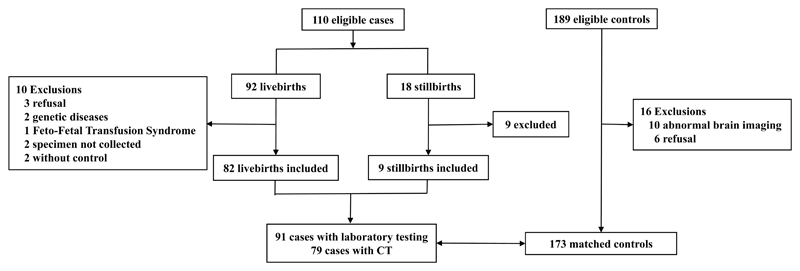
We screened neonates born between Jan 15 and Nov 30, 2016, and prospectively recruited 91 cases and 173 controls. In 32 (35%) cases, congenital Zika virus infection was confirmed by laboratory tests and no controls had confirmed Zika virus infections. 69 (83%) of 83 cases with known birthweight were small for gestational age, compared with eight (5%) of 173 controls. The overall matched odds ratio was 73·1 (95% CI 13·0-∞) for microcephaly and Zika virus infection after adjustments. Neither vaccination during pregnancy or use of the larvicide pyriproxyfen was associated with microcephaly. Results of laboratory tests for Zika virus and brain imaging results were available for 79 (87%) cases; within these cases, ten were positive for Zika virus and had cerebral abnormalities, 13 were positive for Zika infection but had no cerebral abnormalities, and 11 were negative for Zika virus but had cerebral abnormalities.
The association between microcephaly and congenital Zika virus infection was confirmed. We provide evidence of the absence of an effect of other potential factors, such as exposure to pyriproxyfen or vaccines (tetanus, diphtheria, and acellular pertussis, measles and rubella, or measles, mumps, and rubella) during pregnancy, confirming the findings of an ecological study of pyriproxyfen in Pernambuco and previous studies on the safety of Tdap vaccine administration during pregnancy.
Brazilian Ministry of Health, Pan American Health Organization, and Enhancing Research Activity in Epidemic Situations.
2015 年,寨卡病毒在巴西东北部爆发,随后先天性小头畸形病例显著增加,引发了国际公共卫生紧急事件。这是评估小头畸形潜在原因的首例病例对照研究的最终报告:先天性寨卡病毒感染、疫苗和杀虫剂。已发表的初步报告表明,小头畸形与先天性寨卡病毒感染之间存在很强的关联。
我们在巴西累西腓的八家公立医院进行了一项病例对照研究。病例为出生时患有小头畸形的新生儿,定义为头围低于平均值 2 个标准差。每例病例通过预期分娩日期和居住地区与两名无小头畸形的对照相匹配。我们使用定量 RT-PCR 检测病例和对照的血清以及病例的 CSF 中寨卡病毒基因组的存在情况,并使用捕获 IgM ELISA 检测 IgM 抗体的存在情况。我们还用斑块减少中和测定法检测母体血清中的寨卡病毒和登革热病毒。我们使用精确条件逻辑回归来估计匹配的粗比和调整后的比值比,以确定小头畸形与寨卡病毒感染之间的关联。
我们在 2016 年 1 月 15 日至 11 月 30 日之间筛查了新生儿,并前瞻性地招募了 91 例病例和 173 名对照。在 32 例(35%)经实验室检测证实患有先天性寨卡病毒感染的病例中,没有对照病例感染了寨卡病毒。在已知出生体重的 83 例病例中,有 69 例(83%)为小于胎龄儿,而在 173 例对照中只有 8 例(5%)。在调整后,总体匹配比值比为 73.1(95%CI 13.0-∞),提示小头畸形和寨卡病毒感染之间存在关联。在怀孕期间接种疫苗或使用杀虫剂吡丙醚均与小头畸形无关。79 例(87%)病例提供了寨卡病毒实验室检测结果和脑成像结果;在这些病例中,10 例寨卡病毒检测阳性且有脑部异常,13 例寨卡病毒检测阳性但无脑部异常,11 例寨卡病毒检测阴性但有脑部异常。
小头畸形与先天性寨卡病毒感染之间的关联得到证实。我们提供了没有其他潜在因素(如在怀孕期间接触吡丙醚或疫苗(破伤风、白喉和无细胞百日咳、麻疹和风疹或麻疹、腮腺炎和风疹))影响的证据,证实了在伯南布哥州进行的吡丙醚生态研究和先前关于在怀孕期间接种 Tdap 疫苗安全性的研究结果。
巴西卫生部、泛美卫生组织和加强疫情研究活动。