Department of Internal Medicine III, University of Munich, Germany
German Cancer Consortium (DKTK), Partner Site Munich, Munich, Germany.
Haematologica. 2018 Mar;103(3):456-465. doi: 10.3324/haematol.2017.178442. Epub 2017 Dec 14.
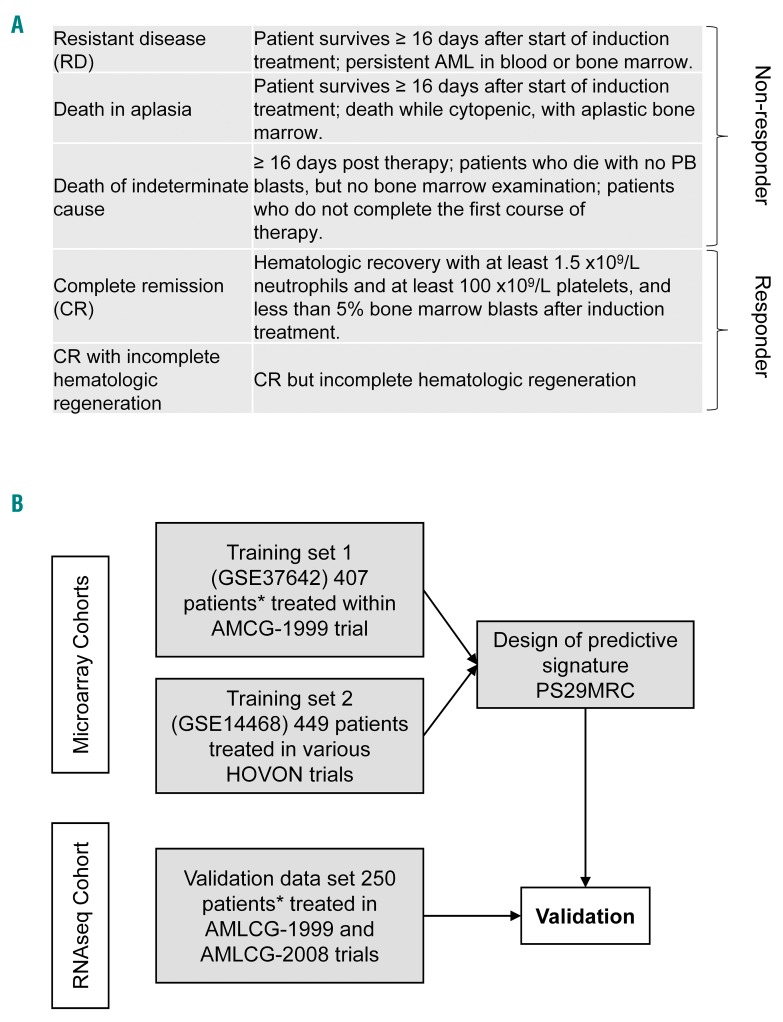
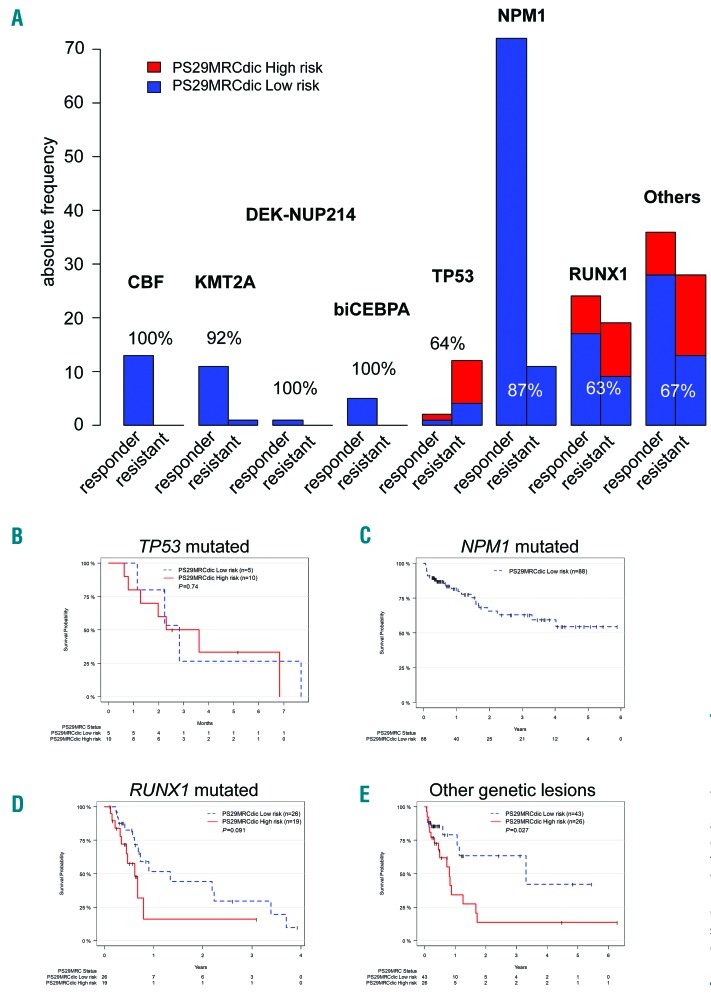
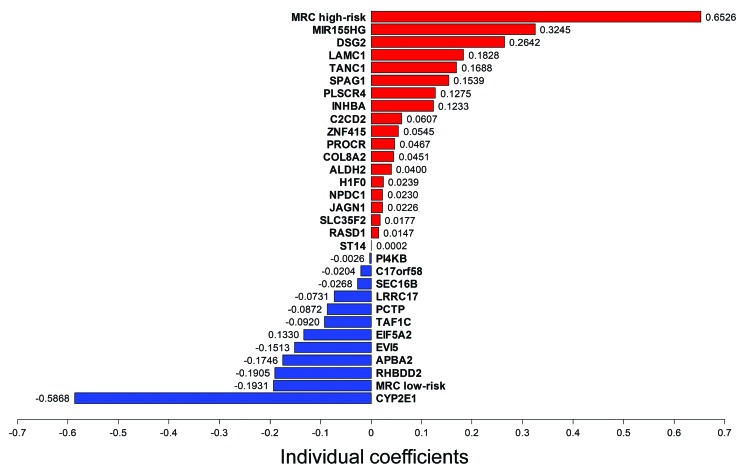
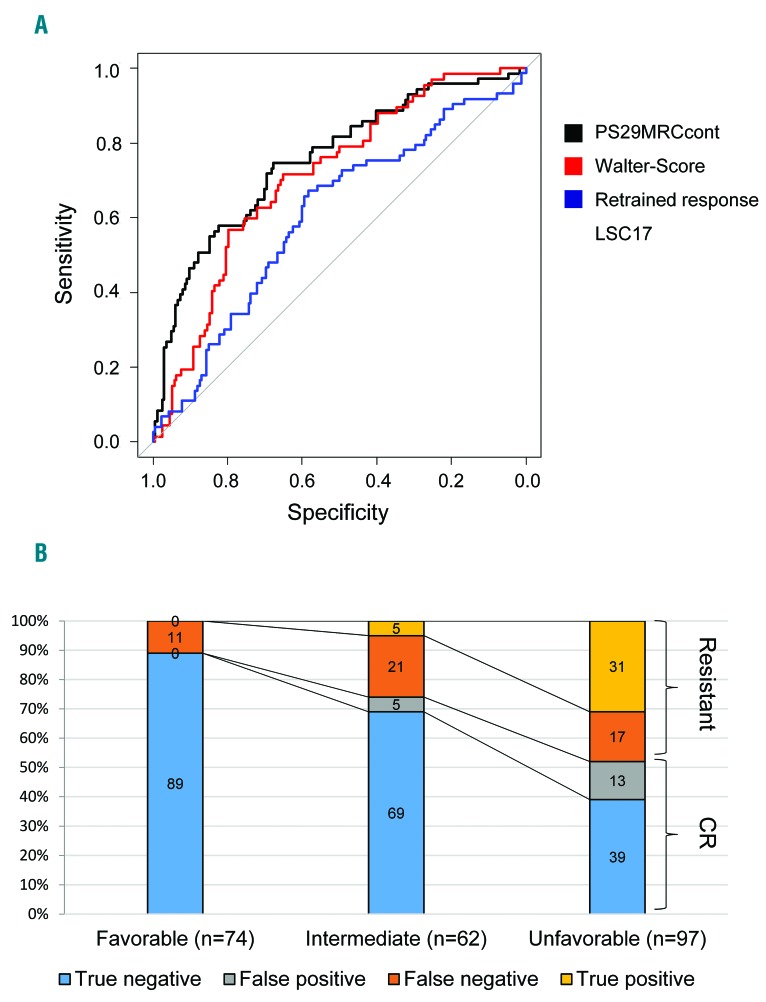
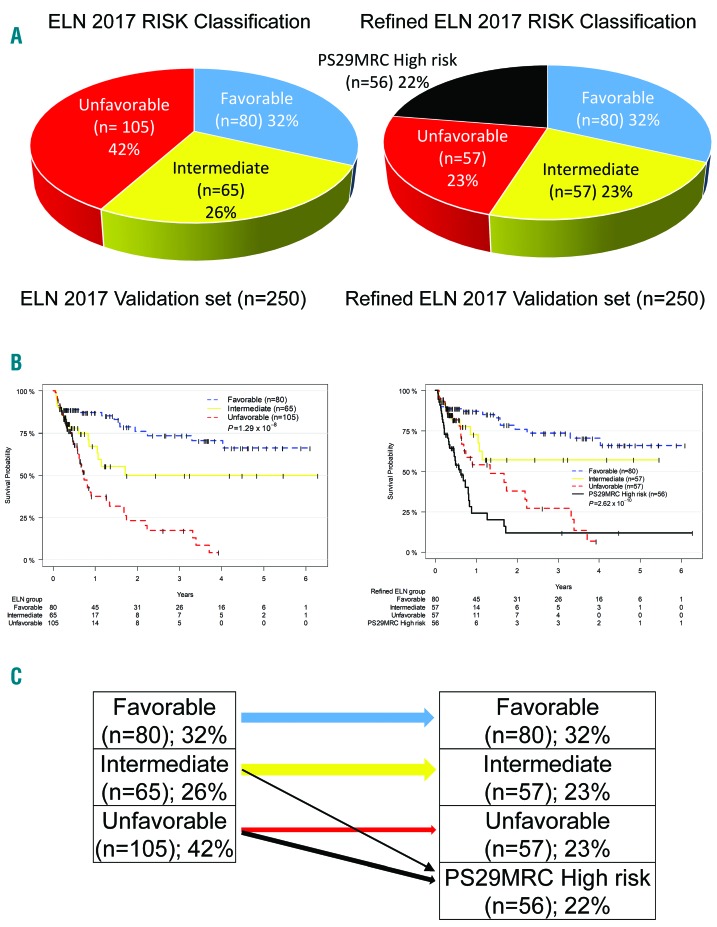
Primary therapy resistance is a major problem in acute myeloid leukemia treatment. We set out to develop a powerful and robust predictor for therapy resistance for intensively treated adult patients. We used two large gene expression data sets (n=856) to develop a predictor of therapy resistance, which was validated in an independent cohort analyzed by RNA sequencing (n=250). In addition to gene expression markers, standard clinical and laboratory variables as well as the mutation status of 68 genes were considered during construction of the model. The final predictor (PS29MRC) consisted of 29 gene expression markers and a cytogenetic risk classification. A continuous predictor is calculated as a weighted linear sum of the individual variables. In addition, a cut off was defined to divide patients into a high-risk and a low-risk group for resistant disease. PS29MRC was highly significant in the validation set, both as a continuous score (OR=2.39, =8.63·10, AUC=0.76) and as a dichotomous classifier (OR=8.03, =4.29·10); accuracy was 77%. In multivariable models, only mutation, age and PS29MRC (continuous: OR=1.75, =0.0011; dichotomous: OR=4.44, =0.00021) were left as significant variables. PS29MRC dominated all models when compared with currently used predictors, and also predicted overall survival independently of established markers. When integrated into the European LeukemiaNet (ELN) 2017 genetic risk stratification, four groups (median survival of 8, 18, 41 months, and not reached) could be defined (=4.01·10). PS29MRC will make it possible to design trials which stratify induction treatment according to the probability of response, and refines the ELN 2017 classification.
原发性治疗抵抗是急性髓系白血病治疗中的一个主要问题。我们旨在为接受强化治疗的成年患者开发一种强大而稳健的治疗抵抗预测因子。我们使用了两个大型基因表达数据集(n=856)来开发治疗抵抗预测因子,并通过 RNA 测序(n=250)对独立队列进行了验证。在构建模型时,除了基因表达标志物外,还考虑了标准的临床和实验室变量以及 68 个基因的突变状态。最终的预测因子(PS29MRC)由 29 个基因表达标志物和细胞遗传学风险分类组成。连续预测因子是通过对各个变量进行加权线性求和计算得出的。此外,还定义了一个截止值,将患者分为对疾病有抵抗作用的高风险和低风险组。PS29MRC 在验证集中具有高度显著性,既是连续评分(OR=2.39,=8.63·10,AUC=0.76),也是二分类分类器(OR=8.03,=4.29·10);准确率为 77%。在多变量模型中,只有 突变、年龄和 PS29MRC(连续:OR=1.75,=0.0011;二分类:OR=4.44,=0.00021)被认为是显著变量。当与目前使用的预测因子进行比较时,PS29MRC 主导了所有模型,并且独立于既定标志物预测总生存期。当整合到欧洲白血病网络(ELN)2017 遗传风险分层中时,可以定义四个组(中位生存期分别为 8、18、41 个月和未达到)(=4.01·10)。PS29MRC 将使根据反应概率设计分层诱导治疗的试验成为可能,并改进 ELN 2017 分类。