Hilal Ziad, Mrkvicka Jennifer, Rezniczek Günther A, Dogan Askin, Tempfer Clemens B
Department of Obstetrics and Gynecology, Ruhr-Universität Bochum, Bochum, Germany.
Medicine (Baltimore). 2017 Dec;96(49):e8839. doi: 10.1097/MD.0000000000008839.
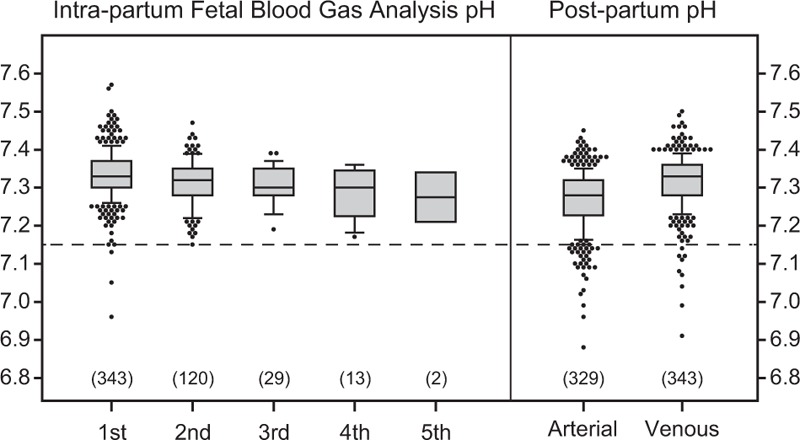
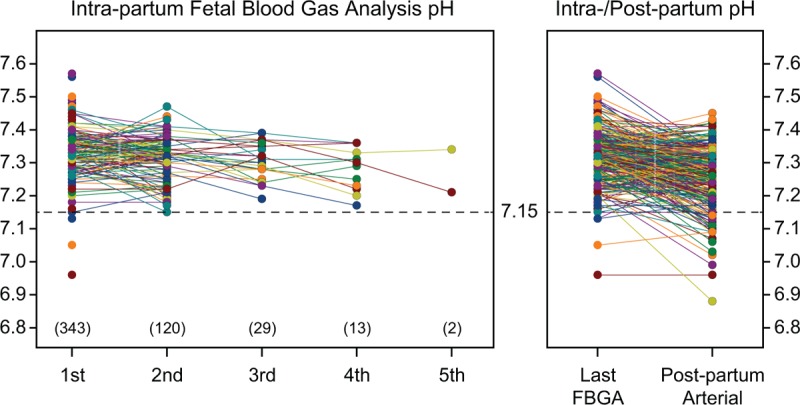
Fetal blood gas analysis (FBGA) using scalp blood is commonly used to identify serious fetal distress. However, there is a lack of data regarding its accuracy and reliability. The aim of this study was to determine the positive predictive value (PPV) and negative predictive value (NPV) of FBGA for predicting postpartum acidosis in case of nonreassuring fetal heart rate tracings (NRFHRT). To this end, we conducted a retrospective cohort study of singleton term deliveries with NRFHRT according to Fédération Internationale de Gynécologie et d'Obstétrique and Fisher cardiotocography scores undergoing FBGA in a university hospital. The PPV and NPV of FBGA regarding neonatal acidosis (defined as a pH value ≤ 7.15 in arterial or venous umbilical cord blood) and Apgar scores indicating neonatal depression (defined as a 5-min Apgar score ≤5) were evaluated. Multivariate analysis was used to determine the influence of cardiotocography variations and the time delay between FBGA and delivery on the accuracy of FBGA. We analyzed 343 deliveries with NRFHRT. In 32 (9%) of these cases, fetal acidosis was confirmed by a postpartum umbilical cord blood pH value ≤ 7.15. In 308/343 (90%) cases, FBGA identified NRFHRT as false positive (as confirmed by nonacidotic postpartum pH values) and thus avoided unnecessary interventions such as operative delivery. The overall test accuracy of FBGA was 91%. FBGA accurately predicted postpartum cord blood pH values with a margin of ±0.2 in 319/343 (93%) cases. On the other hand, the false negative rate of FBGA was 8% (29/343). The PPV and NPV of FBGA for predicting postpartum acidosis were 50% and 91%, respectively. The sensitivity was 9% and the specificity was 99%. In a multivariate logistic regression analysis, maternal body mass index (odds ratio [OR] 1.1; 95% confidence interval [CI] 1.01-1.17; P = .029) and cardiotocography variations (OR 0.80; 95% CI 0.66-0.98; P = .029) independently affected the predictive value of FBGA. The PPV of FBGA regarding neonatal depression according to Apgar scores was low with only 17%. We conclude that FBGA may be used in clinical practice to rule out, but not to rule in, neonatal acidosis in parturients with NRFHRT. It can avoid unnecessary interventions such as cesarean section or operative vaginal delivery in up to 90% of cases, but cannot reliably detect fetal acidosis.
使用头皮血进行胎儿血气分析(FBGA)常用于识别严重胎儿窘迫。然而,关于其准确性和可靠性的数据匮乏。本研究的目的是确定在胎儿心率监护异常(NRFHRT)情况下,FBGA预测产后酸中毒的阳性预测值(PPV)和阴性预测值(NPV)。为此,我们在一家大学医院对根据国际妇产科联合会和费舍尔产程图评分进行FBGA的单胎足月分娩且伴有NRFHRT的病例进行了一项回顾性队列研究。评估了FBGA对于新生儿酸中毒(定义为脐动脉或脐静脉血pH值≤7.15)和提示新生儿窒息的阿氏评分(定义为5分钟阿氏评分≤5)的PPV和NPV。采用多因素分析来确定产程图变化以及FBGA与分娩之间的时间延迟对FBGA准确性的影响。我们分析了343例伴有NRFHRT的分娩病例。其中32例(9%)产后脐血pH值≤7.15,证实存在胎儿酸中毒。在343例中的308例(90%)病例中,FBGA将NRFHRT识别为假阳性(产后pH值非酸性证实),从而避免了诸如手术分娩等不必要的干预。FBGA的总体检测准确性为91%。在343例中的319例(93%)病例中,FBGA准确预测了产后脐血pH值,误差范围为±0.2。另一方面,FBGA的假阴性率为8%(29/343)。FBGA预测产后酸中毒的PPV和NPV分别为50%和91%。敏感性为9%,特异性为99%。在多因素逻辑回归分析中,孕妇体重指数(优势比[OR] 1.1;95%置信区间[CI] 1.01 - 1.17;P = 0.029)和产程图变化(OR 0.80;95% CI 0.66 - 0.98;P = 0.029)独立影响FBGA的预测价值。根据阿氏评分,FBGA对于新生儿窒息的PPV较低,仅为17%。我们得出结论,FBGA可在临床实践中用于排除伴有NRFHRT的产妇的新生儿酸中毒,但不能用于确诊。它在高达90%的病例中可避免诸如剖宫产或手术助产等不必要的干预,但不能可靠地检测胎儿酸中毒。