• 文献检索
  • 文档翻译
  • 深度研究
  • 学术资讯
  • Suppr Zotero 插件Zotero 插件
  • 邀请有礼
  • 套餐&价格
  • 历史记录
应用&插件
Suppr Zotero 插件Zotero 插件浏览器插件Mac 客户端Windows 客户端微信小程序
定价
高级版会员购买积分包购买API积分包
服务
文献检索文档翻译深度研究API 文档MCP 服务
关于我们
关于 Suppr公司介绍联系我们用户协议隐私条款
关注我们

Suppr 超能文献

核心技术专利:CN118964589B侵权必究
粤ICP备2023148730 号-1Suppr @ 2026

文献检索

告别复杂PubMed语法,用中文像聊天一样搜索,搜遍4000万医学文献。AI智能推荐,让科研检索更轻松。

立即免费搜索

文件翻译

保留排版,准确专业,支持PDF/Word/PPT等文件格式,支持 12+语言互译。

免费翻译文档

深度研究

AI帮你快速写综述,25分钟生成高质量综述,智能提取关键信息,辅助科研写作。

立即免费体验

基于CT的股骨近端标本特异性有限元分析预测骨折负荷和刚度:尸体验证研究

Prediction of fracture load and stiffness of the proximal femur by CT-based specimen specific finite element analysis: cadaveric validation study.

作者信息

Miura Michiaki, Nakamura Junichi, Matsuura Yusuke, Wako Yasushi, Suzuki Takane, Hagiwara Shigeo, Orita Sumihisa, Inage Kazuhide, Kawarai Yuya, Sugano Masahiko, Nawata Kento, Ohtori Seiji

机构信息

Department of Orthopedic Surgery, Graduate School of Medicine, Chiba University, 1-8-1 Inohana, Chuo-ku, Chiba city, Chiba, 260-8677, Japan.

出版信息

BMC Musculoskelet Disord. 2017 Dec 16;18(1):536. doi: 10.1186/s12891-017-1898-1.

DOI:10.1186/s12891-017-1898-1
PMID:29246133
原文链接:https://pmc.ncbi.nlm.nih.gov/articles/PMC5732520/
Abstract

BACKGROUND

Finite element analysis (FEA) of the proximal femur has been previously validated with large mesh size, but these were insufficient to simulate the model with small implants in recent studies. This study aimed to validate the proximal femoral computed tomography (CT)-based specimen-specific FEA model with smaller mesh size using fresh frozen cadavers.

METHODS

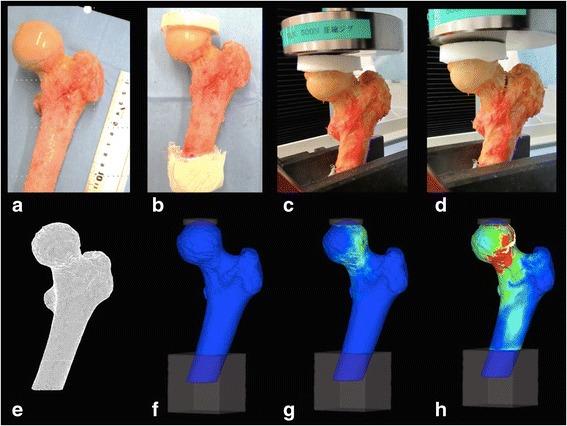
Twenty proximal femora from 10 cadavers (mean age, 87.1 years) were examined. CT was performed on all specimens with a calibration phantom. Nonlinear FEA prediction with stance configuration was performed using Mechanical Finder (mesh,1.5 mm tetrahedral elements; shell thickness, 0.2 mm; Poisson's coefficient, 0.3), in comparison with mechanical testing. Force was applied at a fixed vertical displacement rate, and the magnitude of the applied load and displacement were continuously recorded. The fracture load and stiffness were calculated from force-displacement curve, and the correlation between mechanical testing and FEA prediction was examined.

RESULTS

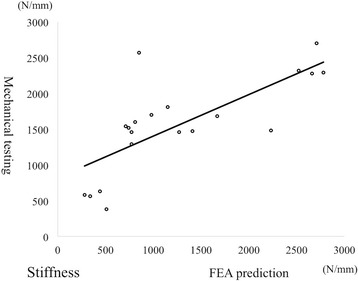
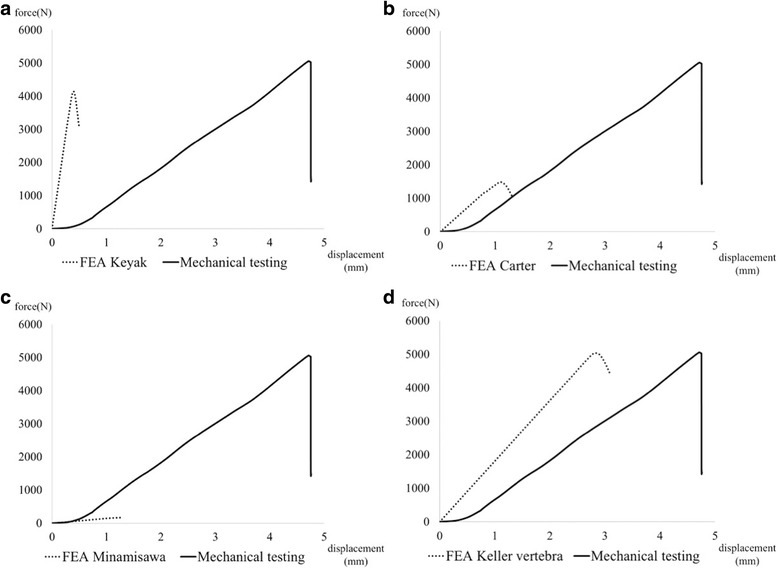
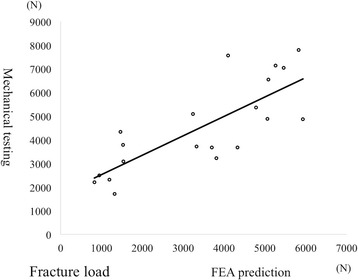
A pilot study with one femur revealed that the equations proposed by Keller for vertebra were the most reproducible for calculating Young's modulus and the yield stress of elements of the proximal femur. There was a good linear correlation between fracture loads of mechanical testing and FEA prediction (R = 0.6187) and between the stiffness of mechanical testing and FEA prediction (R = 0.5499). There was a good linear correlation between fracture load and stiffness (R = 0.6345) in mechanical testing and an excellent correlation between these (R = 0.9240) in FEA prediction.

CONCLUSIONS

CT-based specimen-specific FEA model of the proximal femur with small element size was validated using fresh frozen cadavers. The equations proposed by Keller for vertebra were found to be the most reproducible for the proximal femur in elderly people.

摘要

背景

先前对股骨近端的有限元分析(FEA)已通过大网格尺寸进行验证,但在最近的研究中,这些网格尺寸不足以模拟带有小植入物的模型。本研究旨在使用新鲜冷冻尸体,以较小的网格尺寸验证基于近端股骨计算机断层扫描(CT)的特定标本FEA模型。

方法

检查了来自10具尸体(平均年龄87.1岁)的20个近端股骨。对所有标本使用校准体模进行CT扫描。使用Mechanical Finder(网格,1.5毫米四面体单元;壳厚度,0.2毫米;泊松系数,0.3)对站立姿势配置进行非线性FEA预测,并与力学测试进行比较。以固定的垂直位移速率施加力,并连续记录施加的载荷和位移的大小。从力-位移曲线计算骨折载荷和刚度,并检查力学测试与FEA预测之间的相关性。

结果

对一根股骨的初步研究表明,Keller提出的用于椎骨的方程在计算近端股骨元件的杨氏模量和屈服应力方面最具可重复性。力学测试的骨折载荷与FEA预测之间(R = 0.6187)以及力学测试的刚度与FEA预测之间(R = 0.5499)存在良好的线性相关性。力学测试中骨折载荷与刚度之间(R = 0.6345)存在良好的线性相关性,而在FEA预测中它们之间存在极好的相关性(R = 0.9240)。

结论

使用新鲜冷冻尸体验证了基于CT的近端股骨特定标本FEA模型,其单元尺寸较小。发现Keller提出的用于椎骨的方程在老年人近端股骨中最具可重复性。
https://cdn.ncbi.nlm.nih.gov/pmc/blobs/624b/5732520/019e682070a9/12891_2017_1898_Fig4_HTML.jpg
https://cdn.ncbi.nlm.nih.gov/pmc/blobs/624b/5732520/bf1a8a08249b/12891_2017_1898_Fig1_HTML.jpg
https://cdn.ncbi.nlm.nih.gov/pmc/blobs/624b/5732520/958ad522c450/12891_2017_1898_Fig2_HTML.jpg
https://cdn.ncbi.nlm.nih.gov/pmc/blobs/624b/5732520/0739c8318b4b/12891_2017_1898_Fig3_HTML.jpg
https://cdn.ncbi.nlm.nih.gov/pmc/blobs/624b/5732520/019e682070a9/12891_2017_1898_Fig4_HTML.jpg
https://cdn.ncbi.nlm.nih.gov/pmc/blobs/624b/5732520/bf1a8a08249b/12891_2017_1898_Fig1_HTML.jpg
https://cdn.ncbi.nlm.nih.gov/pmc/blobs/624b/5732520/958ad522c450/12891_2017_1898_Fig2_HTML.jpg
https://cdn.ncbi.nlm.nih.gov/pmc/blobs/624b/5732520/0739c8318b4b/12891_2017_1898_Fig3_HTML.jpg
https://cdn.ncbi.nlm.nih.gov/pmc/blobs/624b/5732520/019e682070a9/12891_2017_1898_Fig4_HTML.jpg

相似文献

1
Prediction of fracture load and stiffness of the proximal femur by CT-based specimen specific finite element analysis: cadaveric validation study.基于CT的股骨近端标本特异性有限元分析预测骨折负荷和刚度:尸体验证研究
BMC Musculoskelet Disord. 2017 Dec 16;18(1):536. doi: 10.1186/s12891-017-1898-1.
2
Finite element analysis of the femoral diaphysis of fresh-frozen cadavers with computed tomography and mechanical testing.利用计算机断层扫描和力学测试对新鲜冷冻尸体股骨干进行有限元分析。
J Orthop Surg Res. 2018 Jul 31;13(1):192. doi: 10.1186/s13018-018-0898-7.
3
Prediction of strength and strain of the proximal femur by a CT-based finite element method.基于CT的有限元方法预测股骨近端的强度和应变
J Biomech. 2007;40(8):1745-53. doi: 10.1016/j.jbiomech.2006.08.003. Epub 2006 Oct 10.
4
Proximal Cadaveric Femur Preparation for Fracture Strength Testing and Quantitative CT-based Finite Element Analysis.用于骨折强度测试和基于定量CT的有限元分析的近端尸体股骨制备
J Vis Exp. 2017 Mar 11(121):54925. doi: 10.3791/54925.
5
To what extent can linear finite element models of human femora predict failure under stance and fall loading configurations?人体股骨的线性有限元模型在预测站立和跌倒加载配置下的失效方面能达到何种程度?
J Biomech. 2014 Nov 7;47(14):3531-8. doi: 10.1016/j.jbiomech.2014.08.024. Epub 2014 Sep 8.
6
Robust QCT/FEA models of proximal femur stiffness and fracture load during a sideways fall on the hip.髋关节侧方跌倒时股骨近端刚度和骨折载荷的稳健 QCT/FEA 模型。
Ann Biomed Eng. 2011 Feb;39(2):742-55. doi: 10.1007/s10439-010-0196-y. Epub 2010 Oct 29.
7
Sensitivity of proximal femoral stiffness and areal bone mineral density to changes in bone geometry and density.股骨近端刚度和骨矿物质密度面积对骨几何形状和密度变化的敏感性。
Proc Inst Mech Eng H. 2008 Apr;222(3):367-75. doi: 10.1243/09544119JEIM307.
8
In-vivo assessment of femoral bone strength using Finite Element Analysis (FEA) based on routine MDCT imaging: a preliminary study on patients with vertebral fractures.基于常规MDCT成像,使用有限元分析(FEA)对股骨骨强度进行体内评估:对椎体骨折患者的初步研究。
PLoS One. 2015 Feb 27;10(2):e0116907. doi: 10.1371/journal.pone.0116907. eCollection 2015.
9
Mapping anisotropy improves QCT-based finite element estimation of hip strength in pooled stance and side-fall load configurations.映射各向异性可改善基于定量计算机断层扫描(QCT)的有限元方法对合并站立和侧方跌倒负荷配置下髋部强度的估计。
Med Eng Phys. 2018 Sep;59:36-42. doi: 10.1016/j.medengphy.2018.06.004. Epub 2018 Jul 4.
10
Prediction of proximal femur strength using a CT-based nonlinear finite element method: differences in predicted fracture load and site with changing load and boundary conditions.使用基于CT的非线性有限元方法预测股骨近端强度:随着载荷和边界条件的变化,预测的骨折载荷和部位的差异。
Bone. 2009 Aug;45(2):226-31. doi: 10.1016/j.bone.2009.04.241. Epub 2009 May 3.

引用本文的文献

1
Influence of the Cortical Layer Thickness and Trabecular Layer Pattern Density on 3D-Printed Femur Strength.皮质层厚度和小梁层模式密度对3D打印股骨强度的影响。
Materials (Basel). 2025 May 9;18(10):2187. doi: 10.3390/ma18102187.
2
Quantitative analysis of protective Kirschner wire diameters in lateral opening wedge distal femoral osteotomy: A finite element study.外侧开口楔形股骨远端截骨术中保护克氏针直径的定量分析:一项有限元研究
Jt Dis Relat Surg. 2025 Jan 2;36(1):97-106. doi: 10.52312/jdrs.2025.1806. Epub 2024 Nov 5.
3
In Silico Clinical Trial for Osteoporosis Treatments to Prevent Hip Fractures: Simulation of the Placebo Arm.

本文引用的文献

1
Bone preserving level of osteotomy in short-stem total hip arthroplasty does not influence stress shielding dimensions - a comparing finite elements analysis.短柄全髋关节置换术中截骨的保骨水平不影响应力遮挡程度——一项对比有限元分析
BMC Musculoskelet Disord. 2017 Aug 7;18(1):343. doi: 10.1186/s12891-017-1702-2.
2
Finite Element Analysis of porously punched prosthetic short stem virtually designed for simulative uncemented Hip Arthroplasty.虚拟设计用于模拟非骨水泥型髋关节置换术的多孔冲压假体短柄的有限元分析。
BMC Musculoskelet Disord. 2017 Jul 11;18(1):295. doi: 10.1186/s12891-017-1651-9.
3
Nonlinear quasi-static finite element simulations predict in vitro strength of human proximal femora assessed in a dynamic sideways fall setup.
用于预防髋部骨折的骨质疏松症治疗的计算机模拟临床试验:安慰剂组模拟
Ann Biomed Eng. 2025 Mar;53(3):578-587. doi: 10.1007/s10439-024-03636-4. Epub 2024 Nov 22.
4
Prediction of Femoral Bone Strength in the Presence of Tumors and Tumor-like Lesions Using Finite Element Analysis.基于有限元分析的肿瘤及肿瘤样病变股骨强度预测。
In Vivo. 2024 Nov-Dec;38(6):3085-3090. doi: 10.21873/invivo.13793.
5
Biomechanical investigation of positive reduction in the femoral neck fracture: a finite element analysis.股骨颈骨折正位复位的生物力学研究:有限元分析
Front Bioeng Biotechnol. 2024 Oct 9;12:1374299. doi: 10.3389/fbioe.2024.1374299. eCollection 2024.
6
The Morphology of the Femur Influences the Fracture Risk during Stumbling and Falls on the Hip-A Computational Biomechanical Study.股骨形态对绊倒及臀部着地摔倒时的骨折风险有影响——一项计算生物力学研究
Life (Basel). 2024 Jul 2;14(7):841. doi: 10.3390/life14070841.
7
Adjacent vertebral fractures in the lumbar and thoracic spine after balloon kyphoplasty: A finite element analysis.球囊扩张椎体后凸成形术后胸腰椎相邻椎体骨折:有限元分析。
Medicine (Baltimore). 2024 Apr 26;103(17):e37912. doi: 10.1097/MD.0000000000037912.
8
A Correspondence-Based Network Approach for Groupwise Analysis of Patient-Specific Spatiotemporal Data.基于对应网络的方法用于分析特定患者的时空数据。
Ann Biomed Eng. 2023 Oct;51(10):2289-2300. doi: 10.1007/s10439-023-03270-6. Epub 2023 Jun 25.
9
The biomechanical behavior of 3D printed human femoral bones based on generic and patient-specific geometries.基于通用和患者特定几何形状的3D打印人体股骨的生物力学行为。
3D Print Med. 2022 Nov 23;8(1):35. doi: 10.1186/s41205-022-00162-8.
10
Cervical Lift-up Basket Laminoplasty after Resection of Spinal Intramedullary Tumors: A Finite Element Analysis and Clinical Image Evaluation.颈椎提拉篮式椎管成形术在脊髓髓内肿瘤切除术后的应用:有限元分析和临床影像学评估。
Neurol Med Chir (Tokyo). 2022 Dec 15;62(12):559-565. doi: 10.2176/jns-nmc.2022-0172. Epub 2022 Sep 30.
非线性准静态有限元模拟预测了在动态侧向跌倒设置中评估的人体近端股骨的体外强度。
J Mech Behav Biomed Mater. 2016 Apr;57:116-27. doi: 10.1016/j.jmbbm.2015.11.026. Epub 2015 Dec 3.
4
Biomechanical Study Using the Finite Element Method of Internal Fixation in Pauwels Type III Vertical Femoral Neck Fractures.使用有限元方法对 Pauwels III 型股骨颈垂直骨折内固定进行的生物力学研究
Arch Trauma Res. 2015 Aug 26;4(3):e23167. doi: 10.5812/atr.23167. eCollection 2015 Sep.
5
Role of the compression screw in the dynamic hip-screw system: A finite-element study.加压螺钉在动力髋螺钉系统中的作用:一项有限元研究。
Med Eng Phys. 2015 Dec;37(12):1174-9. doi: 10.1016/j.medengphy.2015.10.001. Epub 2015 Oct 28.
6
Assessment of complications depending on the sliding screw position - finite element method analysis.基于滑动螺钉位置的并发症评估——有限元法分析
Bratisl Lek Listy. 2015;116(5):302-10. doi: 10.4149/bll_2015_057.
7
The biomechanical effect of bone quality and fracture topography on locking plate fixation in periprosthetic femoral fractures.骨质和骨折形态对人工关节周围股骨骨折锁定钢板固定的生物力学影响。
Injury. 2015 Feb;46(2):213-7. doi: 10.1016/j.injury.2014.10.060. Epub 2014 Nov 1.
8
Quantitative computed tomography-based finite element analysis predictions of femoral strength and stiffness depend on computed tomography settings.基于定量计算机断层扫描的股骨强度和刚度有限元分析预测取决于计算机断层扫描设置。
J Biomech. 2015 Jan 2;48(1):153-61. doi: 10.1016/j.jbiomech.2014.09.016. Epub 2014 Sep 28.
9
Accuracy of specimen-specific nonlinear finite element analysis for evaluation of radial diaphysis strength in cadaver material.用于评估尸体材料桡骨干强度的特定标本非线性有限元分析的准确性。
Comput Methods Biomech Biomed Engin. 2015;18(16):1811-7. doi: 10.1080/10255842.2014.974579. Epub 2014 Nov 6.
10
Bone quality: the determinants of bone strength and fragility.骨质量:决定骨强度和脆性的因素。
Sports Med. 2014 Jan;44(1):37-53. doi: 10.1007/s40279-013-0100-7.