INSERM, U1168, VIMA: Aging and chronic diseases. Epidemiological and public health approaches, 16 Avenue Paul-Vaillant Couturier, F-94807, VILLEJUIF, Cedex, France.
Univ Paris Sud, Le Kremlin-Bicêtre, France.
BMC Public Health. 2017 Dec 15;17(1):956. doi: 10.1186/s12889-017-4967-3.
Despite the increasing interest in place effect to explain health inequalities, there is currently no consensus on which kind of area-based socioeconomic measures researchers should use to assess neighborhood socioeconomic position (SEP). The study aimed to evaluate the reliability of different area-based deprivation indices (DIs) in capturing socioeconomic residential conditions of French elderly women cohort.
We assessed area-based SEP using 3 DIs: Townsend Index, French European Deprivation Index (FEDI) and French Deprivation index (FDep), among women from E3N (Etude épidémiologique auprès des femmes de la Mutuelle Générale de l'Education Nationale). DIs were derived from the 2009 French census at IRIS level (smallest geographical units in France). Educational level was used to evaluate individual-SEP. To evaluate external validity of the 3 DIs, associations between two well-established socially patterned outcomes among French elderly women (smoking and overweight) and SEP, were compared. Odd ratios were computed with generalized estimating equations to control for clustering effects from participants within the same IRIS.
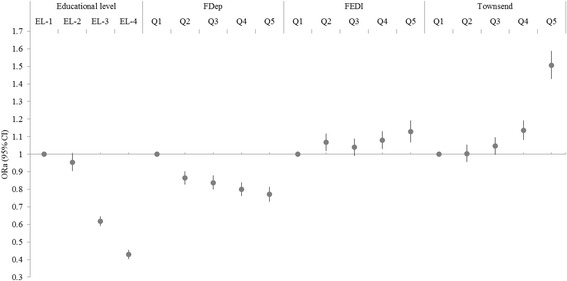
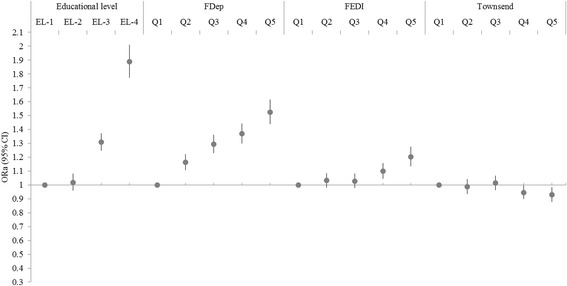
The analysis was performed among 63,888 women (aged 64, 47% ever smokers and 30% overweight). Substantial agreement was observed between the two French DIs (Kappa coefficient = 0.61) and between Townsend and FEDI (0.74) and fair agreement between Townsend and FDep (0.21). As expected among French elderly women, those with lower educational level were significantly less prone to be ever smoker (Low vs. High; OR [95% CI] = 0.43 [0.40-0.46]) and more prone to being overweight (1.89 [1.77-2.01]) than women higher educated. FDep showed expected associations at area-level for both smoking (most deprived vs. least deprived quintile; 0.77 [0.73-0.81]) and overweight (1.52 [1.44-1.62]). For FEDI opposite associations with smoking (1.13 [1.07-1.19]) and expected association with overweight (1.20 [1.13-1.28]) were observed. Townsend showed opposite associations to those expected for both smoking and overweight (1.51 [1.43-1.59]; 0.93 [0.88-0.99], respectively).
FDep seemed reliable to capture socioeconomic residential conditions of the E3N women, more educated in average than general French population. Results varied strongly according to the DI with unexpected results for some of them, which suggested the importance to test external validity before studying social disparities in health in specific populations.
尽管人们越来越关注地方效应来解释健康不平等现象,但目前对于研究人员应该使用哪种基于区域的社会经济措施来评估邻里社会经济地位(SEP),尚未达成共识。本研究旨在评估三种基于区域的剥夺指数(DI)在捕捉法国老年女性队列的社会经济居住条件方面的可靠性。
我们使用三种 DI 评估基于区域的 SEP:汤森指数、法国欧洲剥夺指数(FEDI)和法国剥夺指数(FDep),这些指数均来自 E3N(法国国立教育女性群体的流行病学研究)的女性。DI 是根据 2009 年法国人口普查在 IRIS 级别(法国最小的地理单位)得出的。教育水平用于评估个体的 SEP。为了评估三种 DI 的外部有效性,我们比较了两种在法国老年女性中已经确立的社会模式结果(吸烟和超重)与 SEP 之间的关系。使用广义估计方程计算比值比,以控制参与者在同一 IRIS 内的聚类效应。
在 63888 名女性(年龄 64 岁,47%为曾经吸烟者,30%为超重者)中进行了分析。在两种法国 DI 之间观察到高度一致性(Kappa 系数=0.61),在汤森和 FEDI 之间观察到高度一致性(0.74),在汤森和 FDep 之间观察到适度一致性(0.21)。正如在法国老年女性中预期的那样,那些教育水平较低的人明显不太可能成为曾经的吸烟者(低 vs. 高;比值比[95%置信区间]=0.43[0.40-0.46]),而更有可能超重(1.89[1.77-2.01])。在地区层面,FDep 显示出与吸烟(最贫困与最不贫困五分位数;0.77[0.73-0.81])和超重(1.52[1.44-1.62])相关的预期关联。对于 FEDI,观察到与吸烟的相反关联(1.13[1.07-1.19]),以及与超重的预期关联(1.20[1.13-1.28])。对于汤森指数,观察到与吸烟和超重的关联与预期相反(1.51[1.43-1.59];0.93[0.88-0.99])。
FDep 似乎可以可靠地捕捉 E3N 女性的社会经济居住条件,她们的教育程度平均高于法国一般人口。结果因 DI 而异,其中一些结果出乎意料,这表明在特定人群中研究健康社会差异之前,测试外部有效性非常重要。