Universidade Federal de Minas Gerais (UFMG), Departamento de Fisioterapia, NeuroGroup, Belo Horizonte, MG, Brazil.
Universidade Federal de Minas Gerais (UFMG), Departamento de Fisioterapia, NeuroGroup, Belo Horizonte, MG, Brazil; Universidade Federal do Espírito Santo (UFES), Centro de Ciências da Saúde, Vitória, ES, Brazil.
Braz J Phys Ther. 2018 Mar-Apr;22(2):168-173. doi: 10.1016/j.bjpt.2017.11.002. Epub 2017 Dec 2.
Canes are usually prescribed for individuals with stroke with the purpose of improving walking and increasing safety. However, there is no consensus regarding the clinical effects of these aids on walking and participation.
This study will examine the efficacy of the provision of a cane to improve walking and increase participation after stroke.
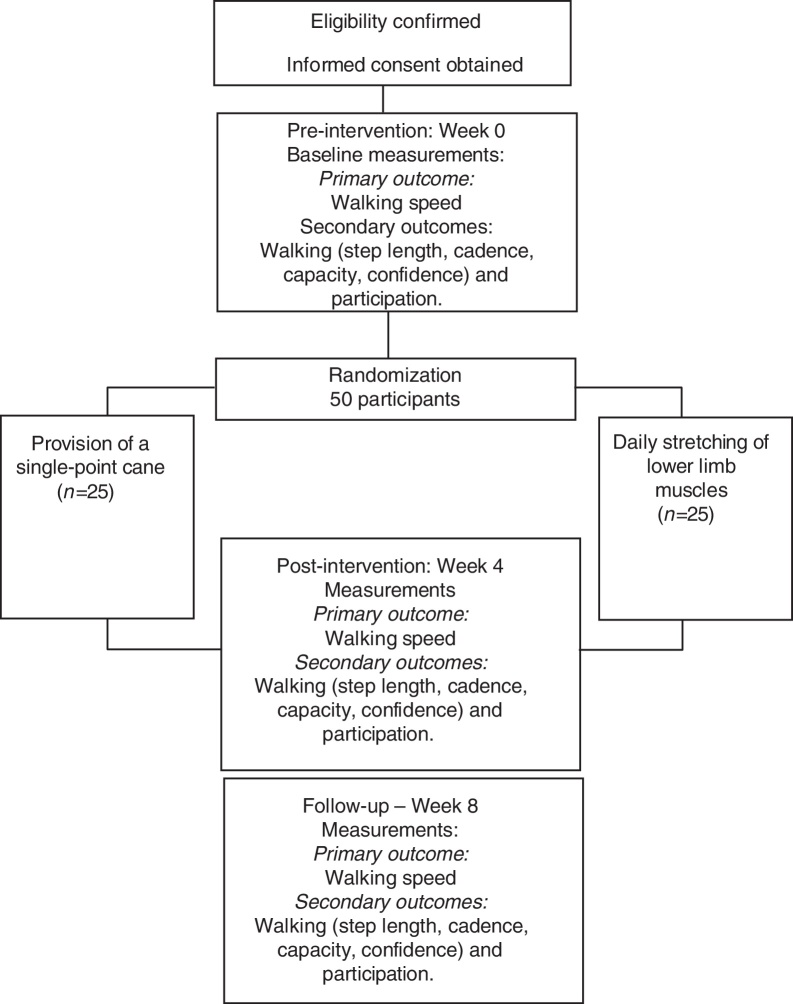
This is a two-arm, prospectively registered, randomized trial with concealed allocation, blinded measurers, and intention-to-treat analysis. Fifty individuals with chronic stroke, categorized as slow or intermediate walkers (walking speeds ≤0.8m/s), will participate. The experimental group will receive a single-point cane and instructions to use the cane anytime they need to walk. The control group will receive a placebo intervention, consisting of self-stretching exercises of the lower limb muscles and instructions to not use assistive devices. The primary outcome will be comfortable walking speed. Secondary outcomes will include walking step length, walking cadence, walking capacity, walking confidence, and participation. Outcomes will be collected by a researcher blinded to group allocation at baseline (Week 0), after intervention (Week 4), and one month beyond intervention (Week 8).
The provision of a single-point cane may help improving walking of slow and intermediate walkers after stroke. If walking is enhanced, the benefits may be carried over to participation, and individuals may experience greater free-living physical activity at home and in the community.
手杖通常被开给患有中风的个体,目的是改善步行能力和提高安全性。然而,关于这些辅助器具对步行和参与度的临床效果,尚未达成共识。
本研究旨在检验提供手杖对改善中风后步行能力和增加参与度的效果。
这是一项双臂、前瞻性注册、随机试验,采用隐蔽分组、盲法测量和意向治疗分析。50 名慢性中风患者(步行速度≤0.8m/s,归类为慢走者或中速走者)将参与研究。实验组将接受单点手杖和随时随地使用手杖的指导。对照组将接受安慰剂干预,包括下肢肌肉自我拉伸运动和不使用辅助器具的指导。主要结局指标为舒适步行速度。次要结局指标包括步行步长、步行步频、步行能力、步行信心和参与度。研究人员将在基线(第 0 周)、干预后(第 4 周)和干预后一个月(第 8 周)对结果进行盲法评估。
提供单点手杖可能有助于改善中风后慢走者和中速走者的步行能力。如果步行能力得到提高,可能会对参与度产生积极影响,个体在家中和社区中可能会经历更多的自由活动。