Department of Clinical Neuroscience, Center for Psychiatry Research, Karolinska Institutet, Stockholm, Sweden.
Stockholm Health Care Services, Stockholm County Council, Stockholm, Sweden.
BMJ Open. 2017 Dec 14;7(12):e018345. doi: 10.1136/bmjopen-2017-018345.
Social anxiety disorder (SAD) is one of the most common psychiatric disorders in youth, with a prevalence of about 3%-4% and increased risk of adverse long-term outcomes, such as depression. Cognitive-behavioural therapy (CBT) is considered the first-line treatment for youth with SAD, but many adolescents remain untreated due to limited accessibility to CBT. The aim of this study was to develop and evaluate the feasibility and preliminary efficacy of a therapist-guided internet-delivered CBT treatment, supplemented with clinic-based group exposure sessions (BIP SOFT).
A proof-of-concept, open clinical trial with 6-month follow-up.
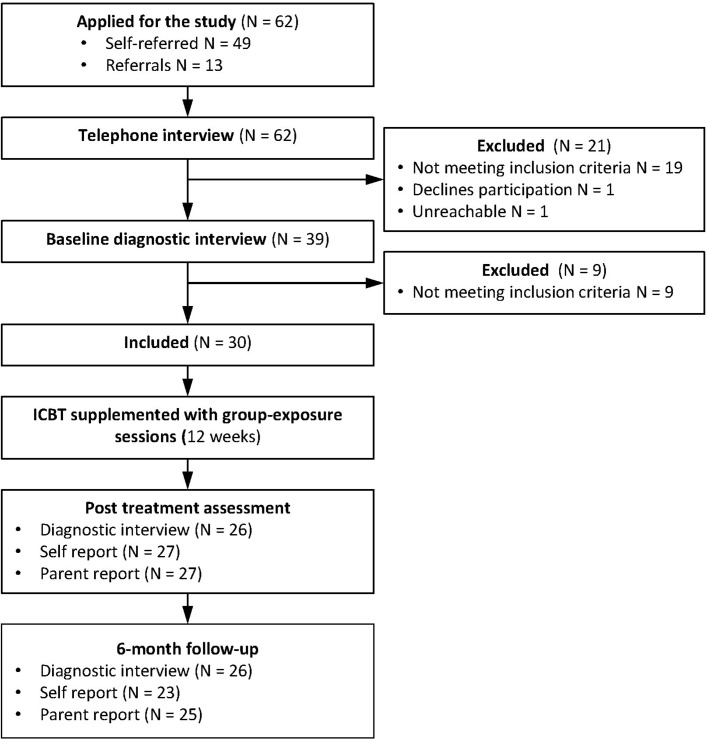
The trial was conducted at a child and adolescent psychiatric research clinic, and participants (n=30) were 13-17 years old (83% girls) with a principal diagnosis of SAD.
12 weeks of intervention, consisting of nine remote therapist-guided internet-delivered CBT sessions and three group exposure sessions at the clinic for the adolescents and five internet-delivered sessions for the parents.
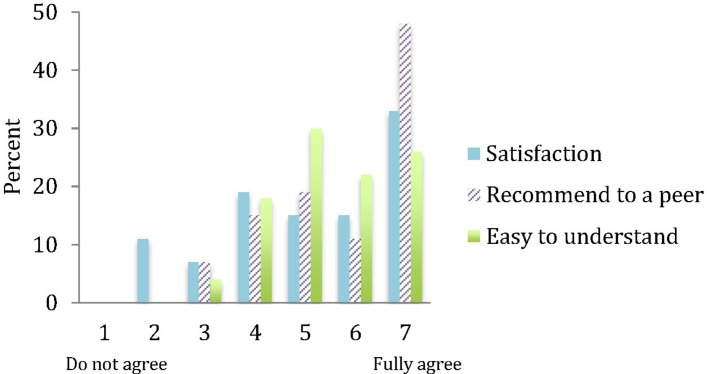
Adolescents were generally satisfied with the treatment, and the completion rate of internet modules, as well as attendance at group sessions, was high. Post-treatment assessment showed a significant decrease in clinician-rated, adolescent-rated and parent-rated social anxiety (=1.17, 0.85 and 0.79, respectively), as well as in general self-rated and parent-rated anxiety and depression (=0.76 and 0.51), compared with pretreatment levels. Furthermore, 47% of participants no longer met Diagnostic and Statistical Manual of Mental Disorders, Fifth Edition (DSM-5) criteria for SAD at post-treatment. At a 6-month follow-up, symptom reductions were maintained, or further improved, and 57% of participants no longer met criteria for SAD.
Therapist-guided and parent-guided internet-delivered CBT, supplemented with a limited number of group exposure sessions, is a feasible and promising intervention for adolescents with SAD.
NCT02576171; Results.
社交焦虑障碍(SAD)是青少年中最常见的精神障碍之一,患病率约为 3%-4%,并且存在抑郁等不良长期后果的风险增加。认知行为疗法(CBT)被认为是治疗 SAD 青少年的首选方法,但由于 CBT 的可及性有限,许多青少年仍未得到治疗。本研究旨在开发和评估一种治疗师指导的互联网 CBT 治疗方法,辅以基于诊所的小组暴露治疗(BIP SOFT)的可行性和初步疗效。
一项为期 6 个月随访的概念验证、开放性临床试验。
该试验在儿童和青少年精神病学研究诊所进行,参与者(n=30)年龄在 13-17 岁(83%为女孩),主要诊断为 SAD。
12 周的干预,包括九次远程治疗师指导的互联网 CBT 治疗和三次诊所小组暴露治疗,以及五次互联网家长治疗。
青少年普遍对治疗满意,互联网模块的完成率以及小组治疗的出席率均很高。治疗后评估显示,临床医生评定、青少年自评和家长评定的社交焦虑显著下降(分别为 1.17、0.85 和 0.79),一般自我评定和家长评定的焦虑和抑郁也显著下降(分别为 0.76 和 0.51),与治疗前相比。此外,治疗后 47%的参与者不再符合精神障碍诊断与统计手册第五版(DSM-5)的 SAD 标准。在 6 个月的随访中,症状减轻得以维持或进一步改善,57%的参与者不再符合 SAD 标准。
治疗师指导和家长指导的互联网 CBT,辅以有限数量的小组暴露治疗,是治疗 SAD 青少年的一种可行且有前途的干预方法。
NCT02576171;结果。