Ander Malin, Wikman Anna, Ljótsson Brjánn, Grönqvist Helena, Ljungman Gustaf, Woodford Joanne, Lindahl Norberg Annika, von Essen Louise
Clinical Psychology in Healthcare, Department of Women's and Children's Health, Uppsala University, Uppsala, Sweden.
Division of Psychology, Department of Clinical Neuroscience, Karolinska Institutet, Stockholm, Sweden.
BMJ Open. 2017 Jan 27;7(1):e013906. doi: 10.1136/bmjopen-2016-013906.
A subgroup of adolescents and young adults diagnosed with cancer during adolescence reports elevated levels of anxiety and depressive symptoms and unmet needs for psychological support. Evidence-based psychological treatments tailored for this population are lacking. This protocol describes a feasibility study of a guided-internet-administered self-help programme (YoungCan) primarily targeting symptoms of anxiety and depression among young persons diagnosed with cancer during adolescence and of the planned study procedures for a future controlled trial.
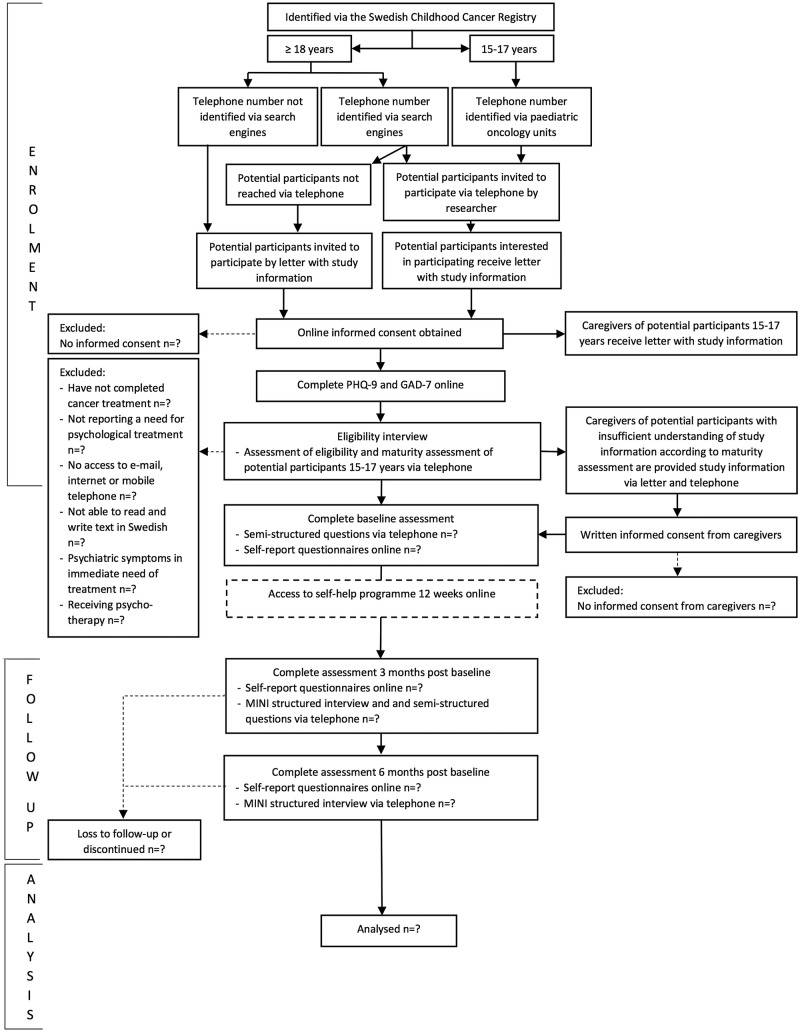
METHODS/ANALYSIS: The study is an uncontrolled feasibility trial with a pre-post and 3-month follow-up design. Potential participants aged 15-25 years, diagnosed with cancer during adolescence, will be identified via the Swedish Childhood Cancer Registry. 30 participants will be included. Participants will receive YoungCan, a 12-week therapist-guided, internet-administered self-help programme consisting primarily of cognitive-behavioural therapy organised into individually assigned modules targeting depressive symptoms, worry and anxiety, body dissatisfaction and post-traumatic stress. Interactive peer support and psychoeducative functions are also available. Feasibility outcomes include: recruitment and eligibility criteria; data collection; attrition; resources needed to complete the study and programme; safety procedures; participants' and therapists' adherence to the programme; and participants' acceptability of the programme and study methodology. Additionally, mechanisms of impact will be explored and data regarding symptoms of anxiety, depression, post-traumatic stress, body dissatisfaction, reactions to social interactions, quality of life, axis I diagnoses according to the Mini International Neuropsychiatric Interview and healthcare service use will be collected. Exploratory analyses of changes in targeted outcomes will be conducted.
ETHICS/DISSEMINATION: This feasibility protocol was approved by the Regional Ethical Review Board in Uppsala, Sweden (ref: 2016/210). Findings will be disseminated to relevant research, clinical, health service and patient communities through publications in peer-reviewed and popular science journals and presentations at scientific and clinical conferences.
ISRCTN97835363.
在青少年时期被诊断患有癌症的一部分青少年和青年报告称,他们的焦虑和抑郁症状水平升高,心理支持需求未得到满足。目前缺乏针对这一人群的循证心理治疗方法。本方案描述了一项针对在青少年时期被诊断患有癌症的年轻人的焦虑和抑郁症状的指导性互联网自助计划(YoungCan)的可行性研究,以及未来对照试验的计划研究程序。
方法/分析:本研究是一项采用前后测和3个月随访设计的非对照可行性试验。将通过瑞典儿童癌症登记处确定年龄在15 - 25岁、在青少年时期被诊断患有癌症的潜在参与者。将纳入3