Mwacharo Joram M, Kim Eui-Soo, Elbeltagy Ahmed R, Aboul-Naga Adel M, Rischkowsky Barbara A, Rothschild Max F
Small Ruminant Genomics Group, International Center for Agricultural Research in the Dry Areas (ICARDA), P. O. Box 5689, Addis Ababa, Ethiopia.
Department of Animal Science, Iowa State University, 2255 Kildee Hall, Ames, IA, 50011-3150, USA.
Sci Rep. 2017 Dec 15;7(1):17647. doi: 10.1038/s41598-017-17775-3.
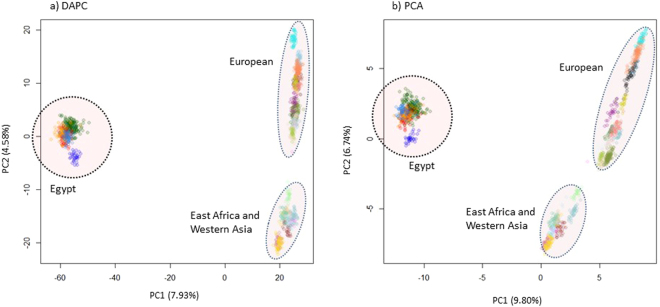
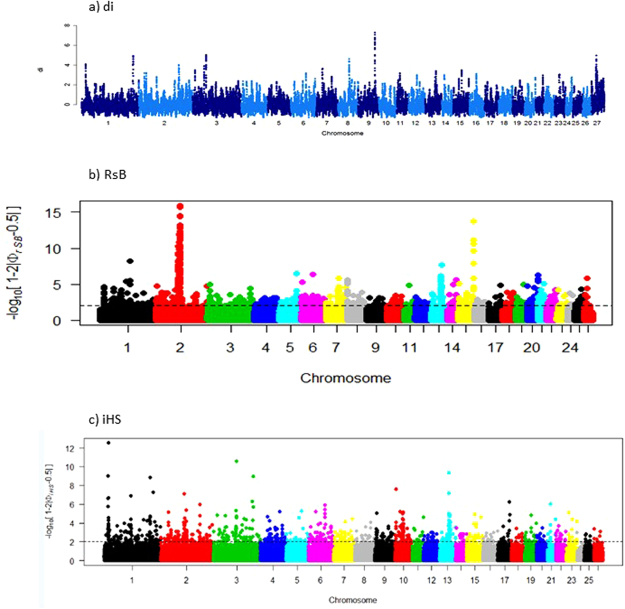
African indigenous sheep are classified as fat-tail, thin-tail and fat-rump hair sheep. The fat-tail are well adapted to dryland environments, but little is known on their genome profiles. We analyzed patterns of genomic variation by genotyping, with the Ovine SNP50K microarray, 394 individuals from five populations of fat-tail sheep from a desert environment in Egypt. Comparative inferences with other East African and western Asia fat-tail and European sheep, reveal at least two phylogeographically distinct genepools of fat-tail sheep in Africa that differ from the European genepool, suggesting separate evolutionary and breeding history. We identified 24 candidate selection sweep regions, spanning 172 potentially novel and known genes, which are enriched with genes underpinning dryland adaptation physiology. In particular, we found selection sweeps spanning genes and/or pathways associated with metabolism; response to stress, ultraviolet radiation, oxidative stress and DNA damage repair; activation of immune response; regulation of reproduction, organ function and development, body size and morphology, skin and hair pigmentation, and keratinization. Our findings provide insights on the complexity of genome architecture regarding dryland stress adaptation in the fat-tail sheep and showcase the indigenous stocks as appropriate genotypes for adaptation planning to sustain livestock production and human livelihoods, under future climates.
非洲本土绵羊被分为肥尾羊、瘦尾羊和肥臀毛羊。肥尾羊能很好地适应旱地环境,但人们对它们的基因组概况了解甚少。我们使用绵羊50K SNP芯片对来自埃及沙漠环境的五个肥尾羊种群的394只个体进行基因分型,分析了基因组变异模式。与其他东非和西亚肥尾羊以及欧洲绵羊的比较推断表明,非洲至少有两个地理谱系上不同的肥尾羊基因库,它们与欧洲基因库不同,这表明它们有着独立的进化和育种历史。我们确定了24个候选选择清除区域,涵盖172个潜在的新基因和已知基因,这些基因富含支持旱地适应生理学的基因。特别是,我们发现选择清除区域涉及与代谢、应激反应、紫外线辐射、氧化应激和DNA损伤修复、免疫反应激活、生殖调控、器官功能和发育、体型和形态、皮肤和毛发色素沉着以及角质化相关的基因和/或途径。我们的研究结果揭示了肥尾羊在旱地胁迫适应方面基因组结构的复杂性,并展示了这些本土种群作为适应规划的合适基因型,以在未来气候条件下维持畜牧生产和人类生计。