University of Augsburg, Augsburg, Germany.
University Hospital Erlangen, Erlangen, Germany.
Clin Res Cardiol. 2018 Mar;107(3):193-200. doi: 10.1007/s00392-017-1186-y. Epub 2017 Dec 16.
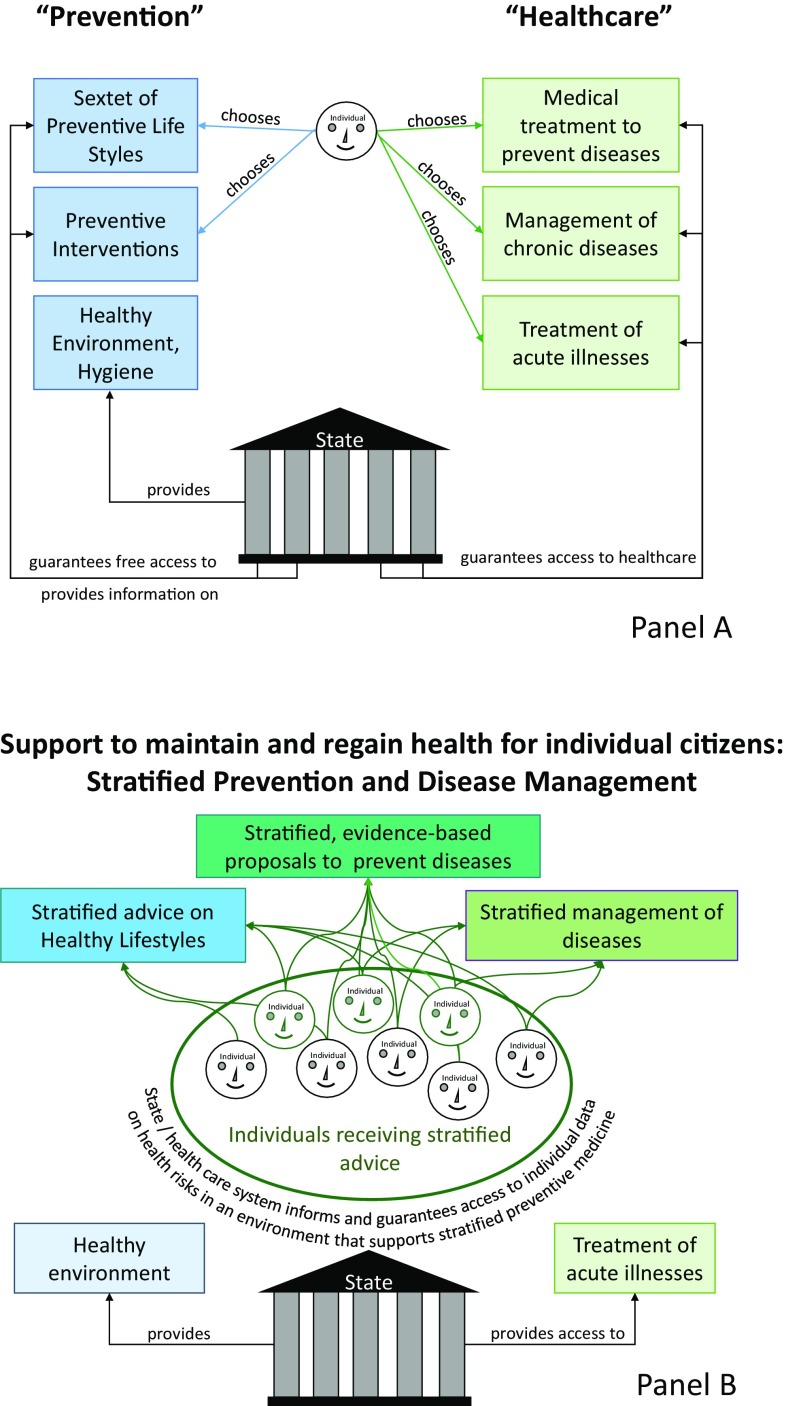
Sufficient exercise and sleep, a balanced diet, moderate alcohol consumption and a good approach to handle stress have been known as lifestyles that protect health and longevity since the Middle Age. This traditional prevention quintet, turned into a sextet by smoking cessation, has been the basis of the "preventive personality" that formed in the twentieth century. Recent analyses of big data sets including genomic and physiological measurements have unleashed novel opportunities to estimate individual health risks with unprecedented accuracy, allowing to target preventive interventions to persons at high risk and at the same time to spare those in whom preventive measures may not be needed or even be harmful. To fully grasp these opportunities for modern preventive medicine, the established healthy life styles require supplementation by stratified prevention. The opportunities of these developments for life and health contrast with justified concerns: A "surveillance society", able to predict individual behaviour based on big data, threatens individual freedom and jeopardises equality. Social insurance law and the new German Disease Prevention Act (Präventionsgesetz) rightly stress the need for research to underpin stratified prevention which is accessible to all, ethical, effective, and evidence based. An ethical and acceptable development of stratified prevention needs to start with autonomous individuals who control and understand all information pertaining to their health. This creates a mandate for lifelong health education, enabled in an individualised form by digital technology. Stratified prevention furthermore requires the evidence-based development of a new taxonomy of cardiovascular diseases that reflects disease mechanisms. Such interdisciplinary research needs broad support from society and a better use of biosamples and data sets within an updated research governance framework.
自中世纪以来,充足的运动和睡眠、均衡的饮食、适量饮酒和良好的应对压力的方法,一直被认为是保护健康和长寿的生活方式。这个由戒烟加入的新元素组成的传统预防五联,已经成为了 20 世纪形成的“预防人格”的基础。最近对包括基因组和生理测量在内的大数据集的分析,为以空前的准确性估计个体健康风险提供了新的机会,从而可以针对高风险人群进行预防干预,同时避免那些可能不需要预防措施甚至可能有害的人群。为了充分利用现代预防医学的这些机会,既定的健康生活方式需要分层预防来补充。这些发展为生命和健康带来的机会与合理的担忧形成了鲜明的对比:一个能够基于大数据预测个人行为的“监控社会”,威胁着个人自由,危及平等。社会保险法和新的德国疾病预防法(Präventionsgesetz)正确地强调了需要进行研究,以支持所有能够负担得起的、符合伦理道德的、有效的、基于证据的分层预防。分层预防的伦理和可接受的发展需要从能够控制和理解与自身健康相关的所有信息的自主个体开始。这为终身健康教育创造了一个任务,数字化技术可以实现这种教育的个性化。分层预防还需要基于证据的开发新的心血管疾病分类法,反映疾病机制。这种跨学科研究需要社会的广泛支持,以及在更新的研究治理框架内更好地利用生物样本和数据集。