Koehler Karsten, Drenowatz Clemens
Department of Nutrition and Health Sciences, University of Nebraska-Lincoln, Lincoln, NE, United States.
Division of Physical Education, University of Education Upper Austria, Linz, Austria.
Front Physiol. 2017 Nov 30;8:983. doi: 10.3389/fphys.2017.00983. eCollection 2017.
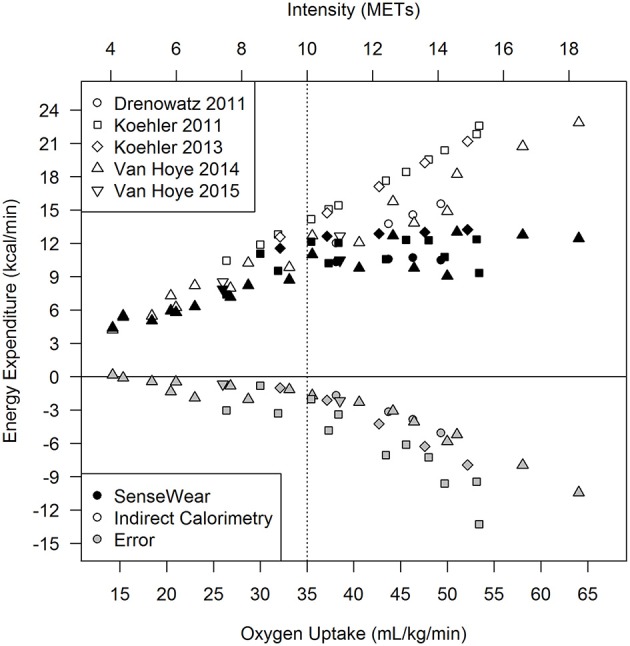
In order to monitor their energy requirements, athletes may desire to assess energy expenditure (EE) during training and competition. Recent technological advances and increased customer interest have created a market for wearable devices that measure physiological variables and bodily movement over prolonged time periods and convert this information into EE data. This mini-review provides an overview of the applicability of the SenseWear armband (SWA), which combines accelerometry with measurements of heat production and skin conductivity, to measure total daily energy expenditure (TDEE) and its components such as exercise energy expenditure (ExEE) in athletic populations. While the SWA has been shown to provide valid estimates of EE in the general population, validation studies in athletic populations indicate a tendency toward underestimation of ExEE particularly during high-intensity exercise (>10 METs) with an increasing underestimation as exercise intensity increases. Although limited information is available on the accuracy of the SWA during resistance exercise, high-intensity interval exercise, or mixed exercise forms, there seems to be a similar trend of underestimating high levels of ExEE. The SWA, however, is capable of detecting movement patterns and metabolic measurements even at high exercise intensities, suggesting that underestimation may result from limitations in the proprietary algorithms. In addition, the SWA has been used in the assessment of sleep quantity and quality as well as non-exercise activity thermogenesis. Overall, the SWA provides viable information and remains to be used in various clinical and athletic settings, despite the termination of its commercial sale.
为了监测自身能量需求,运动员可能希望评估训练和比赛期间的能量消耗(EE)。近期的技术进步以及客户兴趣的增加,催生了可穿戴设备市场,这类设备能够长时间测量生理变量和身体活动,并将这些信息转化为EE数据。本综述概述了SenseWear臂带(SWA)在运动员群体中测量每日总能量消耗(TDEE)及其组成部分(如运动能量消耗(ExEE))的适用性,该臂带将加速度测量与产热和皮肤电导率测量相结合。虽然SWA已被证明能够在普通人群中提供有效的EE估计值,但在运动员群体中的验证研究表明,尤其是在高强度运动(>10梅脱)期间,SWA有低估ExEE的倾向,且随着运动强度增加,低估程度也会增加。尽管关于SWA在抗阻运动、高强度间歇运动或混合运动形式中的准确性的信息有限,但似乎也存在类似的低估高水平ExEE的趋势。然而,SWA即使在高运动强度下也能够检测运动模式和代谢测量值,这表明低估可能是由于专有算法的局限性所致。此外,SWA还被用于评估睡眠数量和质量以及非运动活动产热。总体而言,尽管SWA已停止商业销售,但它仍能提供可行的信息,并继续在各种临床和运动环境中使用。