Mittal Mitesh, Kundu Krishnendu, Chakravarti Soumendu, Mohapatra Jajati K, Nehra Kapil, Sinha V K, Sanjeeth B S, Churamani C P, Kumar Anil
Central Military Veterinary Laboratory (CMVL), Sardhana Road, Meerut Cantt, Meerut, Uttar-Pradesh, India; Defence Institute of Bio-Energy Research (DIBER), Project Site Secunderabad, Military Farm Road, Old Bowenpally, Secunderabad, Telangana State, India.
Veterinary Parasitology, KNP College of Veterinary Science, Shirwal, District-Satara, Maharashtra, India.
Prev Vet Med. 2017 Nov 1;147:26-33. doi: 10.1016/j.prevetmed.2017.08.012. Epub 2017 Aug 25.
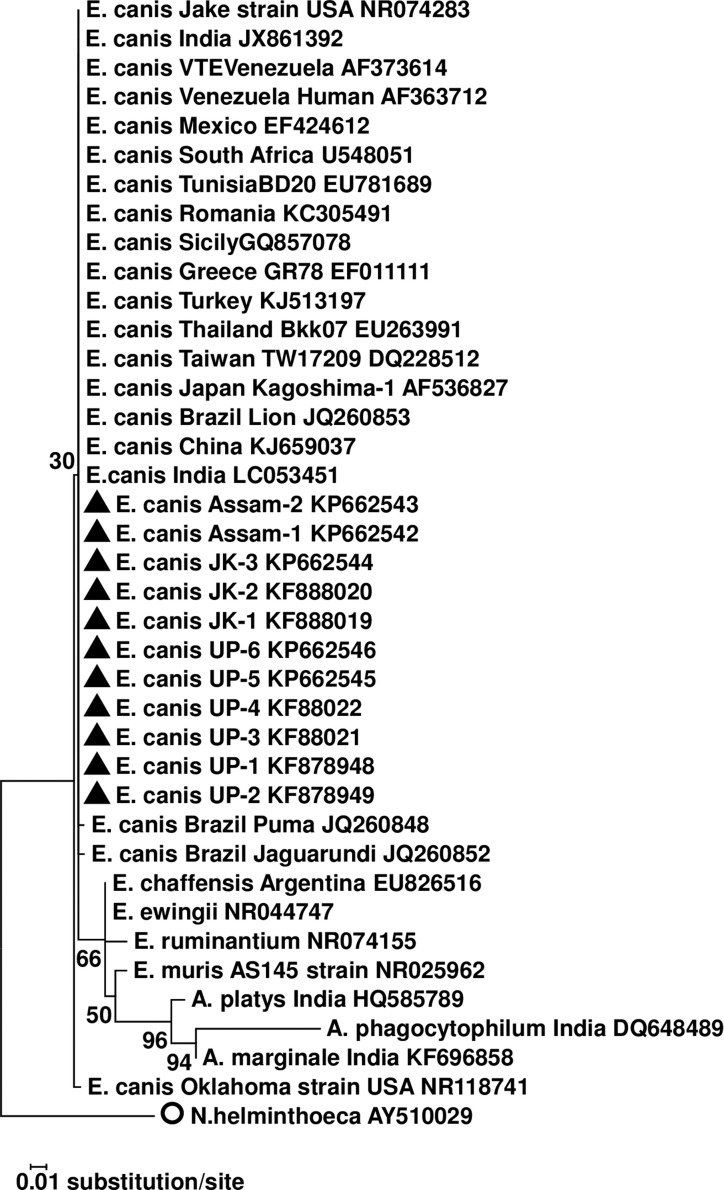
Canine Monocytic Ehrlichiosis (CME) is a serious tick-borne rickettsial disease affecting canine populations globally. Besides few reports from stray and pet dogs from localised geographical regions (cities/towns/small states), a comprehensive study on prevalence of Ehrlichia canis (E. canis) among working dogs from different geo-climatic zones of India was pertinently lacking. Study of CME among these dog populations was thus carried out, encompassing clinical aspects and different diagnostic methodologies viz., microscopy, serology and molecular biology. During the two-year study period, clinical specimens from 225 cases suspected of canine ehrlichiosis were examined for clinical pathology and presence of the haemoparasites. Overall prevalence of ehrlichiosis by microscopic examination, commercial dot-ELISA kit and nested PCR assay was estimated to be 1.3%, 19.1% and 5.8%, respectively, which were found to be statistically significant by McNemar Chi squared test (p<0.05). It was also observed that possibly due to widespread use of doxycycline therapy in field, CME presently does not remain a potential threat which it uses to pose earlier. However, concurrent infections of E. canis and Babesia gibsoni were found to be mostly fatal. Keeping in view of high number of apparently healthy dogs (24) out of total positive cases (46) observed during the study, it is recommended that prevalence studies on CME should also involve screening of apparently healthy dogs. Phylogenetic analysis carried on partial sequencing of 16S rRNA of E. canis strains revealed that all of the Indian strains clustered in a single clade with other E. canis species from India and rest of the world. Molecular divergence was observed among the sequences of Brazilian and American isolates which were also included in the present study. These findings have thus opened a new paradigm for planning of pragmatic control strategies against CME.
犬单核细胞埃立克体病(CME)是一种严重的蜱传立克次体病,影响着全球的犬类群体。除了来自局部地理区域(城市/城镇/小邦)的流浪狗和宠物狗的少数报告外,印度不同地理气候区的工作犬中犬埃立克体(E. canis)流行情况的全面研究一直严重缺乏。因此,对这些犬类群体中的CME进行了研究,涵盖了临床方面以及不同的诊断方法,即显微镜检查、血清学和分子生物学。在为期两年的研究期间,对225例疑似犬埃立克体病病例的临床标本进行了临床病理学检查和血寄生虫检测。通过显微镜检查、商用斑点ELISA试剂盒和巢式PCR检测,埃立克体病的总体患病率分别估计为1.3%、19.1%和5.8%,通过McNemar卡方检验发现这些患病率具有统计学意义(p<0.05)。还观察到,可能由于多西环素疗法在野外的广泛使用,CME目前已不再像以前那样构成潜在威胁。然而,发现犬埃立克体和吉氏巴贝斯虫的并发感染大多是致命的。鉴于在研究期间观察到的所有阳性病例(46例)中有大量看似健康的狗(24只),建议对CME的患病率研究也应包括对看似健康的狗进行筛查。对犬埃立克体菌株的16S rRNA部分测序进行的系统发育分析表明,所有印度菌株与来自印度和世界其他地区的其他犬埃立克体物种聚集在一个单一的进化枝中。在本研究中也纳入的巴西和美国分离株的序列之间观察到了分子差异。因此,这些发现为制定针对CME的实用控制策略开辟了新的范例。