Federal University of Rio de Janeiro (UFRJ), Electrical Engineering Program, Photonics and Instrumentation Laboratory, Rio de Janeiro 21.941-901, Brazil.
Institute of Advanced Studies (IEAv), S. José dos Campos 12.228-001, Brazil.
Sensors (Basel). 2017 Dec 19;17(12):2944. doi: 10.3390/s17122944.
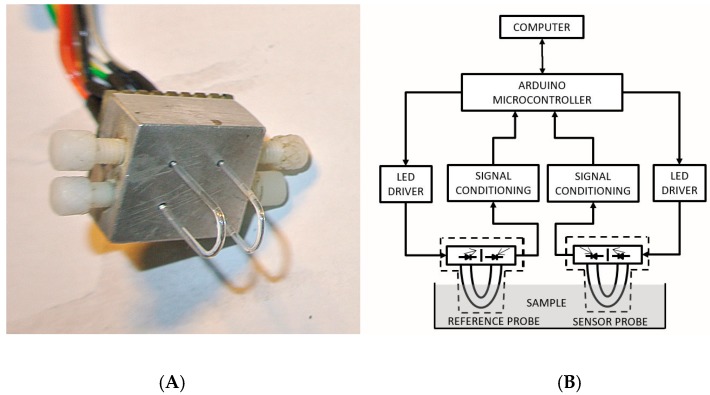
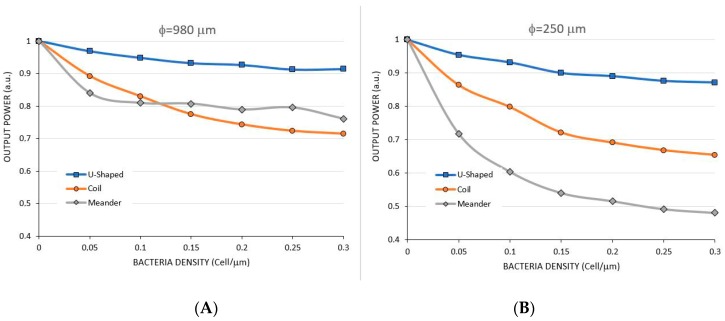
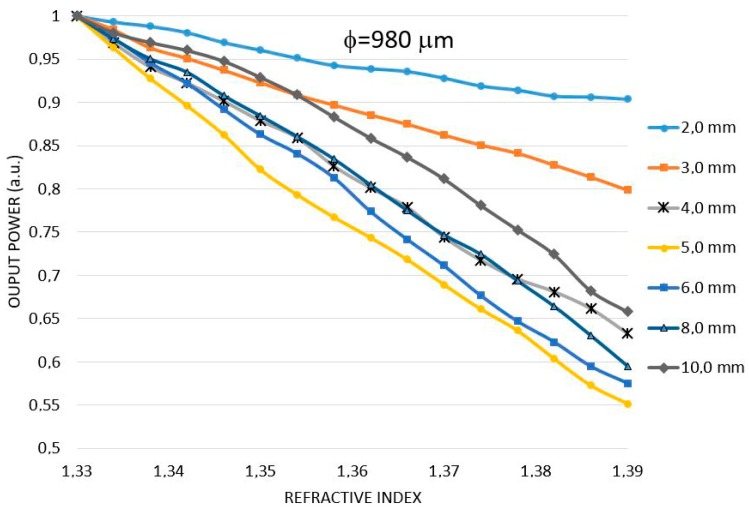
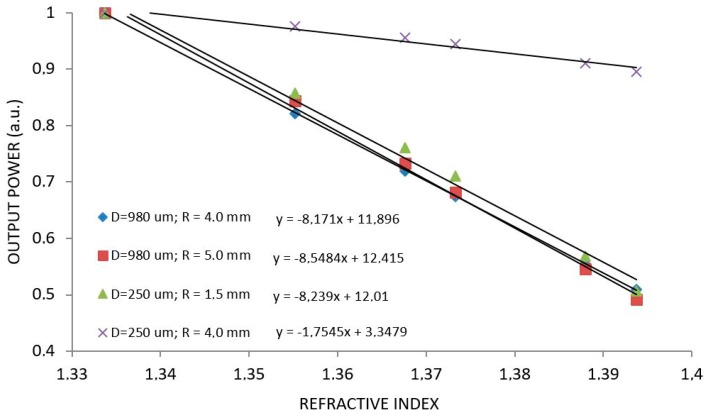
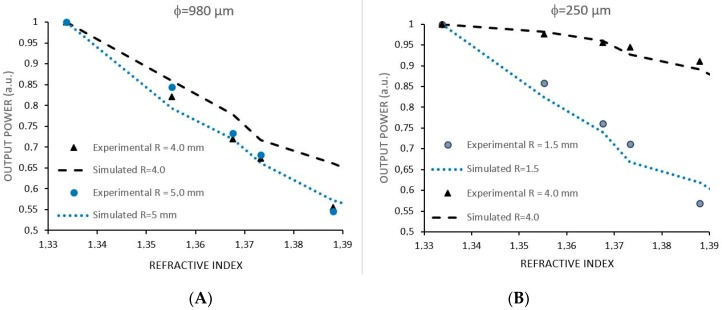
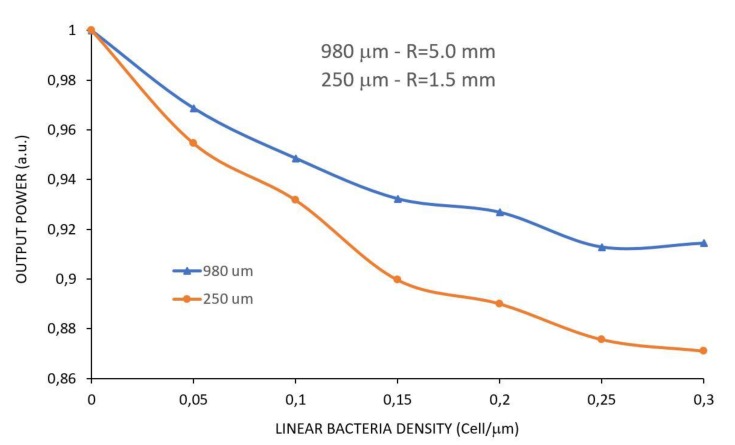
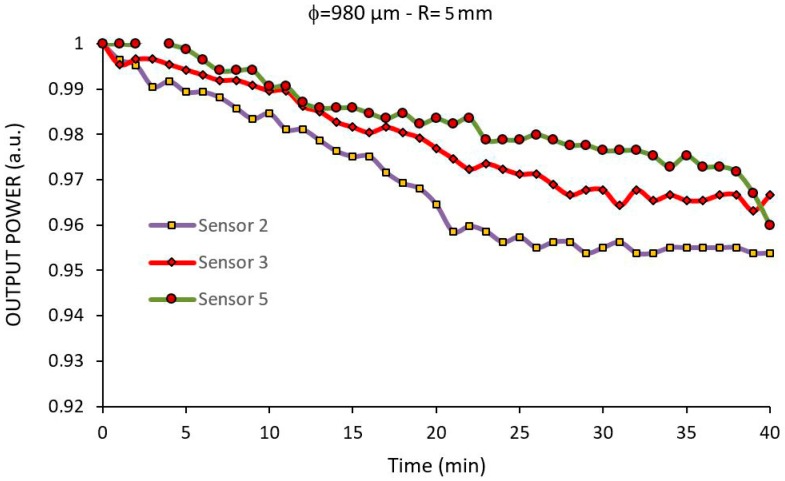
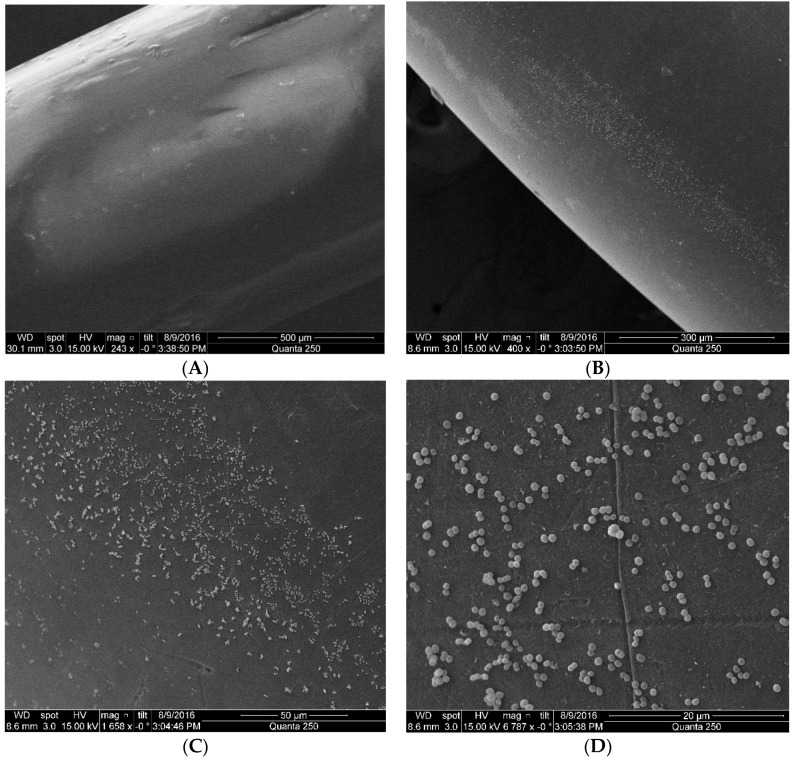
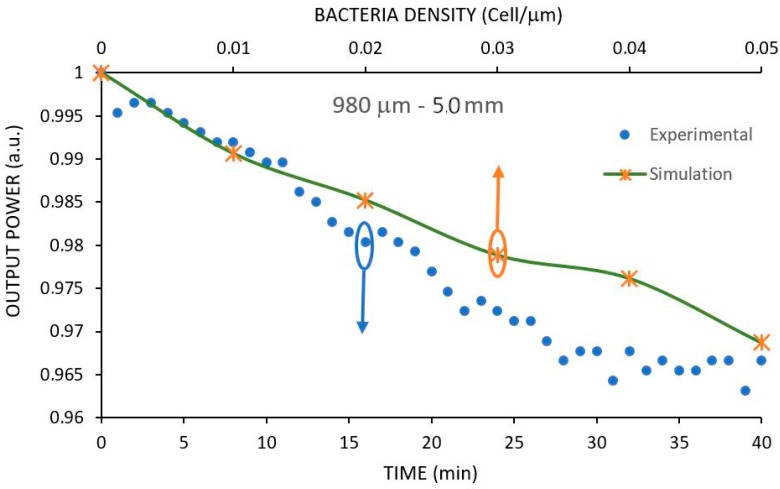
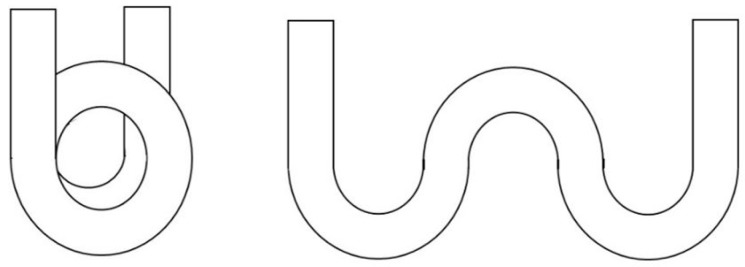
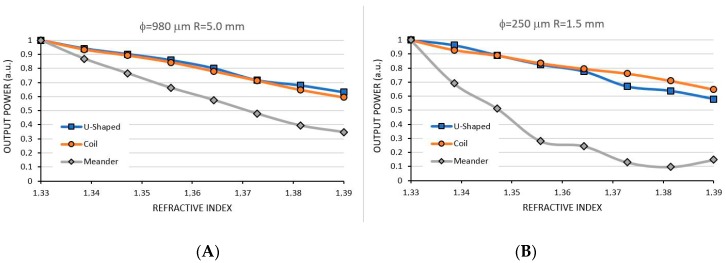
Conventional pathogen detection methods require trained personnel, specialized laboratories and can take days to provide a result. Thus, portable biosensors with rapid detection response are vital for the current needs for in-loco quality assays. In this work the authors analyze the characteristics of an immunosensor based on the evanescent field in plastic optical fibers with macro curvature by comparing experimental with simulated results. The work studies different shapes of evanescent-wave based fiber optic sensors, adopting a computational modeling to evaluate the probes with the best sensitivity. The simulation showed that for a U-Shaped sensor, the best results can be achieved with a sensor of 980 µm diameter by 5.0 mm in curvature for refractive index sensing, whereas the meander-shaped sensor with 250 μm in diameter with radius of curvature of 1.5 mm, showed better sensitivity for either bacteria and refractive index (RI) sensing. Then, an immunosensor was developed, firstly to measure refractive index and after that, functionalized to detect . Based on the results with the simulation, we conducted studies with a real sensor for RI measurements and for detection aiming to establish the best diameter and curvature radius in order to obtain an optimized sensor. On comparing the experimental results with predictions made from the modelling, good agreements were obtained. The simulations performed allowed the evaluation of new geometric configurations of biosensors that can be easily constructed and that promise improved sensitivity.
传统的病原体检测方法需要经过培训的人员、专业实验室,并且可能需要数天才能得出结果。因此,具有快速检测响应的便携式生物传感器对于当前对现场质量分析的需求至关重要。在这项工作中,作者通过比较实验和模拟结果来分析基于宏观曲率塑料光纤中的倏逝场的免疫传感器的特性。该工作研究了不同形状的基于倏逝波的光纤传感器,采用计算建模来评估具有最佳灵敏度的探头。模拟表明,对于 U 形传感器,对于折射率传感,曲率为 5.0mm 的直径为 980µm 的传感器可以获得最佳结果,而对于细菌和折射率 (RI) 传感,曲率半径为 1.5mm 的直径为 250µm 的曲折形传感器具有更好的灵敏度。然后,开发了一种免疫传感器,首先用于测量折射率,然后进行功能化以检测 。基于与模拟结果的比较,我们对 RI 测量和 检测进行了实际传感器研究,旨在确定最佳直径和曲率半径,以获得优化的传感器。将实验结果与建模预测进行比较,得到了很好的一致性。所进行的模拟允许评估新的生物传感器几何配置,这些配置易于构建,并有望提高灵敏度。