IBE, Institut de Biologia Evolutiva (Universitat Pompeu Fabra/CSIC), Ciencies Experimentals i de la Salut, 08003, Barcelona, Spain.
CNAG-CRG, Centre for Genomic Regulation (CRG), The Barcelona Institute of Science and Technology (BIST), Barcelona, Spain.
BMC Genomics. 2017 Dec 19;18(1):977. doi: 10.1186/s12864-017-4318-x.
Whole genome re-sequencing data from dogs and wolves are now commonly used to study how natural and artificial selection have shaped the patterns of genetic diversity. Single nucleotide polymorphisms, microsatellites and variants in mitochondrial DNA have been interrogated for links to specific phenotypes or signals of domestication. However, copy number variation (CNV), despite its increasingly recognized importance as a contributor to phenotypic diversity, has not been extensively explored in canids.
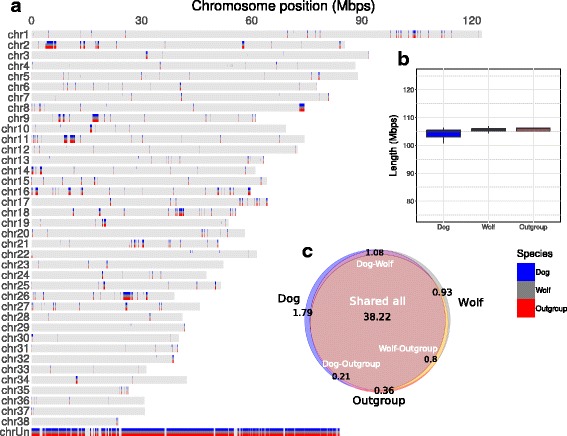
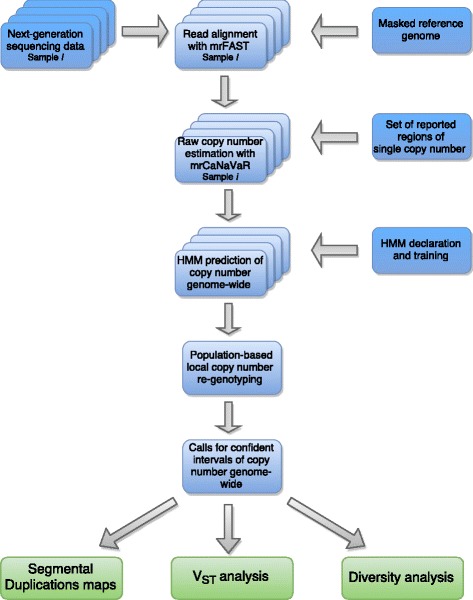
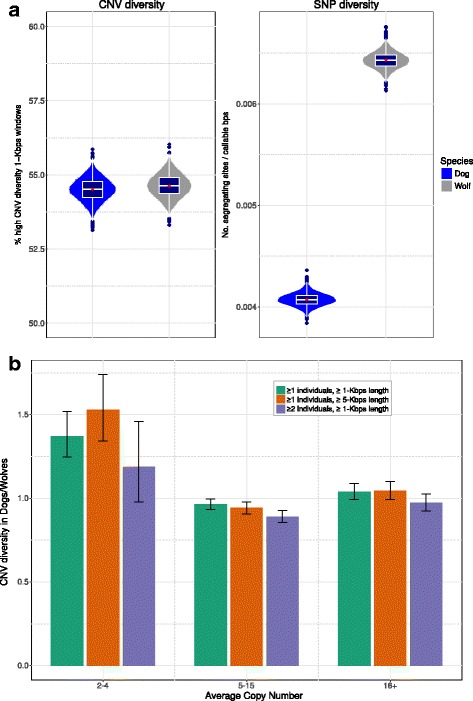
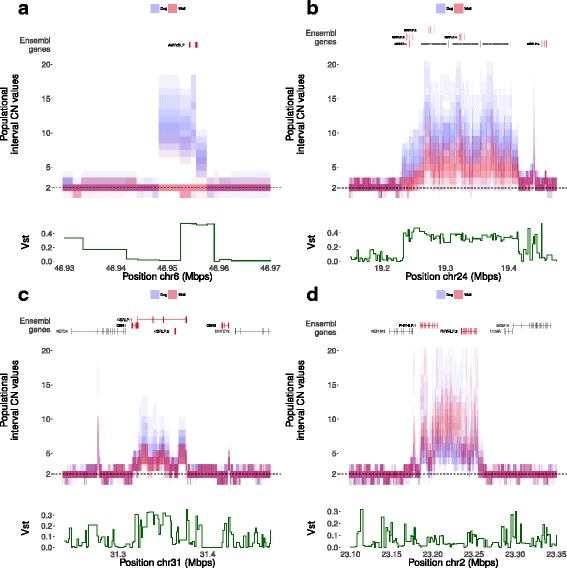
Here, we develop a new accurate probabilistic framework to create fine-scale genomic maps of segmental duplications (SDs), compare patterns of CNV across groups and investigate their role in the evolution of the domestic dog by using information from 34 canine genomes. Our analyses show that duplicated regions are enriched in genes and hence likely possess functional importance. We identify 86 loci with large CNV differences between dogs and wolves, enriched in genes responsible for sensory perception, immune response, metabolic processes, etc. In striking contrast to the observed loss of nucleotide diversity in domestic dogs following the population bottlenecks that occurred during domestication and breed creation, we find a similar proportion of CNV loci in dogs and wolves, suggesting that other dynamics are acting to particularly select for CNVs with potentially functional impacts.
This work is the first comparison of genome wide CNV patterns in domestic and wild canids using whole-genome sequencing data and our findings contribute to study the impact of novel kinds of genetic changes on the evolution of the domestic dog.
目前,来自狗和狼的全基因组重测序数据常被用于研究自然选择和人工选择是如何影响遗传多样性模式的。单核苷酸多态性、微卫星和线粒体 DNA 中的变异已被用于研究与特定表型或驯化信号的关联。然而,尽管拷贝数变异(CNV)作为表型多样性的一个重要贡献者,其在犬科动物中的研究尚未得到广泛探索。
在这里,我们开发了一种新的精确概率框架来创建片段重复(SD)的精细基因组图谱,通过使用 34 个犬基因组的信息来比较不同群体之间的 CNV 模式,并研究其在犬类进化中的作用。我们的分析表明,重复区域富含基因,因此可能具有功能重要性。我们确定了 86 个在犬和狼之间存在较大 CNV 差异的基因座,这些基因座富集了负责感觉感知、免疫反应、代谢过程等的基因。与在驯化和品种创造过程中发生的种群瓶颈导致的犬核苷酸多样性明显丧失形成鲜明对比的是,我们发现犬和狼之间具有相似比例的 CNV 基因座,这表明其他动态因素特别选择了具有潜在功能影响的 CNV。
这项工作首次使用全基因组测序数据比较了家犬和野生犬科动物的全基因组 CNV 模式,我们的研究结果有助于研究新型遗传变化对家犬进化的影响。