School of Nursing, Faculty of Medical and Health Sciences, University of Auckland, Auckland, New Zealand.
BMC Palliat Care. 2017 Dec 19;16(1):76. doi: 10.1186/s12904-017-0258-0.
Understanding end of life preferences amongst the oldest old is crucial to informing appropriate palliative and end of life care internationally. However, little has been reported in the academic literature about the end of life preferences of people in advanced age, particularly the preferences of indigenous older people, including New Zealand Māori.
Data on end of life preferences were gathered from 147 Māori (aged >80 years) and 291 non- Māori aged (>85 years), during three waves of Te Puawaitangi O Nga Tapuwae Kia Ora Tonu, Life and Living in Advanced Age (LiLACs NZ). An interviewer-led questionnaire using standardised tools and including Māori specific subsections was used.
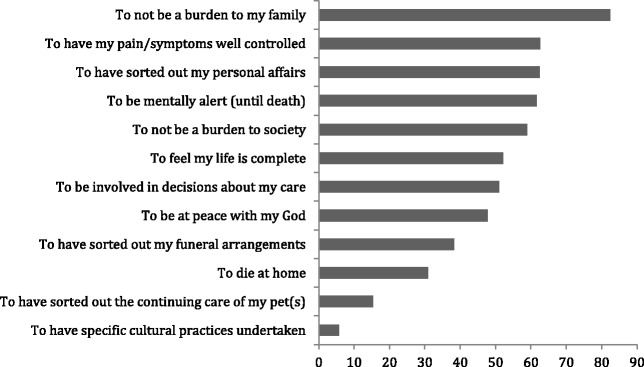
The top priority for both Māori and non-Māori participants at end of life was 'not being a burden to my family'. Interestingly, a home death was not a high priority for either group. End of life preferences differed by gender, however these differences were culturally contingent. More female Māori participants wanted spiritual practices at end of life than male Māori participants. More male non-Māori participants wanted to be resuscitated than female non- Māori participants.
That a home death was not in the top three end of life priorities for our participants is not consistent with palliative care policy in most developed countries where place of death, and particularly home death, is a central concern. Conversely our participants' top concern - namely not being a burden - has received little research or policy attention. Our results also indicate a need to pay attention to diversity in end of life preferences amongst people of advanced age, as well as the socio-cultural context within which preferences are formulated.
了解最年长人群的临终偏好对于在国际上提供适当的姑息治疗和临终关怀至关重要。然而,学术文献中关于高龄人群,尤其是包括新西兰毛利人在内的本土老年人临终偏好的报道却很少。
在三个阶段的 Te Puawaitangi O Nga Tapuwae Kia Ora Tonu,即高级年龄的生活和生存(LiLACs NZ)中,从 147 名毛利人(年龄>80 岁)和 291 名非毛利人(年龄>85 岁)中收集了临终偏好数据。使用标准化工具和包括毛利人特定部分的访谈者主导问卷进行数据收集。
毛利人和非毛利人参与者在临终时的首要任务都是“不要成为家人的负担”。有趣的是,对于这两个群体来说,在家中去世并不是一个高优先级的选择。临终偏好因性别而异,但这些差异受到文化因素的影响。更多的毛利女性参与者希望在临终时进行精神实践,而毛利男性参与者则不然。更多的非毛利男性参与者希望在临终时接受复苏治疗,而女性参与者则不然。
我们的参与者中,在家中去世并不是他们临终时的三个首要任务之一,这与大多数发达国家的姑息治疗政策不一致,在这些国家,死亡地点,特别是在家中去世,是一个核心关注点。相反,我们的参与者最关心的问题——即不成为负担——在研究或政策中很少受到关注。我们的研究结果还表明,需要关注高龄人群在临终偏好方面的多样性,以及在制定偏好时所处的社会文化背景。