Health & Rehabilitation Research Institute, School of Clinical Sciences, Auckland University of Technology, Auckland, 1142, New Zealand.
Department of General Practice and Primary Health Care, Faculty of Medical and Health Sciences, University of Auckland, Tamaki Campus, Auckland, New Zealand.
BMC Geriatr. 2020 Feb 5;20(1):43. doi: 10.1186/s12877-020-1420-8.
Understanding falls risk in advanced age is critical with people over 80 a rapidly growing demographic. Slow gait and cognitive complaint are established risk factors and together comprise the Motoric Cognitive Risk Syndrome (MCR). This study examined trajectories of gait and cognition and their association with falls over 5 years, and documented MCR in Māori and non-Māori of advanced age living in New Zealand.
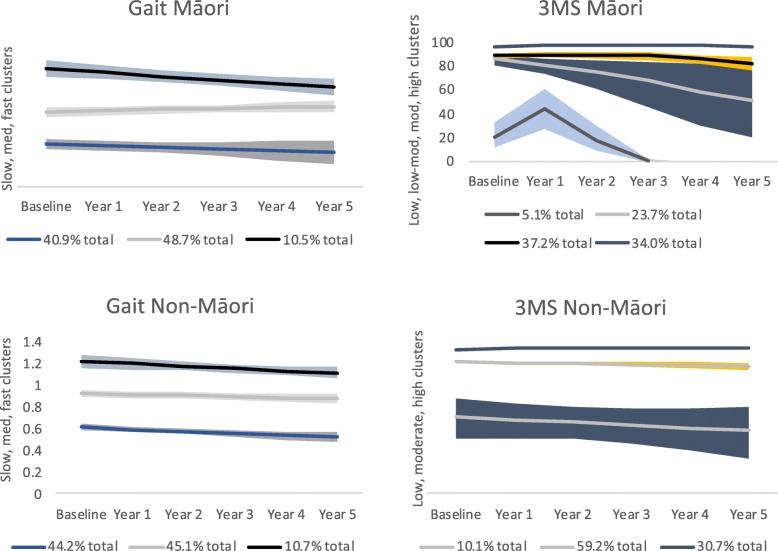
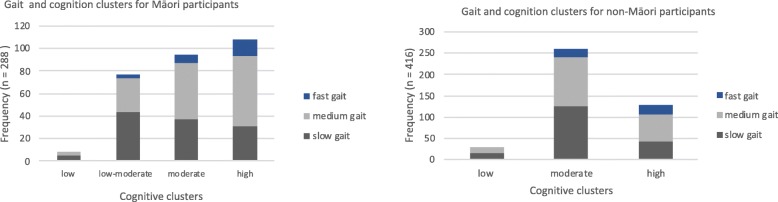
Falls frequency was ascertained retrospectively at annual assessments. 3 m gait speed was measured and cognition was assessed using the Modified Mini-Mental Status Examination (3MS). Frequency of MCR was reported. Gait and cognition trajectories were modelled and clusters identified from Latent Class Analysis. Generalised linear models examined association between changes in gait, cognition, MCR and falls.
At baseline, 138 of 408 Māori (34%) and 205 of 512 non-Māori (40%) had fallen. Mean (SD) gait speed (m/s) for Māori was 0.66 (0.29) and 0.82 (0.26) for non-Māori. Respective 3MS scores were 86.2 (15.6) and 91.6 (10.4). Ten (4.3%) Maori participants met MCR criteria, compared with 7 (1.9%) non-Māori participants. Māori men were more likely to fall (OR 1.56; 95% CI 1.0-2.43 (P = 0.04) whilst for non-Māori slow gait increased falls risk (OR 0.40; 95% CI 0.24-0.68(P < 0.001). Non-Māori with MCR were more than twice as likely to fall than those without MCR (OR 2.45; 95% CI 1.06-5.68 (P = 0.03).
Māori and non-Māori of advanced age show a mostly stable pattern of gait and cognition over time. Risk factors for falls differ for Māori, and do not include gait and cognition.
了解高龄人群的跌倒风险至关重要,因为 80 岁以上的人口是一个快速增长的群体。缓慢的步态和认知障碍是已确定的风险因素,两者共同构成运动认知风险综合征(MCR)。本研究旨在探讨 5 年内步态和认知的变化轨迹及其与跌倒的关系,并记录了生活在新西兰的高龄毛利人和非毛利人的 MCR 情况。
每年评估时回顾性地确定跌倒频率。使用改良的 Mini-Mental 状态检查(3MS)测量 3 米步行速度,评估认知功能。报告 MCR 的频率。采用潜在类别分析对步态和认知轨迹进行建模,并确定聚类。广义线性模型检验了步态、认知、MCR 变化与跌倒之间的关系。
基线时,408 名毛利人中有 138 人(34%)和 512 名非毛利人中有 205 人(40%)跌倒。毛利人的平均(SD)步行速度(m/s)为 0.66(0.29),非毛利人的速度为 0.82(0.26)。相应的 3MS 评分为 86.2(15.6)和 91.6(10.4)。10 名毛利人(4.3%)符合 MCR 标准,而 7 名非毛利人(1.9%)符合标准。毛利男性跌倒的可能性更高(OR 1.56;95%CI 1.0-2.43(P=0.04),而非毛利人则是步态缓慢增加了跌倒风险(OR 0.40;95%CI 0.24-0.68(P<0.001)。与没有 MCR 的非毛利人相比,有 MCR 的非毛利人跌倒的可能性是其两倍多(OR 2.45;95%CI 1.06-5.68(P=0.03)。
高龄毛利人和非毛利人的步态和认知在一段时间内表现出相对稳定的模式。毛利人的跌倒风险因素与步态和认知无关,而与其他因素有关。