Olewnik Łukasz, Wysiadecki Grzegorz, Polguj Michał, Podgórski Michał, Jezierski Hubert, Topol Mirosław
Department of Normal and Clinical Anatomy, Interfaculty Chair of Anatomy and Histology, Medical University of Lodz, ul. Narutowicza 60, 90-136, Łódź, Poland.
Department of Angiology, Interfaculty Chair of Anatomy and Histology, Medical University of Lodz, Lodz, Poland.
BMC Musculoskelet Disord. 2017 Dec 19;18(1):539. doi: 10.1186/s12891-017-1901-x.
The palmaris longus (PL) muscle is characterised by high morphological diversity, and its tendon crosses the median nerve (MN) at different levels. Due to the fact that the palmaris longus tendon is routinely harvested for reconstruction of other tendons, knowledge of its morphological variations is clinically important. Therefore, the purpose of the study was to suggest a new morphological classification of the PL muscle and characterise the relationship of its tendon to the median nerve.
Standard dissection was performed on 80 randomised and isolated upper limbs (40 left and 40 right) fixed in a 10% formalin solution. Measurements of muscle belly and tendon were obtained. The course and location of tendon insertion, as well as its relationship to the median nerve, were noted.
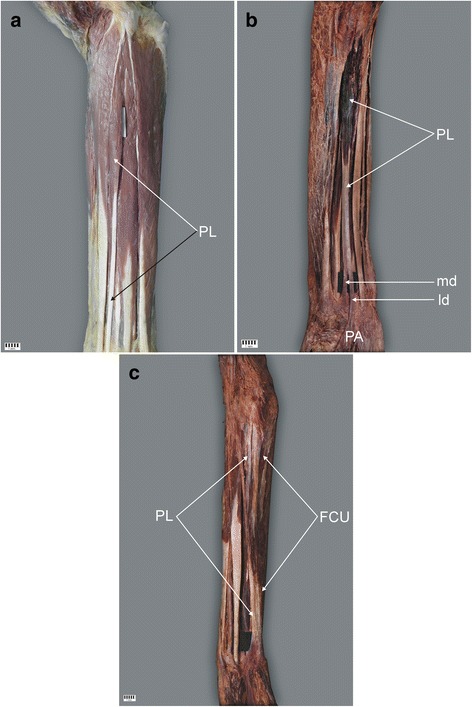
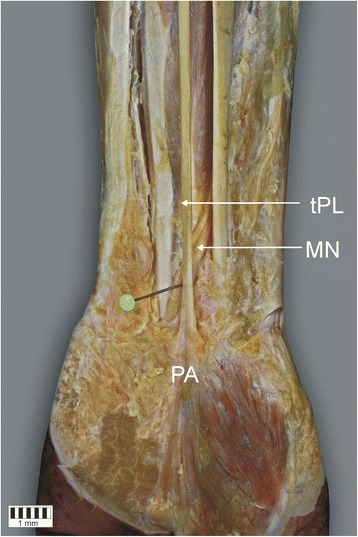
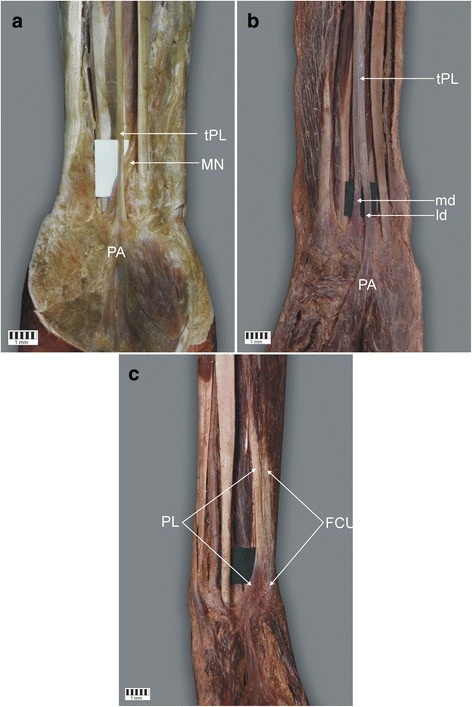
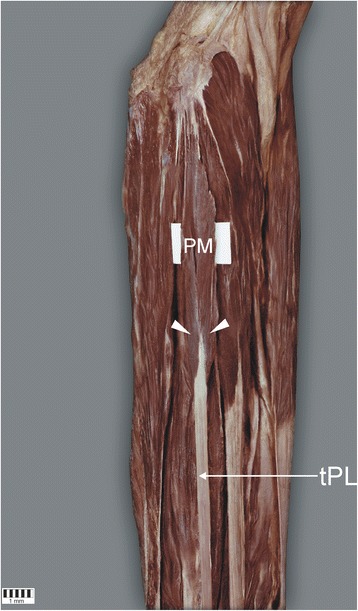
The palmaris longus muscle was present in 92.5% of specimens. Three types of palmaris longus muscle were identified based on the morphology of its insertion (types I-III) and these were further subdivided into three subgroups (A-C) according to the ratio of the length of the muscle belly and its tendon. The most frequent was type I (78.8%), where the tendon attached to the palmar aponeurosis, and subtype B, where the tendon-to-belly ratio was 1-1.5 (41.1%). The mean distance from the interstyloid line to the crossing between the median nerve and the palmaris longus tendon was 31.6 mm. In addition, two types of palmaris longus were described.
The presented classification of palmaris longus muscle types allows a better characterization of its diversity and may be useful in planning tendon grafting.
掌长肌形态多样性高,其肌腱在不同水平穿过正中神经。由于掌长肌腱常被用于其他肌腱的重建,了解其形态变异具有临床重要性。因此,本研究的目的是提出一种新的掌长肌形态分类,并描述其肌腱与正中神经的关系。
对80例随机选取并固定于10%福尔马林溶液中的上肢标本(40例左侧和40例右侧)进行标准解剖。测量肌腹和肌腱。记录肌腱插入的走行和位置及其与正中神经的关系。
92.5%的标本存在掌长肌。根据其插入形态确定了三种类型的掌长肌(I - III型),并根据肌腹和肌腱长度的比例进一步细分为三个亚组(A - C)。最常见的是I型(78.8%),其肌腱附着于掌腱膜,以及B亚型,其肌腱与肌腹的比例为1 - 1.5(41.1%)。从腕骨间线到正中神经与掌长肌腱交叉处的平均距离为31.6毫米。此外,还描述了两种类型的掌长肌。
所提出的掌长肌类型分类能够更好地描述其多样性,可能有助于肌腱移植的规划。