Kuroda Yutaka, Matsuda Shuichi, Akiyama Haruhiko
Department of Orthopaedic Surgery, Graduate School of Medicine, Kyoto University, Shogoin, Kawahara-cho 54, Sakyo-ku, Kyoto 606-8507 Japan.
Department of Orthopaedic Surgery, Gifu University, Gifu, Japan.
Inflamm Regen. 2016 Apr 25;36:4. doi: 10.1186/s41232-016-0002-9. eCollection 2016.
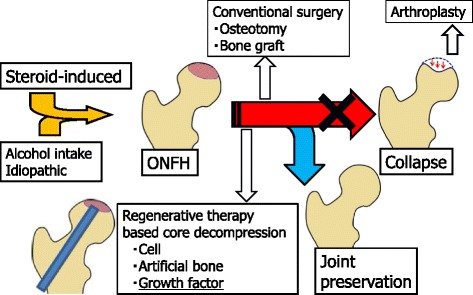
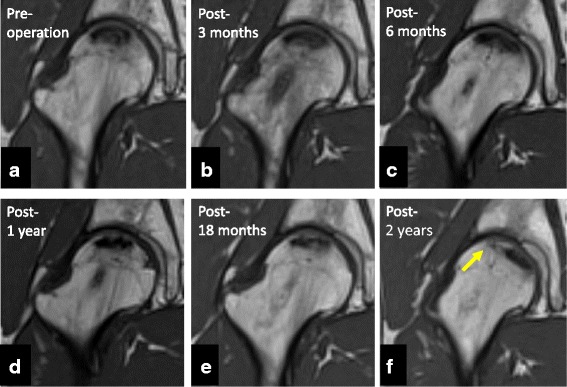
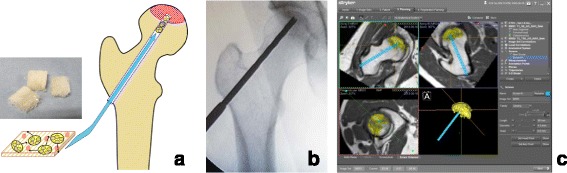
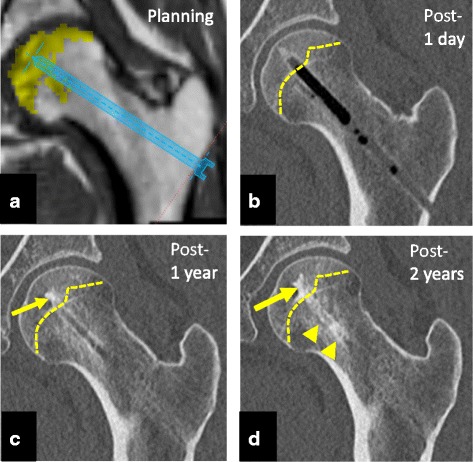
Osteonecrosis of the femoral head is an intractable disease often occurring in patients aged 30-40 years that can cause femoral head collapse, pain, and gait disturbance. Background factors, including corticosteroid use, alcohol intake, and idiopathic causes, have been indicated. It is estimated that 70-80 % of osteonecrosis patients experience femoral head collapse, for which total hip arthroplasty is considered the most effective treatment, even in young patients. Thus, there is a crucial need for developing a minimally invasive regenerative therapy as a preventive surgery for femoral head collapse: this has been an important area of research in the past decades. Core decompression, the most popular minimally invasive surgery for osteonecrosis of the femoral head, has been used for a long time; however, it has been insufficient to prevent femoral head collapse. For further improvement in therapeutic efficacy, cell transplantation and the use of artificial bone and growth factors have been proposed in addition to core decompression. Since 2000, newer therapies such as autologous bone marrow cell transplantation and the embedding of metal implant rods have been developed in Europe and the USA; however, these approaches have yet to become a global standard. This practical review summarizes applied state-of-the-art regenerative therapy-based core decompression. We introduce the clinical application of recombinant human fibroblast growth factor (rhFGF)-2-impregnated gelatin hydrogel for patients with precollapse osteonecrosis of the femoral head. Radiography and computed tomography have confirmed bone regeneration inside the femoral heads around the region of rhFGF-2 gelatin hydrogel administration. With further development, the minimally invasive method, which can be expected to promote bone regeneration in necrotic areas, could become a useful early-stage treatment for osteonecrosis of the femoral head. Patients can resume their daily routine soon after surgery, and the procedure is inexpensive. As such, it is a promising regenerative therapy that can be actively employed in osteonecrosis of the femoral head before femoral head collapse.
股骨头坏死是一种难治性疾病,常发生于30至40岁的患者,可导致股骨头塌陷、疼痛和步态障碍。已表明其背景因素包括使用皮质类固醇、饮酒和特发性病因。据估计,70%至80%的股骨头坏死患者会出现股骨头塌陷,对此全髋关节置换术被认为是最有效的治疗方法,即使是年轻患者。因此,迫切需要开发一种微创再生疗法作为预防股骨头塌陷的手术:这在过去几十年一直是一个重要的研究领域。核心减压是治疗股骨头坏死最常用的微创手术,已使用很长时间;然而,它不足以预防股骨头塌陷。为了进一步提高治疗效果,除核心减压外,还提出了细胞移植以及使用人工骨和生长因子。自2000年以来,欧洲和美国已开发出自体骨髓细胞移植和金属植入棒植入等更新的疗法;然而,这些方法尚未成为全球标准。本实用综述总结了基于再生疗法的核心减压的应用现状。我们介绍了重组人成纤维细胞生长因子(rhFGF)-2浸渍明胶水凝胶在股骨头塌陷前坏死患者中的临床应用。X线摄影和计算机断层扫描已证实,在给予rhFGF-2明胶水凝胶区域周围的股骨头内部有骨再生。随着进一步发展,有望促进坏死区域骨再生的微创方法可能成为股骨头坏死有用的早期治疗方法。患者术后很快就能恢复日常生活,而且该手术费用低廉。因此,它是一种有前景的再生疗法,可在股骨头塌陷前积极应用于股骨头坏死。