Kim Kitae, Kaji Shuichiro, Kasamoto Manabu, Murai Ryosuke, Sasaki Yasuhiro, Kitai Takeshi, Yamane Takafumi, Ehara Natsuhiko, Kobori Atsushi, Kinoshita Makoto, Furukawa Yutaka
Department of Cardiovascular Medicine, Kobe City Medical Center General Hospital, Kobe, Japan.
Open Heart. 2017 Dec 10;4(2):e000637. doi: 10.1136/openhrt-2017-000637. eCollection 2017.
Little is known about the long-term effects of renin-angiotensin system inhibitors (RASI) on cardiovascular events in patients after acute myocardial infarction (AMI) with ischaemic mitral regurgitation (IMR). The purpose of this study was to investigate the association of RASI with the incidence of adverse cardiac events in patients with or without IMR after AMI.
We reviewed charts of 1208 consecutive patients admitted with AMI who underwent emergency coronary angiography between 2000 and 2012. After excluding patients who died within 30 days, 551 patients were diagnosed to have mild or greater MR by transthoracic echocardiography (patients with IMR); the remaining 505 patients had no or trivial MR (non-IMR patients).
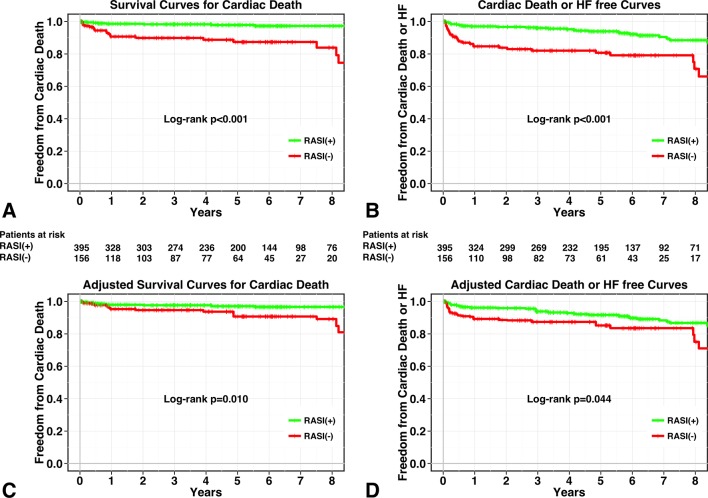
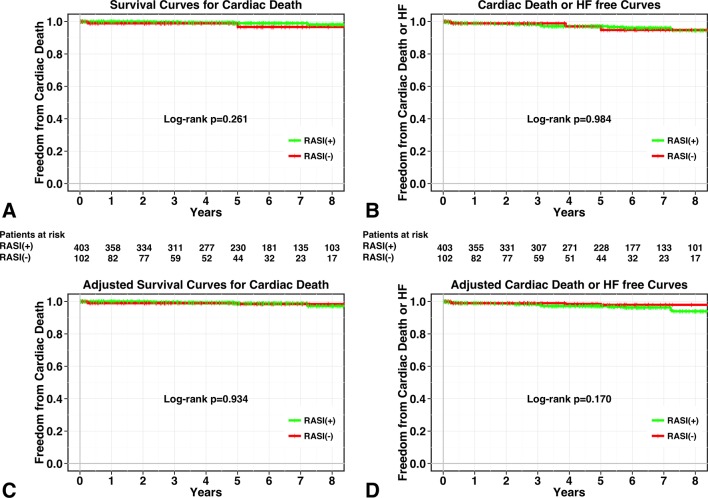
Of the study patients, 395 (72%) patients with IMR and 403 (80%) non-IMR patients received RASI. Survival analysis showed that freedom from cardiac death and the composite of cardiac death and heart failure (HF) was significantly higher in patients with IMR receiving RASI than in those not receiving RASI (P<0.001 and P<0.001, respectively). Moreover, adjusted survival analysis using the inverse probability treatment weighting method showed a significant association of RASI therapy with reduced cardiac death P=0.010) and the composite of cardiac death and HF (P=0.044) in patients with IMR. However, in non-IMR patients, there were no significant associations between RASI therapy and the outcome measures.
RASI therapy was associated with a lower incidence of adverse cardiac events in patients with IMR after AMI, but not in patients without IMR.
关于肾素-血管紧张素系统抑制剂(RASI)对急性心肌梗死(AMI)合并缺血性二尖瓣反流(IMR)患者心血管事件的长期影响,目前所知甚少。本研究的目的是调查RASI与AMI后有或无IMR患者不良心脏事件发生率之间的关联。
我们回顾了2000年至2012年间因AMI入院并接受急诊冠状动脉造影的1208例连续患者的病历。排除30天内死亡的患者后,551例患者经胸超声心动图诊断为轻度或更严重的二尖瓣反流(IMR患者);其余505例患者无或仅有微量二尖瓣反流(非IMR患者)。
在研究患者中,395例(72%)IMR患者和403例(80%)非IMR患者接受了RASI治疗。生存分析显示,接受RASI治疗的IMR患者的心脏死亡以及心脏死亡和心力衰竭(HF)复合终点的无事件生存率显著高于未接受RASI治疗的患者(分别为P<0.001和P<0.001)。此外,使用逆概率治疗加权法进行的校正生存分析显示,RASI治疗与IMR患者心脏死亡风险降低(P=0.010)以及心脏死亡和HF复合终点风险降低(P=0.044)显著相关。然而,在非IMR患者中,RASI治疗与结局指标之间无显著关联。
RASI治疗与AMI后IMR患者不良心脏事件发生率较低相关,但与无IMR患者无关。