Child Health, Royal Aberdeen Children's Hospital, Aberdeen, AB25 2ZG, UK.
Centre for Rural Health, University of Aberdeen, Inverness, UK.
Eur J Pediatr. 2018 Mar;177(3):381-388. doi: 10.1007/s00431-017-3064-z. Epub 2017 Dec 19.
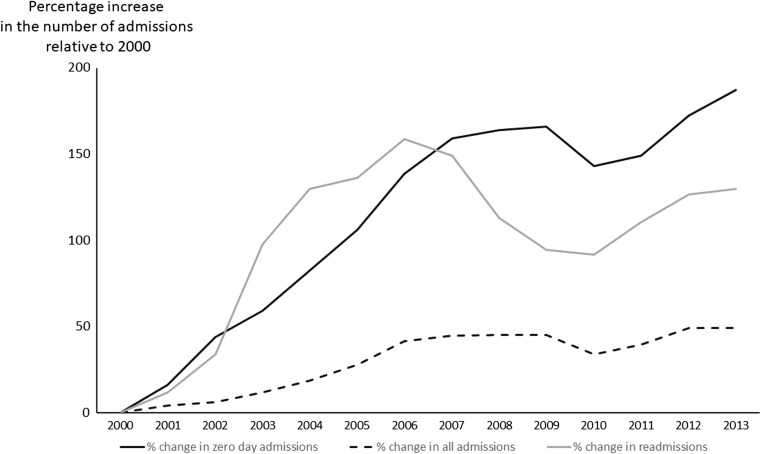
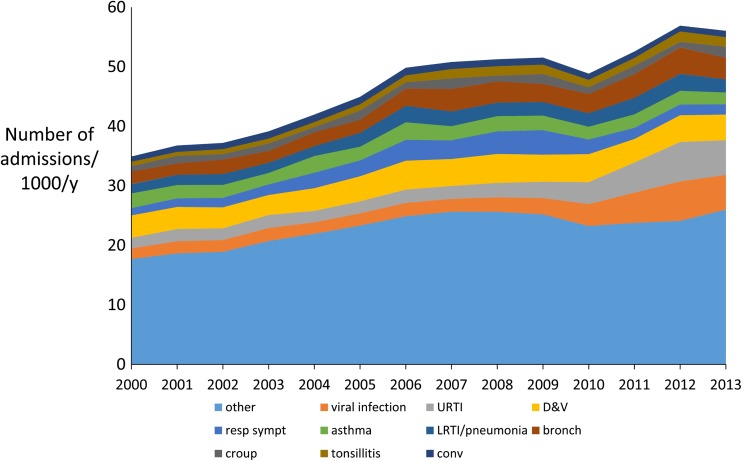
There are increasing numbers of emergency medical paediatric admissions. Our hypothesis was that characteristics of children and details of their emergency admissions are also changing over time. Details of emergency admissions in Scotland 2000-2013 were analysed. There were 574,403 emergency admissions, median age 2.3 years. The age distribution, proportion of boys and socioeconomic status of children admitted were essentially unchanged. Emergency admissions rose by 49% from 36/1000 children per annum to 54/1000 between 2000 and 2013. Emergency admissions that were discharged on the same day rose by 186% from 8.6/1000 to 24.6/1000. The mean duration of emergency admission fell from 1.7 to 1.0 days. The odds for an emergency admission with upper respiratory infection, "viral infection", tonsillitis, bronchiolitis and lower respiratory tract infection all rose. In contrast the odds for an emergency admission with asthma and gastroenteritis fell.
The demographics of children with emergency admissions have not changed substantially but characteristics of admissions have changed considerably, in particular admissions which are short stay and due to respiratory infection are much more common. The fall in the absolute number of children with some acute medical diagnoses suggests that the rise in admissions is not necessarily inexorable. What is Known: • Emergency admission prevalence is rising in many countries across Europe. What is New: • Our paper is the first to comprehensively analyse emergency medical paediatric admissions by exploring how characteristics of admissions and the children admitted have changed over time for a whole population. • The "take home message" is that whilst characteristics of emergency admissions have changed (e.g. number, duration of stay, readmissions, diagnoses), the characteristics of the children have not changed.
急诊儿科入院人数不断增加。我们的假设是,儿童的特征和他们的急诊入院细节也随着时间的推移而发生变化。对 2000-2013 年苏格兰的急诊入院情况进行了分析。共有 574403 例急诊入院,中位数年龄为 2.3 岁。儿童的年龄分布、男孩比例和社会经济地位基本不变。2000 年至 2013 年,急诊入院人数增加了 49%,从每年每 1000 名儿童 36 例增至 54 例。当天出院的急诊入院人数增加了 186%,从每 1000 名儿童 8.6 例增至 24.6 例。急诊入院的平均持续时间从 1.7 天降至 1.0 天。因上呼吸道感染、“病毒感染”、扁桃体炎、细支气管炎和下呼吸道感染而急诊入院的几率均有所上升。相反,因哮喘和肠胃炎而急诊入院的几率则有所下降。
急诊入院儿童的人口统计学特征没有发生实质性变化,但入院特征发生了很大变化,特别是短期住院和因呼吸道感染而入院的情况更为常见。一些急性医学诊断的儿童绝对数量下降表明,入院人数的增加不一定是不可避免的。已知:• 欧洲许多国家的急诊入院率都在上升。新内容:• 我们的论文首次全面分析了急诊儿科入院情况,通过探讨整个人群中入院情况和入院儿童的特征随时间的变化,来了解这一问题。• 这篇论文的“重要信息”是,尽管急诊入院的特征发生了变化(例如数量、住院时间、再入院、诊断),但入院儿童的特征没有变化。