Vila-Rodriguez Fidel, Lang Donna J, Baitz Heather, Gicas Kristina, Thorton Allen E, Ehmann Thomas S, Smith Geoff N, Barr Alasdair M, Torres Ivan J, Kopala Lili C, MacEwan G William, Müller Daniel J, Kennedy James L, Honer William G
Department of Psychiatry.
Division of Neuroradiology, Department of Radiology, The University of British Columbia, Vancouver.
Neuropsychiatr Dis Treat. 2017 Dec 8;13:2945–2953. doi: 10.2147/NDT.S150488. eCollection 2017.
Verbal memory impairment is a core feature in schizophrenia even at early stages of the disease, but its etiopathogenesis is not fully understood. The -ε4 is the main genetic risk factor for late-onset Alzheimer's disease. Our primary goal was to ascertain whether -ε4 status had a pleiotropic effect in early stages of the illness.
A total of 86 first-episode psychosis (FEP) outpatients and 39 healthy volunteers were recruited. Demographic and clinical data, genotyping, and a neuropsychological test battery including the California Verbal Learning Test - second edition (CVLT-II) were administered and assessed at study entry and at 1-year follow-up. Data were analyzed using mixed-model repeated measures, where the dependent variable was verbal memory indexed by California Verbal Learning Test (CVLT) Trials 1-5 total recall score.
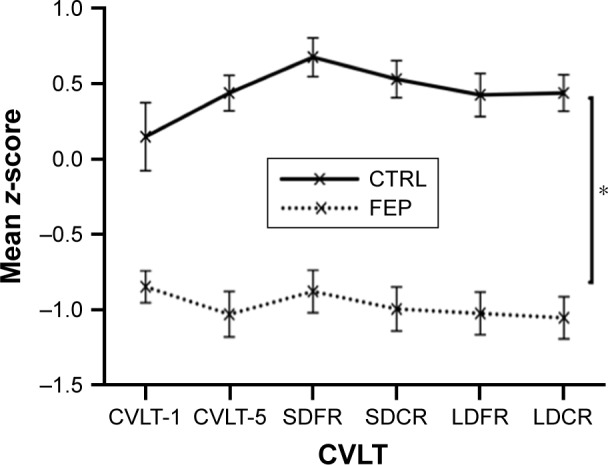
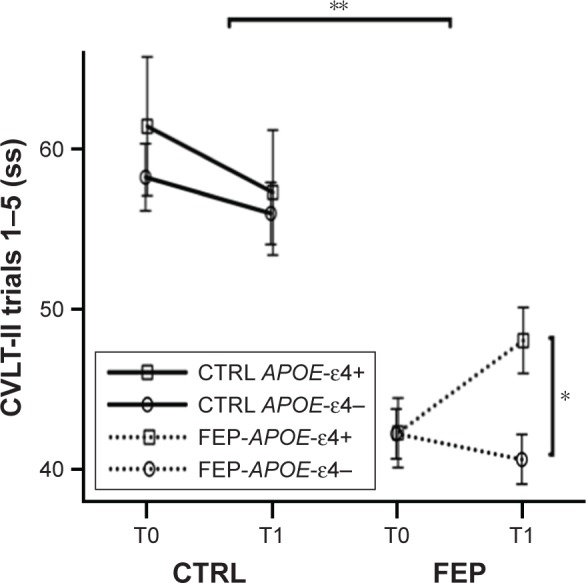
FEP--ε4 carriers and FEP--ε4 noncarriers had similar symptom severity, clinical outcomes, premorbid and current intelligence quotient, and exposure to antipsychotics. There was a main effect of group on CVLT 1-5 (FEP =43.30 vs control =58.25; [1, 119.7]=42.97; <0.001) as well as an -ε4 by group by time ([4, 116.2]=2.73, =0.033) interaction with only FEP--ε4 carriers showing improved verbal memory at follow-up.
Our study is the first to report improvement in verbal memory in persons afflicted by FEP who are -ε4 carriers and replicates the prominent verbal memory deficits present in FEP. Our work provides further evidence pointing to an antagonistic pleiotropic effect of -ε4 in neuropsychiatric disorders. Our results merit further research into antagonistic pleiotropic effects in schizophrenia.
言语记忆障碍是精神分裂症的核心特征,即使在疾病早期也是如此,但其病因发病机制尚未完全明确。-ε4是晚发性阿尔茨海默病的主要遗传风险因素。我们的主要目标是确定-ε4状态在疾病早期是否具有多效性作用。
共招募了86名首发精神病(FEP)门诊患者和39名健康志愿者。在研究开始时和1年随访时,收集了人口统计学和临床数据、基因分型,并进行了包括加利福尼亚言语学习测验第二版(CVLT-II)在内的神经心理测试组。使用混合模型重复测量分析数据,其中因变量是由加利福尼亚言语学习测验(CVLT)第1-5次试验总回忆分数索引的言语记忆。
FEP-ε4携带者和FEP-ε4非携带者在症状严重程度、临床结局、病前和当前智商以及抗精神病药物暴露方面相似。组间对CVLT 1-5有主要影响(FEP =43.30 vs对照组 =58.25;[1, 119.7]=42.97;<0.001),以及-ε4×组×时间([4, 116.2]=2.73,=0.033)交互作用,只有FEP-ε4携带者在随访时言语记忆有所改善。
我们的研究首次报告了FEP患者中-ε4携带者的言语记忆改善情况,并重现了FEP中显著的言语记忆缺陷。我们的工作提供了进一步的证据,表明-ε4在神经精神疾病中具有拮抗性多效性作用。我们的结果值得对精神分裂症中的拮抗性多效性作用进行进一步研究。