DeZure Adam D, Coates Emily E, Hu Zonghui, Yamshchikov Galina V, Zephir Kathryn L, Enama Mary E, Plummer Sarah H, Gordon Ingelise J, Kaltovich Florence, Andrews Sarah, McDermott Adrian, Crank Michelle C, Koup Richard A, Schwartz Richard M, Bailer Robert T, Sun Xiangjie, Mascola John R, Tumpey Terrence M, Graham Barney S, Ledgerwood Julie E
Vaccine Research Center (VRC), National Institute of Allergy and Infectious Diseases, National Institutes of Health, Bethesda, MD 20892 USA.
Biostatistics Research Branch, National Institute of Allergy and Infectious Diseases, National Institutes of Health, Bethesda, MD 20892 USA.
NPJ Vaccines. 2017 Jun 1;2:15. doi: 10.1038/s41541-017-0016-6. eCollection 2017.
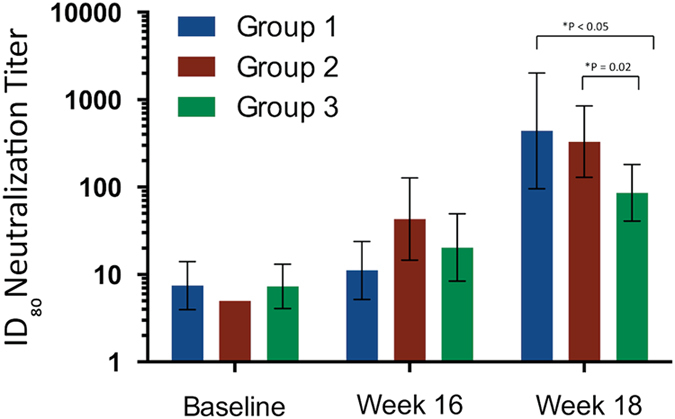
A novel avian influenza subtype, A/H7N9, emerged in 2013 and represents a public health threat with pandemic potential. We have previously shown that DNA vaccine priming increases the magnitude and quality of antibody responses to H5N1 monovalent inactivated boost. We now report the safety and immunogenicity of a H7 DNA-H7N9 monovalent inactivated vaccine prime-boost regimen. In this Phase 1, open label, randomized clinical trial, we evaluated three H7N9 vaccination regimens in healthy adults, with a prime-boost interval of 16 weeks. Group 1 received H7 DNA vaccine prime and H7N9 monovalent inactivated vaccine boost. Group 2 received H7 DNA and H7N9 monovalent inactivated vaccine as a prime and H7N9 monovalent inactivated vaccine as a boost. Group 3 received H7N9 monovalent inactivated vaccine in a homologous prime-boost regimen. Overall, 30 individuals between 20 to 60 years old enrolled and 28 completed both vaccinations. All injections were well tolerated with no serious adverse events. 2 weeks post-boost, 50% of Group 1 and 33% of Group 2 achieved a HAI titer ≥1:40 compared with 11% of Group 3. Also, at least a fourfold increase in neutralizing antibody responses was seen in 90% of Group 1, 100% of Group 2, and 78% of Group 3 subjects. Peak neutralizing antibody geometric mean titers were significantly greater for Group 1 (GMT = 440.61, < 0.05) and Group 2 (GMT = 331, = 0.02) when compared with Group 3 (GMT = 86.11). A novel H7 DNA vaccine was safe, well-tolerated, and immunogenic when boosted with H7N9 monovalent inactivated vaccine, while priming for higher HAI and neutralizing antibody titers than H7N9 monovalent inactivated vaccine alone.
一种新型禽流感亚型A/H7N9于2013年出现,具有引发大流行的潜在公共卫生威胁。我们之前已经表明,DNA疫苗初免可提高对H5N1单价灭活疫苗加强免疫的抗体反应的强度和质量。我们现在报告H7 DNA-H7N9单价灭活疫苗初免-加强免疫方案的安全性和免疫原性。在这项1期、开放标签、随机临床试验中,我们评估了健康成年人中的三种H7N9疫苗接种方案,初免-加强免疫间隔为16周。第1组接受H7 DNA疫苗初免和H7N9单价灭活疫苗加强免疫。第2组接受H7 DNA和H7N9单价灭活疫苗初免以及H7N9单价灭活疫苗加强免疫。第3组接受同源初免-加强免疫方案的H7N9单价灭活疫苗。总体而言,20至60岁的30人入组,28人完成了两次接种。所有注射耐受性良好,无严重不良事件。加强免疫后2周,第1组的50%和第2组的33%的血凝抑制(HAI)效价≥1:40,而第3组为11%。此外,第1组90%、第2组100%和第3组78%的受试者的中和抗体反应至少增加了四倍。与第3组(几何平均滴度(GMT)=86.11)相比,第1组(GMT=440.61,P<0.05)和第2组(GMT=331,P=0.02)的中和抗体峰值几何平均滴度显著更高。一种新型H7 DNA疫苗在与H7N9单价灭活疫苗联合加强免疫时是安全的、耐受性良好且具有免疫原性,同时初免可产生比单独使用H7N9单价灭活疫苗更高的HAI和中和抗体滴度。