An Vincent V G, Scholes Corey, Mhaskar Vikram A, Parker David A, Fritsch Brett A
Sydney Orthopaedic Research Institute, Chatswood, NSW, Australia.
Faculty of Medicine, University of Sydney, Sydney, NSW, Australia.
Asia Pac J Sports Med Arthrosc Rehabil Technol. 2017 Feb 27;8:24-31. doi: 10.1016/j.asmart.2017.02.001. eCollection 2017 Apr.
Previous studies have associated anthropometric data and pre-operative hamstring tendon measurements to intraoperative graft diameter for hamstring autograft ACL reconstruction, although an integrated model has yet to be described. The aim of this study was to present such a predictive model for quadrupled semitendinosus (4-ST) and doubled semitendinosus-gracilis (4-STG) graft constructs combining anthropometry (height and weight) and preoperative measurements of tendon as predictors.
ACL reconstructions using 4-STG and 4-ST were retrospectively reviewed. The outlines of the semitendinosus and gracilis tendons were identified manually in the axial slice of a preoperative T2 weighted MRI using a region-of-interest tool. Regression analysis using intraoperative graft diameter as the dependent variable was performed with tendon cross-sectional area (XSA), gender and height as predictors.
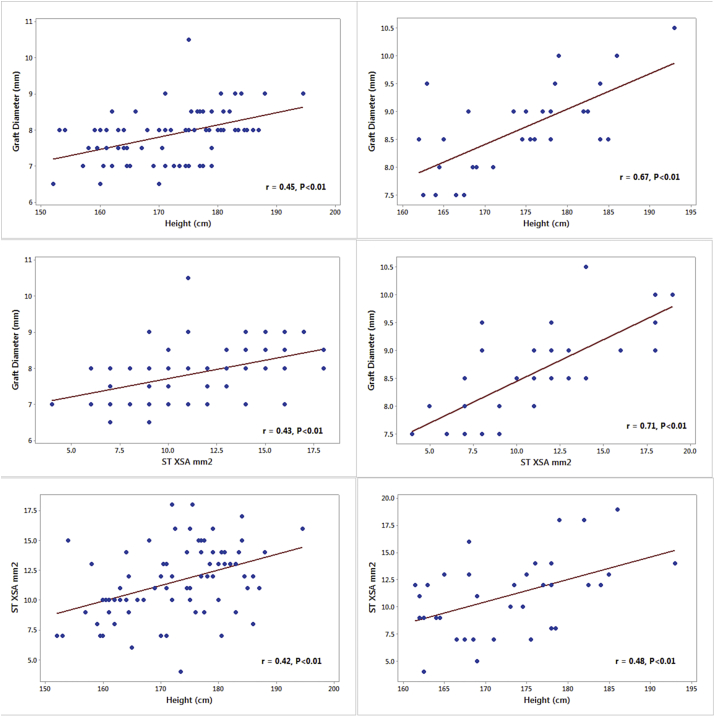
108 ACL reconstructions in 107 patients were examined, 75 of which were performed using the 4-STG construct, and 33 which employed the 4-ST construct. The mean graft diameter in the 4-ST group (8.6 ± 0.8 mm) was significantly (p < 0.001) greater than the 4-STG group (7.9 ± 0.7 mm). Female gender and 4-STG graft construct were associated with increased risk of graft diameter <8 mm. Predictive models of graft diameter were accurate to ±1 mm for both construct types.
An integrated method for assessing patient risk of producing a diminutive graft diameter and planning augmentation in select cases has been presented. The present findings describe a validated predictive model that builds on previous univariable analyses. Further investigation of larger samples, including factors associated with graft preparation, is required to improve model accuracy for routine clinical application.
IV, Retrospective Cohort Study.
先前的研究已将人体测量数据和术前绳肌肌腱测量值与自体绳肌前交叉韧带重建术中移植物直径相关联,尽管尚未描述一个综合模型。本研究的目的是提出这样一个预测模型,该模型将人体测量学(身高和体重)和术前肌腱测量值作为预测指标,用于四倍半腱肌(4-ST)和双倍半腱肌-股薄肌(4-STG)移植物构建。
对使用4-STG和4-ST进行的前交叉韧带重建进行回顾性研究。使用感兴趣区域工具在术前T2加权MRI的轴位切片中手动识别半腱肌和股薄肌肌腱的轮廓。以术中移植物直径为因变量,以肌腱横截面积(XSA)、性别和身高为预测指标进行回归分析。
检查了107例患者的108例前交叉韧带重建,其中75例使用4-STG构建,33例使用4-ST构建。4-ST组的平均移植物直径(8.6±0.8mm)显著大于4-STG组(7.9±0.7mm)(p<0.001)。女性性别和4-STG移植物构建与移植物直径<8mm的风险增加相关。两种构建类型的移植物直径预测模型的准确度均为±1mm。
提出了一种综合方法,用于评估患者产生小直径移植物的风险,并在特定情况下规划增加移植物直径。本研究结果描述了一个基于先前单变量分析的经过验证的预测模型。需要对更大样本进行进一步研究,包括与移植物制备相关的因素,以提高模型在常规临床应用中的准确性。
IV,回顾性队列研究。