Garner Kathryn L, Voliotis Margaritis, Alobaid Hussah, Perrett Rebecca M, Pham Thanh, Tsaneva-Atanasova Krasimira, McArdle Craig A
Laboratories for Integrative Neuroscience and Endocrinology, School of Clinical Sciences, University of Bristol, Bristol BS1 3NY, United Kingdom.
EPSRC Centre for Predictive Modelling in Healthcare, and.
J Endocr Soc. 2017 Feb 27;1(4):260-277. doi: 10.1210/js.2016-1096. eCollection 2017 Apr 1.
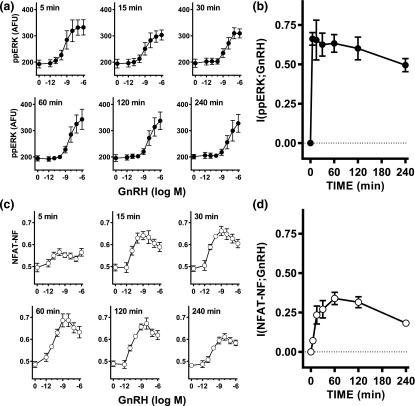
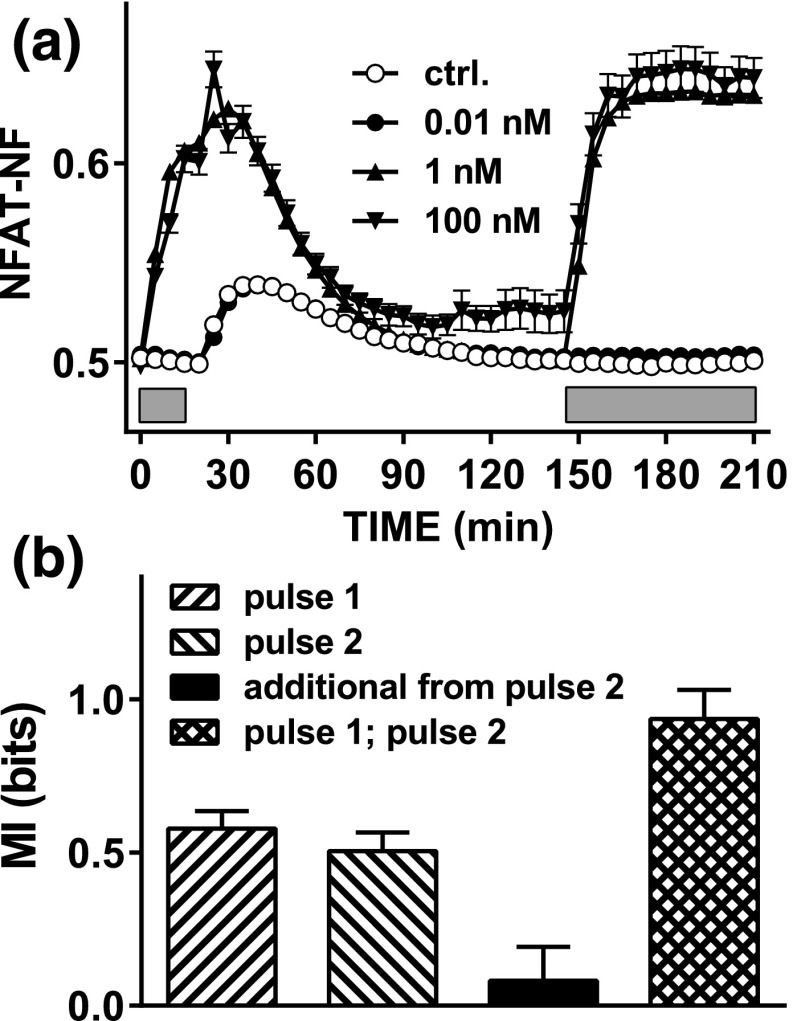
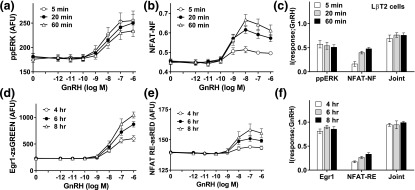
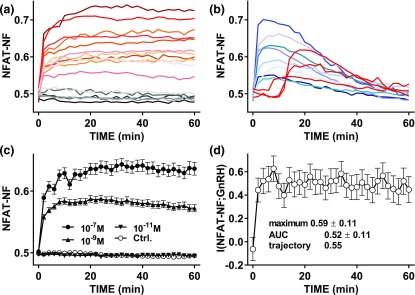
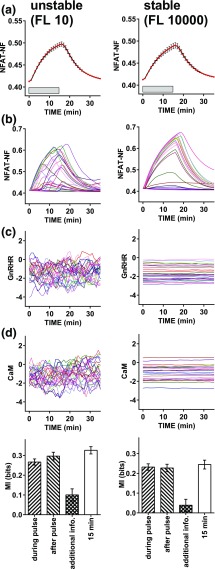
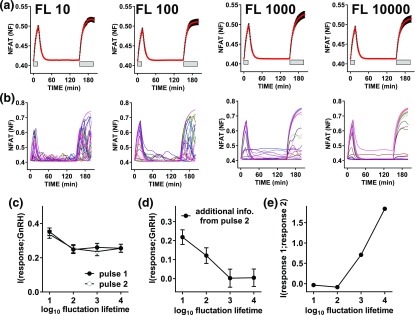
Information theoretic approaches can be used to quantify information transfer via cell signaling networks. In this study, we do so for gonadotropin-releasing hormone (GnRH) activation of extracellular signal-regulated kinase (ERK) and nuclear factor of activated T cells (NFAT) in large numbers of individual fixed LT2 and HeLa cells. Information transfer, measured by mutual information between GnRH and ERK or NFAT, was <1 bit (despite 3-bit system inputs). It was increased by sensing both ERK and NFAT, but the increase was <50%. In live cells, information transfer via GnRH receptors to NFAT was also <1 bit and was increased by consideration of response trajectory, but the increase was <10%. GnRH secretion is pulsatile, so we explored information gained by sensing a second pulse, developing a model of GnRH signaling to NFAT with variability introduced by allowing effectors to fluctuate. Simulations revealed that when cell-cell variability reflects rapidly fluctuating effector levels, additional information is gained by sensing two GnRH pulses, but where it is due to slowly fluctuating effectors, responses in one pulse are predictive of those in another, so little information is gained from sensing both. Wet laboratory experiments revealed that the latter scenario holds true for GnRH signaling; within the timescale of our experiments (1 to 2 hours), cell-cell variability in the NFAT pathway remains relatively constant, so trajectories are reproducible from pulse to pulse. Accordingly, joint sensing, sensing of response trajectories, and sensing of repeated pulses can all increase information transfer via GnRH receptors, but in each case the increase is small.
信息论方法可用于量化通过细胞信号网络的信息传递。在本研究中,我们对大量单个固定的LT2和HeLa细胞中促性腺激素释放激素(GnRH)激活细胞外信号调节激酶(ERK)和活化T细胞核因子(NFAT)的情况进行了这样的研究。通过GnRH与ERK或NFAT之间的互信息测量的信息传递小于1比特(尽管系统输入为3比特)。通过同时检测ERK和NFAT,信息传递有所增加,但增幅小于50%。在活细胞中,通过GnRH受体向NFAT的信息传递也小于1比特,并且通过考虑反应轨迹信息传递有所增加,但增幅小于10%。GnRH的分泌是脉冲式的,因此我们探索了通过检测第二个脉冲获得的信息,建立了一个向NFAT传递GnRH信号的模型,该模型通过允许效应器波动引入了变异性。模拟结果表明,当细胞间变异性反映效应器水平的快速波动时,检测两个GnRH脉冲可获得更多信息,但当变异性是由效应器的缓慢波动引起时,一个脉冲中的反应可预测另一个脉冲中的反应,因此检测两个脉冲获得的信息很少。湿实验室实验表明,GnRH信号的情况就是后者;在我们实验的时间尺度(1至2小时)内,NFAT途径中的细胞间变异性保持相对恒定,因此脉冲之间的轨迹是可重复的。因此,联合检测、反应轨迹检测和重复脉冲检测都可以增加通过GnRH受体的信息传递,但在每种情况下增幅都很小。