Romaszko Jerzy, Cymes Iwona, Dragańska Ewa, Kuchta Robert, Glińska-Lewczuk Katarzyna
Family Medicine Unit, University of Warmia and Mazury in Olsztyn, Olsztyn, Poland.
Department of Water Resources, Climatology and Environmental Management, University of Warmia and Mazury in Olsztyn, Olsztyn, Poland.
PLoS One. 2017 Dec 21;12(12):e0189938. doi: 10.1371/journal.pone.0189938. eCollection 2017.
The homeless constitute a subpopulation particularly exposed to atmospheric conditions, which, in the temperate climate zone, can result in both cold and heat stress leading to the increased mortality hazard. Environmental conditions have become a significant independent risk factor for mortality from specific causes, including circulatory or respiratory diseases. It is known that this group is particularly prone to some addictions, has a shorter life span, its members often die of different causes than those of the general population and may be especially vulnerable to the influence of weather conditions.
The retrospective analysis is based on data concerning 615 homeless people, out of which 176 died in the analyzed period (2010-2016). Data for the study was collected in the city of Olsztyn, located in north-east Poland, temperate climatic zone of transitional type. To characterize weather conditions, meteorological data including daily minimum and maximum temperatures and the Universal Thermal Climate Index (UTCI) were used.
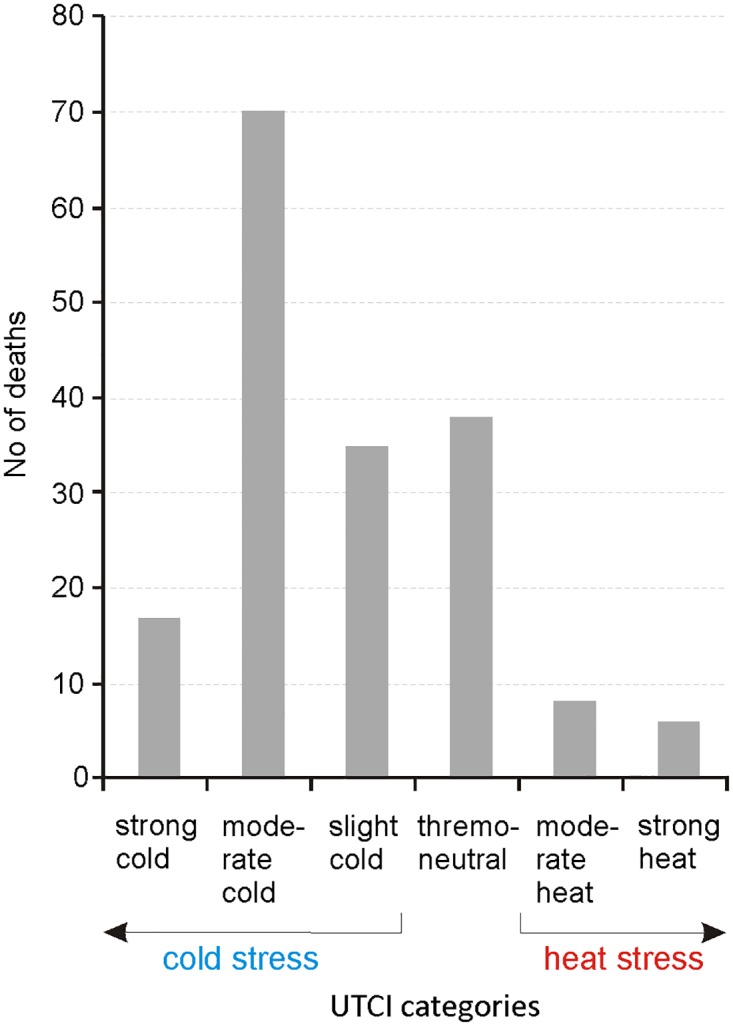
The average life span of a homeless person was shorter by about 17.5 years than that recorded for the general population. The average age at death of a homeless male was 56.27 years old (SD 10.38), and 52.00 years old (SD 9.85) of a homeless female. The most frequent causes of death were circulatory system diseases (33.80%). A large number of deaths were attributable to smoking (47.18%), whereas a small number was caused by infectious diseases, while a relatively large proportion of deaths were due to tuberculosis (2.15%). Most deaths occurred in the conditions of cold stress (of different intensity). Deaths caused by hypothermia were thirteen-fold more frequently recorded among the homeless than for the general population. A relative risk of death for a homeless person even in moderate cold stress conditions is higher (RR = 1.84) than in thermoneutral conditions.
Our results indicate excessive mortality among the homeless as well as the weak and rather typical influence of atmospheric conditions on mortality rates in this subpopulation, except for a greater risk of cold related deaths than in the general population. UTCI may serve as a useful tool to predict death risk in this group of people.
无家可归者是一个特别容易受到大气条件影响的亚群体,在温带气候区,这可能导致寒冷和热应激,从而增加死亡风险。环境条件已成为特定原因死亡的一个重要独立风险因素,包括循环系统或呼吸系统疾病。众所周知,这个群体特别容易染上一些成瘾问题,寿命较短,其成员的死因往往与普通人群不同,而且可能特别容易受到天气条件的影响。
回顾性分析基于615名无家可归者的数据,其中176人在分析期间(2010 - 2016年)死亡。研究数据收集于波兰东北部过渡型温带气候区的奥尔什丁市。为了描述天气状况,使用了包括每日最低和最高温度以及通用热气候指数(UTCI)在内的气象数据。
无家可归者的平均寿命比普通人群短约17.5岁。无家可归男性的平均死亡年龄为56.27岁(标准差10.38),无家可归女性为52.00岁(标准差9.85)。最常见的死因是循环系统疾病(33.80%)。大量死亡归因于吸烟(47.18%),少数由传染病导致,而相对较大比例的死亡是由于结核病(2.15%)。大多数死亡发生在寒冷应激(不同强度)的情况下。无家可归者中因体温过低导致的死亡记录比普通人群频繁13倍。即使在中度寒冷应激条件下,无家可归者的相对死亡风险也高于热中性条件下(RR = 1.84)。
我们的结果表明无家可归者死亡率过高,以及大气条件对该亚群体死亡率有微弱且相当典型的影响,除了与寒冷相关的死亡风险比普通人群更大。通用热气候指数可作为预测该人群死亡风险的有用工具。