Department of Emergency Medicine, Seoul Metropolitan Government - Seoul National University Boramae Medical Center, 20, Boramae-ro 5-gil, Dongjak-gu, Seoul, 07061, Republic of Korea.
Department of Emergency Medicine, Gachon University Gil Medical Center, 21, Namdong-daero 774 Beon-gil, Namdong-gu, Incheon, 21565, Republic of Korea.
Crit Care. 2017 Dec 21;21(1):322. doi: 10.1186/s13054-017-1893-9.
When an out-of-hospital cardiac arrest (OHCA) patient receives cardiopulmonary resuscitation (CPR) in the emergency department (ED), blood laboratory test results can be obtained by using point-of-care testing during CPR. In the present study, the relationship between blood laboratory test results during CPR and outcomes of OHCA patients was investigated.
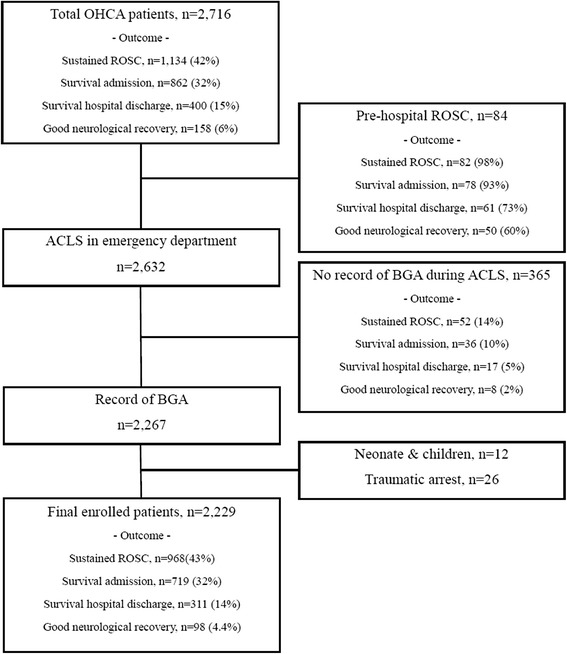
This study was a multicenter retrospective analysis of prospective registered data that included 2716 OHCA patients. Data from the EDs of three university hospitals in different areas were collected from January 2009 to December 2014. Univariate and multivariable analyses were conducted to elucidate the factors associated with survival to discharge and neurological outcomes. A final analysis was conducted by including patients who had no prehospital return of spontaneous circulation and those who underwent rapid blood laboratory examination during CPR.
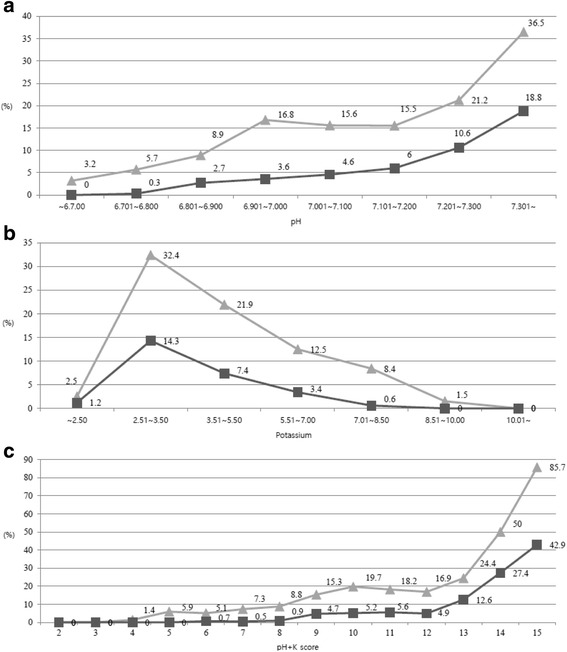
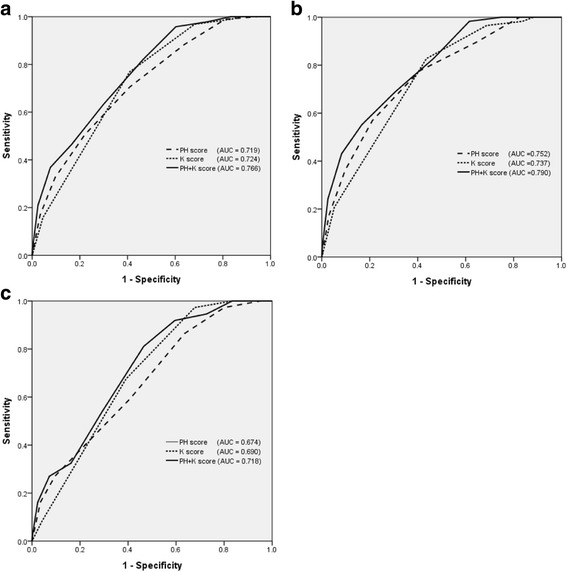
Overall, 2229 OHCA patients were included in the final analysis. Among them, the rate of survival to discharge and a good Cerebral Performance Categories Scale score were 14% and 4.4%, respectively. The pH level was independently related to survival to hospital discharge (adjusted OR 6.287, 95% CI 2.601-15.197; p < 0.001) and good neurological recovery (adjusted OR 15.395, 95% CI 3.439-68.911; p < 0.001). None of the neurologically intact patients had low pH levels (< 6.8) or excessive potassium levels (> 8.5 mEq/L) during CPR.
Among the blood laboratory test results during CPR of OHCA patients, pH and potassium levels were observed as independent factors associated with survival to hospital discharge, and pH level was considered as an independent factor related to neurological recovery.
当院外心脏骤停(OHCA)患者在急诊科(ED)接受心肺复苏(CPR)时,可以通过在 CPR 期间进行即时检验来获得血液实验室检测结果。在本研究中,研究了 CPR 期间血液实验室检测结果与 OHCA 患者结局之间的关系。
这是一项多中心回顾性分析,前瞻性注册数据纳入了 2716 例 OHCA 患者。这些数据来自三个不同地区的大学医院的 ED,收集时间为 2009 年 1 月至 2014 年 12 月。采用单变量和多变量分析阐明与出院生存率和神经结局相关的因素。最后,对无院前自主循环恢复的患者和在 CPR 期间进行快速血液实验室检查的患者进行了分析。
共有 2229 例 OHCA 患者纳入最终分析。其中,出院生存率和良好的脑功能分类量表评分分别为 14%和 4.4%。pH 值与出院生存率独立相关(调整后的 OR 6.287,95%CI 2.601-15.197;p<0.001),与良好的神经恢复也独立相关(调整后的 OR 15.395,95%CI 3.439-68.911;p<0.001)。在 CPR 期间,没有神经功能完好的患者 pH 值<6.8 或钾水平>8.5 mEq/L。
在 OHCA 患者 CPR 期间的血液实验室检测结果中,pH 值和钾水平被观察为与出院生存率相关的独立因素,而 pH 值被认为是与神经恢复相关的独立因素。