Gedin Filip, Skeppholm Martin, Burström Kristina, Sparring Vibeke, Tessma Mesfin, Zethraeus Niklas
Karolinska Institutet, Department of Learning, Informatics, Management and Ethics (LIME), Medical Management Centre, Health Economics and Economic Evaluation Research Group, Tomtebodavägen 18A, 17177, Stockholm, Sweden.
Ryggkirurgiskt Centrum Stockholm AB, Sophiahemmets sjukhus, Box 5605, 11485, Stockholm, Sweden.
Trials. 2017 Dec 22;18(1):613. doi: 10.1186/s13063-017-2351-3.
Low back pain is a global public health problem and a leading cause of disability all over the world. The lifetime prevalence of low back pain is 70-80% and a significant proportion of people affected develop chronic low back pain (CLBP). Besides a severe negative impact on people's health and health-related quality of life, CLBP is associated with substantial costs for society. Medical costs for the management of CLBP and costs for production losses due to absenteeism from work are sizeable. Pharmaceuticals, physical activity, manipulation, and multidisciplinary rehabilitation interventions are examples of widely used treatments for CLBP. However, the scientific basis to recommend the use of one treatment over another is limited and more research is needed to study the effects, costs and cost-effectiveness of treatments for CLBP in clinical practice. The aim of the study is to evaluate the effectiveness (back pain-related functional limitation, back pain intensity, general health, health-related quality of life, and working status), costs (medical costs and costs for production losses) and cost-effectiveness of chiropractic care and physiotherapy when added to information and advice in the treatment of patients with non-specific CLBP in Sweden.
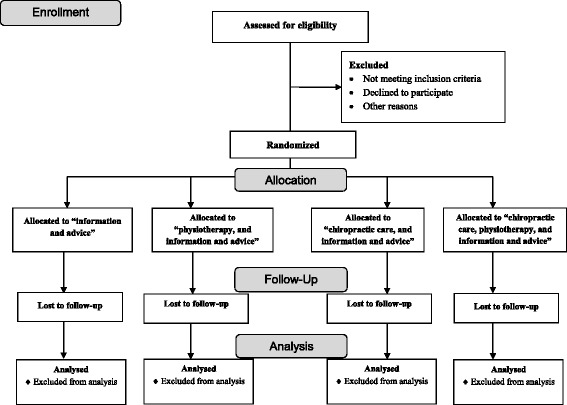
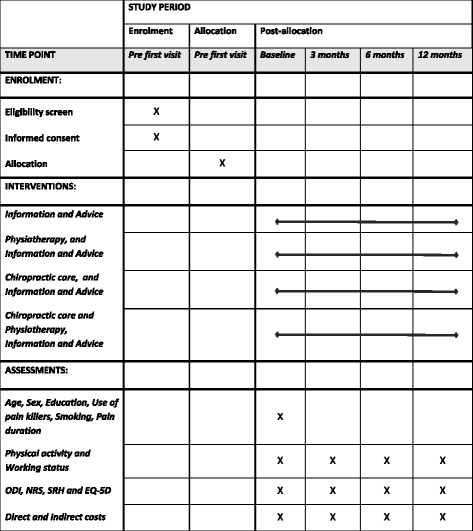
METHODS/DESIGN: This is a pragmatic randomised controlled trial, where participants are recruited through six primary care rehabilitation units (PCRUs) in Stockholm County Council, Sweden. Individuals with non-specific CLBP are individually randomised to one of four treatment groups: 'information and advice'; 'physiotherapy, and information and advice'; 'chiropractic care, and information and advice'; or 'chiropractic care, physiotherapy, and information and advice'. A sample size of 600 participants will be recruited during a period of 33 months. A computer-based questionnaire is used to collect data on back pain-related functional limitation (Oswestry Disability Index), pain intensity (Numeric Rating Scale), general health (self-rated health), health-related quality of life (EQ-5D-3L), and working status (measured as percentage of full-time work). Data will be collected at baseline, and at 3, 6, and 12 months after baseline.
The results from our study should be considered when producing evidence-based guidelines and recommendations on which treatment strategies to use for CLBP.
ISRCTN registry, ID: ISRCTN15830360 . Registered prospectively on 2 February 2017.
腰痛是一个全球性的公共卫生问题,也是全球致残的主要原因。腰痛的终生患病率为70%-80%,很大一部分受影响的人会发展为慢性腰痛(CLBP)。除了对人们的健康和与健康相关的生活质量产生严重负面影响外,CLBP还会给社会带来巨大成本。CLBP的管理医疗成本以及因旷工导致的生产损失成本都相当可观。药物治疗、体育活动、手法治疗和多学科康复干预是CLBP广泛使用的治疗方法的例子。然而,推荐使用一种治疗方法而非另一种治疗方法的科学依据有限,需要更多研究来探讨CLBP治疗方法在临床实践中的效果、成本和成本效益。本研究的目的是评估在瑞典非特异性CLBP患者治疗中,整脊疗法和物理治疗在加入信息和建议后的有效性(与背痛相关的功能受限、背痛强度、总体健康状况、与健康相关的生活质量和工作状态)、成本(医疗成本和生产损失成本)以及成本效益。
方法/设计:这是一项实用的随机对照试验,参与者通过瑞典斯德哥尔摩郡议会的六个初级保健康复单位(PCRUs)招募。非特异性CLBP患者被单独随机分配到四个治疗组之一:“信息和建议”组;“物理治疗及信息和建议”组;“整脊疗法及信息和建议”组;或“整脊疗法、物理治疗及信息和建议”组。将在33个月的时间内招募600名参与者。使用基于计算机的问卷收集与背痛相关的功能受限(奥斯威斯残疾指数)、疼痛强度(数字评分量表)、总体健康状况(自我评估健康)、与健康相关的生活质量(EQ-5D-3L)和工作状态(以全职工作百分比衡量)的数据。数据将在基线时以及基线后3、6和12个月收集。
在制定关于CLBP应采用何种治疗策略的循证指南和建议时,应考虑我们研究的结果。
ISRCTN注册库,ID:ISRCTN15830360。于2017年2月2日前瞻性注册。