Centre d'Épidémiologie Clinique, Hôpital Hôtel Dieu, Assistance Publique-Hôpitaux de Paris, Paris, France.
Department of Gastroenterology and Nutrition, Saint-Antoine Hospital, Assistance Publique-Hôpitaux de Paris, Paris, France.
BMJ Open. 2017 Dec 21;7(12):e018587. doi: 10.1136/bmjopen-2017-018587.
To characterise postmarketing studies for drugs that were newly approved by the US Food and Drug Administration and the European Medicines Agency.
Cross-sectional analysis of postmarketing studies registered in ClinicalTrials.gov until September 2014 for all novel drugs approved by both regulators between 2005 and 2010. Regulatory documents from both agencies were used.
All identified postmarketing studies were classified according to planned enrolment, funding, status and geographical location, and we determined whether studies studied the originally approved indication.
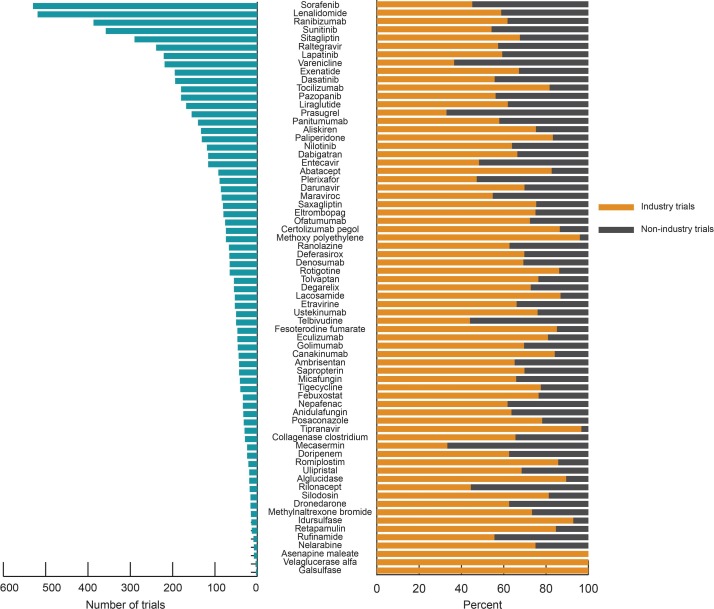
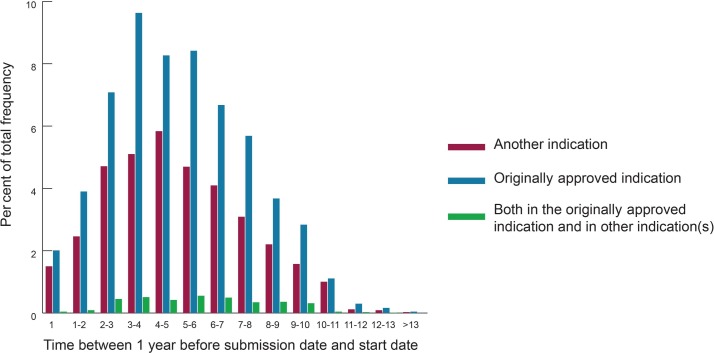
Overall, 69 novel drugs approved between 2005 and 2010 were eligible for inclusion. A total of 6679 relevant postmarketing studies were identified; 5972 were interventional (89.4%). The median number of studies per drug was 55 (IQR 33-119) and median number of patients to be enrolled per study was 60 (IQR 28-183). Industry was the primary sponsor of 2713 studies (40.6%) and was a primary or secondary sponsor in 4176 studies (62.5%). In all, 2901 studies (43.4%) were completed, 487 (7.3%) terminated, 1013 (15.2%) active yet not recruiting, 1895 (28.4%) recruiting and 319 (4.8%) not yet recruiting. A total of 80% of studies were conducted in only one country and 84.4% took place in Europe and/or North America; 2441 (36.5%) studied another indication than the originally approved indication. Studies designed in the originally approved indication were found to be more industry-sponsored than others 68.7%vs53.7%; P<0.0001.
Postmarketing pharmaceutical research was highly variable and predominantly located in North America and Europe. Postmarketing studies were frequently designed to study indications other than the originally approved one. Although some findings were reassuring, others question the lack of coordination of postmarketing research.
描述美国食品和药物管理局(FDA)和欧洲药品管理局(EMA)新批准的药物的上市后研究。
对截至 2014 年 9 月在 ClinicalTrials.gov 注册的所有在 2005 年至 2010 年间由这两个监管机构批准的新型药物的上市后研究进行横断面分析。使用了来自这两个机构的监管文件。
根据计划的入组人数、资金、状态和地理位置对所有确定的上市后研究进行分类,并确定研究是否研究了最初批准的适应证。
总体而言,2005 年至 2010 年间批准的 69 种新型药物符合纳入标准。共确定了 6679 项相关的上市后研究;5972 项为干预性研究(89.4%)。每种药物的平均研究数量为 55 项(IQR 33-119),每项研究的平均入组患者数量为 60 人(IQR 28-183)。工业界是 2713 项研究(40.6%)的主要赞助商,也是 4176 项研究(62.5%)的主要或次要赞助商。共有 2901 项研究(43.4%)完成,487 项(7.3%)终止,1013 项(15.2%)正在进行但未招募,1895 项(28.4%)正在招募,319 项(4.8%)尚未招募。总共 80%的研究仅在一个国家进行,84.4%的研究在欧洲和/或北美进行;2441 项(36.5%)研究的适应证与最初批准的适应证不同。研究发现,在最初批准的适应证中设计的研究比其他研究更受工业界的赞助,分别为 68.7%和 53.7%;P<0.0001。
上市后药物研究具有高度的可变性,主要集中在北美和欧洲。上市后研究经常被设计用于研究最初批准适应证以外的适应证。尽管有些发现令人放心,但其他发现却对缺乏上市后研究的协调提出了质疑。