Departments of Health Behavior (Drs Amato, Bansal-Travers, and Hyland) and Medicine (Drs Reid and Mahoney), Roswell Park Cancer Institute, Buffalo, New York; Department of Epidemiology and Environmental Health (Drs Amato and Ochs-Balcom), Primary Care Research Institute, Department of Family Medicine (Dr Amato), and Department of Community Health and Health Behavior (Dr Giovino), University at Buffalo, Buffalo, New York; and Department of Radiation Oncology, Medical University of South Carolina, Charleston, South Carolina (Dr Warren).
J Public Health Manag Pract. 2018 Sep/Oct;24(5):E12-E19. doi: 10.1097/PHH.0000000000000674.
Cancer patients' continued tobacco use results in poorer therapeutic outcomes including decreased quality of life and survival.
To assess reach and impact of a free, opt-out, telephone-based tobacco cessation program for thoracic cancer center patients.
Observational study.
Comprehensive Cancer Center in Western New York.
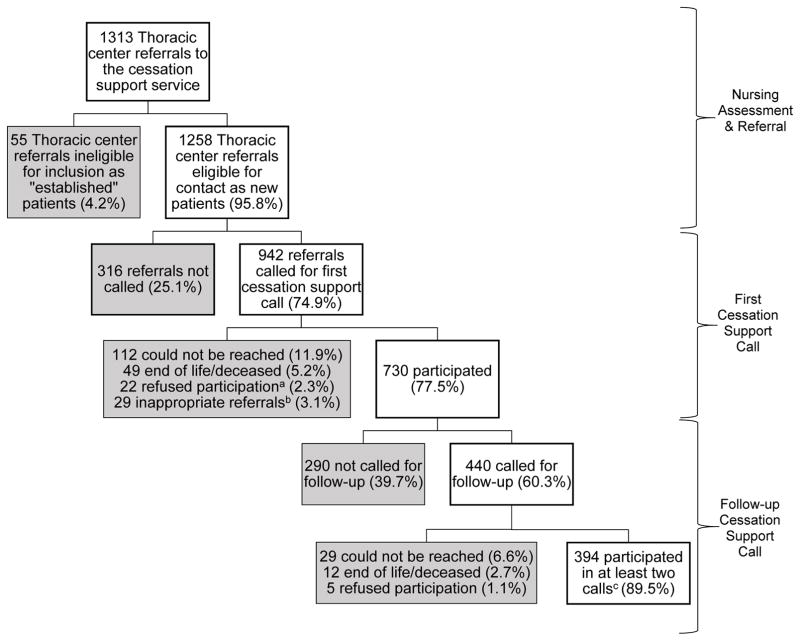
Current or recent (within past 30 days) tobacco-using thoracic cancer center patients referred to a tobacco cessation support service between October 2010 and October 2012 at a Comprehensive Cancer Center (n = 942/1313 referrals were eligible for cessation support).
A free, opt-out, telephone-based cessation service that was implemented as standard of care. Cessation specialists had patient-guided conversations that assessed readiness to quit; methods used in the past provided cessation strategies and worked to set up a quit date. There was an average of 35.9 days between referral and first contact.
Program reach (referral and participation rates) and impact (as self-reported cessation outcomes measured twice after referral).
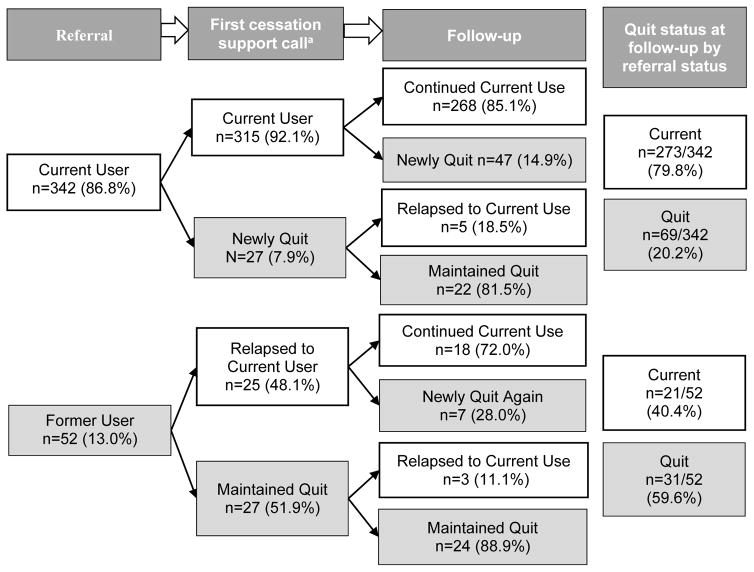
Of 942 patients, 730 (77.5%) referred to and called by a tobacco cessation service participated in at least 1 cessation support call, of which 440 of 730 (60.3%) were called for follow-up and 89.5% (394/440) participated. In total, 20.2% (69/342) of current smokers at referral reported at least 7-day abstinence at follow-up. Among current smokers at referral and first contact, being married (odds ratio [OR] = 2.05; 95% confidence interval [CI], 1.01-4.18) and having a lower Eastern Cooperative Oncology Group (ECOG) performance score (OR = 4.05; 95% CI, 1.58-10.39) were associated with quitting at follow-up, after controlling for demographic, clinical, and health behavior characteristics.
Our results demonstrate that 78% of thoracic cancer center patients, if contacted, participated at least once in this cessation support service; for current smokers at referral and first contact, being married and having a lower ECOG performance score were associated with self-reported quitting at follow-up. Other organizations may find our results useful while implementing a systematic way to identify tobacco-using patients as part of routine care and to improve available cessation support services.
癌症患者持续吸烟会导致治疗效果较差,包括生活质量下降和存活率降低。
评估为胸科癌症中心患者提供的免费、选择退出、电话式戒烟计划的覆盖范围和影响。
观察性研究。
纽约西部综合癌症中心。
2010 年 10 月至 2012 年 10 月期间,在综合癌症中心被转介至戒烟支持服务的当前或近期(过去 30 天内)使用烟草的胸科癌症中心患者(942/1313 例转介患者有资格获得戒烟支持)。
一项免费、选择退出、电话式的戒烟服务,作为标准护理实施。戒烟专家与患者进行引导性对话,评估戒烟意愿;使用过去提供的方法制定戒烟策略,并设定戒烟日期。从转介到第一次联系的平均时间为 35.9 天。
计划覆盖范围(转介和参与率)和影响(通过自我报告的转介后两次戒烟结果衡量)。
在 942 名患者中,730 名(77.5%)被转介并致电戒烟服务的患者至少参加了 1 次戒烟支持电话,其中 440 名/730 名(60.3%)被电话随访,95.5%(394/440)参与。总的来说,在转诊时为当前吸烟者的患者中,有 20.2%(69/342)在随访时报告至少有 7 天的戒烟。在转诊和第一次联系时为当前吸烟者的患者中,已婚(比值比[OR] = 2.05;95%置信区间[CI],1.01-4.18)和东部肿瘤协作组(ECOG)表现评分较低(OR = 4.05;95%CI,1.58-10.39)与随访时的戒烟相关,控制了人口统计学、临床和健康行为特征。
我们的研究结果表明,如果联系到,78%的胸科癌症中心患者至少参加了一次这种戒烟支持服务;对于转诊和第一次联系时的当前吸烟者,已婚和 ECOG 表现评分较低与随访时的自我报告戒烟有关。其他组织可能会发现我们的研究结果在实施一种系统的方法来识别作为常规护理一部分的使用烟草的患者,并改善现有的戒烟支持服务方面是有用的。