Internal Medicine and Metabolic Diseases, Fondazione IRCCS Ca' Granda Ospedale Policlinico Milano, Milan, Italy.
Department of Molecular Genetics, University of Texas Southwestern Medical Center, Dallas, TX, USA.
J Intern Med. 2018 Apr;283(4):356-370. doi: 10.1111/joim.12719. Epub 2017 Dec 27.
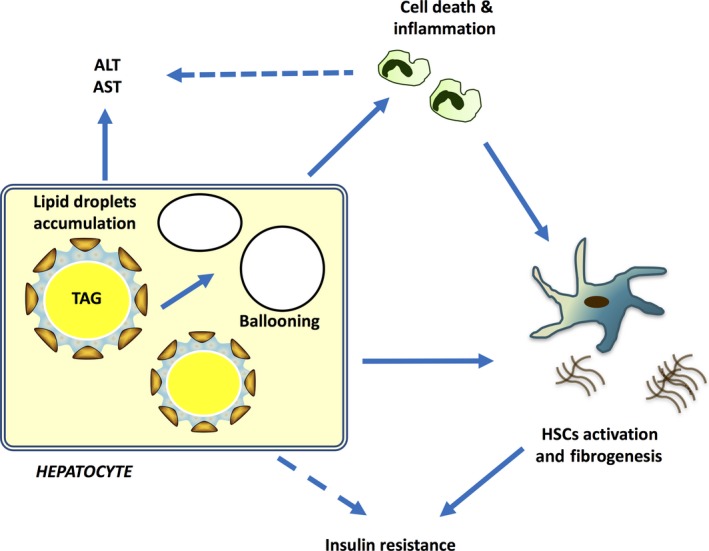
Nonalcoholic fatty liver disease is epidemiologically associated with hepatic and metabolic disorders. The aim of this study was to examine whether hepatic fat accumulation has a causal role in determining liver damage and insulin resistance.
We performed a Mendelian randomization analysis using risk alleles in PNPLA3, TM6SF2, GCKR and MBOAT7, and a polygenic risk score for hepatic fat, as instruments. We evaluated complementary cohorts of at-risk individuals and individuals from the general population: 1515 from the liver biopsy cohort (LBC), 3329 from the Swedish Obese Subjects Study (SOS) and 4570 from the population-based Dallas Heart Study (DHS).
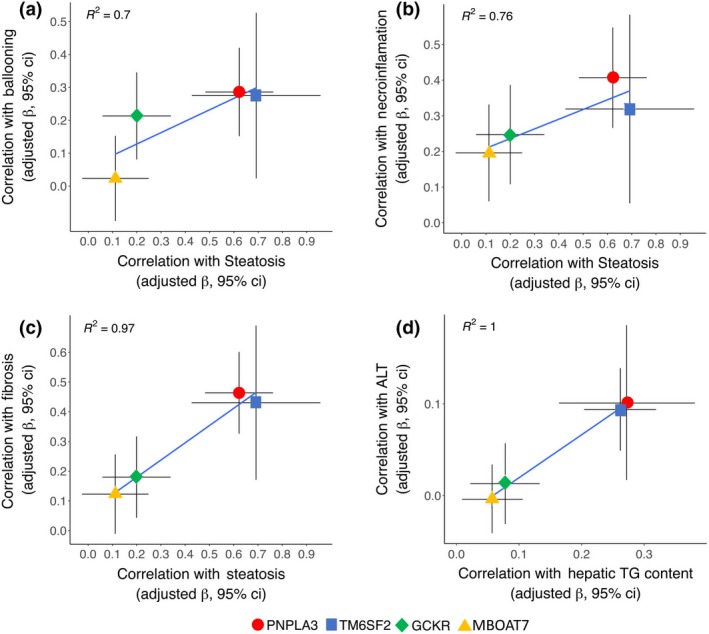
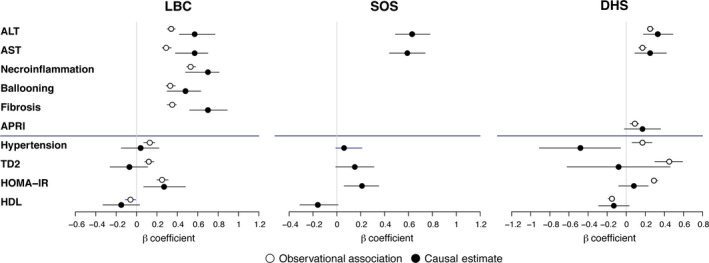
Hepatic fat was epidemiologically associated with liver damage, insulin resistance, dyslipidemia and hypertension. The impact of genetic variants on liver damage was proportional to their effect on hepatic fat accumulation. Genetically determined hepatic fat was associated with aminotransferases, and with inflammation, ballooning and fibrosis in the LBC. Furthermore, in the LBC, the causal association between hepatic fat and fibrosis was independent of disease activity, suggesting that a causal effect of long-term liver fat accumulation on liver disease is independent of inflammation. Genetically determined hepatic steatosis was associated with insulin resistance in the LBC and SOS. However, this association was dependent on liver damage severity. Genetically determined hepatic steatosis was associated with liver fibrosis/cirrhosis and with a small increase in risk of type 2 diabetes in publicly available databases.
These data suggest that long-term hepatic fat accumulation plays a causal role in the development of chronic liver disease.
非酒精性脂肪性肝病在流行病学上与肝和代谢紊乱有关。本研究旨在探讨肝脂肪堆积是否在决定肝损伤和胰岛素抵抗方面起因果作用。
我们使用 PNPLA3、TM6SF2、GCKR 和 MBOAT7 的风险等位基因和肝脂肪的多基因风险评分作为工具,进行了孟德尔随机化分析。我们评估了高危人群和一般人群中的互补队列:来自肝活检队列(LBC)的 1515 人、来自瑞典肥胖受试者研究(SOS)的 3329 人和来自基于人群的达拉斯心脏研究(DHS)的 4570 人。
肝脂肪与肝损伤、胰岛素抵抗、血脂异常和高血压在流行病学上有关。遗传变异对肝损伤的影响与其对肝脂肪堆积的影响成正比。遗传决定的肝脂肪与 LBC 中的转氨酶有关,并与炎症、气球样变和纤维化有关。此外,在 LBC 中,肝脂肪与纤维化之间的因果关系独立于疾病活动,表明长期肝脂肪堆积对肝病的因果效应独立于炎症。遗传决定的肝脂肪堆积与 LBC 和 SOS 中的胰岛素抵抗有关。然而,这种关联依赖于肝损伤的严重程度。遗传决定的肝脂肪堆积与肝纤维化/肝硬化有关,并在公开可用的数据库中与 2 型糖尿病风险的小幅增加有关。
这些数据表明,长期肝脂肪堆积在慢性肝病的发展中起因果作用。