Gabert Rose, Ng Marie, Sogarwal Ruchi, Bryant Miranda, Deepu R V, McNellan Claire R, Mehra Sunil, Phillips Bryan, Reitsma Marissa, Thomson Blake, Wilson Shelley, Wollum Alexandra, Gakidou Emmanuela, Duber Herbert C
Institute for Health Metrics and Evaluation, University of Washington, 2301 5th Ave, Suite 600, Seattle, WA, 98121, USA.
MAMTA Health Institute for Mother and Child, New Delhi, India.
BMC Health Serv Res. 2017 Dec 27;17(1):846. doi: 10.1186/s12913-017-2796-9.
Non-communicable diseases (NCDs) represent the largest, and fastest growing, burden of disease in India. This study aimed to quantify levels of diagnosis, treatment, and control among hypertensive and diabetic patients, and to describe demand- and supply-side barriers to hypertension and diabetes diagnosis and care in two Indian districts, Shimla and Udaipur.
We conducted household and health facility surveys, as well as qualitative focus group discussions and interviews. The household survey randomly sampled individuals aged 15 and above in rural and urban areas in both districts. The survey included questions on NCD knowledge, history, and risk factors. Blood pressure, weight, height, and blood glucose measurements were obtained. The health facility survey was administered in 48 health care facilities, focusing on NCD diagnosis and treatment capacity, including staffing, equipment, and pharmaceuticals. Qualitative data was collected through semi-structured key informant interviews with health professionals and public health officials, as well as focus groups with patients and community members.
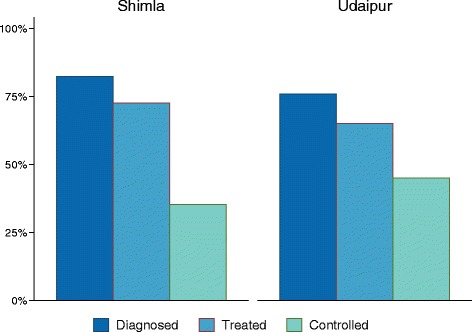
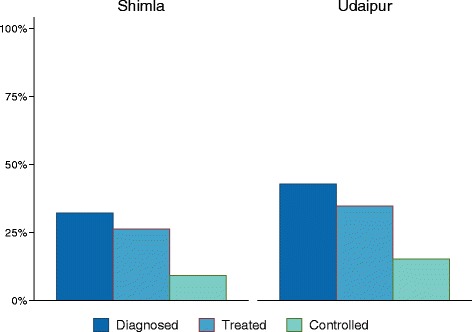
Among 7181 individuals, 32% either reported a history of hypertension or were found to have a systolic blood pressure ≥ 140 mmHg and/or diastolic ≥90 mmHg. Only 26% of those found to have elevated blood pressure reported a prior diagnosis, and just 42% of individuals with a prior diagnosis of hypertension were found to be normotensive. A history of diabetes or an elevated blood sugar (Random blood glucose (RBG) ≥200 mg/dl or fasting blood glucose (FBG) ≥126 mg/dl) was noted in 7% of the population. Among those with an elevated RBG/FBG, 59% had previously received a diagnosis of diabetes. Only 60% of diabetics on treatment were measured with a RBG <200 mg/dl. Lower-level health facilities were noted to have limited capacity to measure blood glucose as well as significant gaps in the availability of first-line pharmaceuticals for both hypertension and diabetes.
We found high rates of uncontrolled diabetes and undiagnosed and uncontrolled hypertension. Lower level health facilities were constrained by capacity to test, monitor and treat diabetes and hypertension. Interventions aimed at improving patient outcomes will need to focus on the expanding access to quality care in order to accommodate the growing demand for NCD services.
非传染性疾病(NCDs)是印度最大且增长最快的疾病负担。本研究旨在量化高血压和糖尿病患者的诊断、治疗及控制水平,并描述印度喜马偕尔邦和乌代布尔两个地区在高血压和糖尿病诊断与护理方面的需求侧和供给侧障碍。
我们开展了家庭和医疗机构调查,以及定性焦点小组讨论和访谈。家庭调查在两个地区的农村和城市地区随机抽取15岁及以上个体。调查包括关于非传染性疾病知识、病史和风险因素的问题。测量了血压、体重、身高和血糖。医疗机构调查在48家医疗机构进行,重点关注非传染性疾病的诊断和治疗能力,包括人员配备、设备和药品。通过与卫生专业人员和公共卫生官员进行半结构化关键信息访谈,以及与患者和社区成员进行焦点小组讨论收集定性数据。
在7181名个体中,32%的人报告有高血压病史或收缩压≥140 mmHg和/或舒张压≥90 mmHg。在血压升高的人群中,只有26%的人报告曾被诊断过,而在先前被诊断为高血压的个体中,只有42%的人血压正常。7%的人群有糖尿病病史或血糖升高(随机血糖(RBG)≥200 mg/dl或空腹血糖(FBG)≥126 mg/dl)。在RBG/FBG升高的人群中,59%的人此前被诊断为糖尿病。在接受治疗的糖尿病患者中,只有60%的人的RBG测量值<200 mg/dl。较低级别的医疗机构被指出测量血糖的能力有限,并且在高血压和糖尿病一线药品的可获得性方面存在重大差距。
我们发现糖尿病控制不佳以及高血压未被诊断和控制的比例很高。较低级别的医疗机构在糖尿病和高血压的检测、监测和治疗能力方面受到限制。旨在改善患者治疗效果的干预措施需要专注于扩大获得优质护理的机会,以满足对非传染性疾病服务不断增长的需求。