Alsaleem Badr M Rasheed, Ahmed Amna Basheer M, Fageeh Musa Ahmad
Department of Pediatric Gastroenterology and Department of Pathology, Children's Hospital, King Fahad Medical City, Riyadh, Saudi Arabia.
Case Rep Gastroenterol. 2017 Nov 2;11(3):647-651. doi: 10.1159/000479624. eCollection 2017 Sep-Dec.
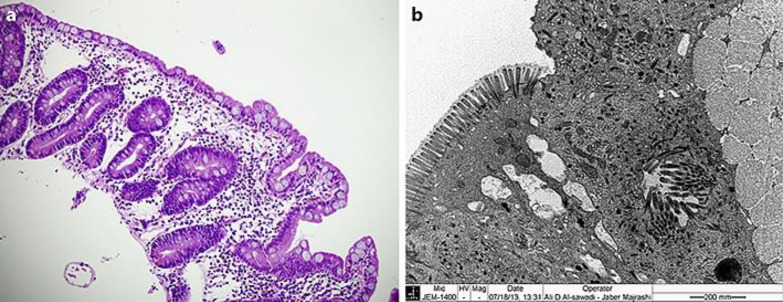
Microvillus inclusion disease (MVID) is a rare autosomal recessive congenital enteropathy characterized by intractable secretory diarrhea. We report a case of MVID variant with a homozygous gene mutation in syntaxin 3 . The patient is a male Saudi infant who presented shortly after birth with severe vomiting, metabolic acidosis, and mild diarrhea. Electron microscopy study for small intestinal biopsy was consistent with MVID. MYO5B gene mutation was excluded; subsequently, whole exome sequencing (WES) was performed, which revealed homozygous gene mutation in . Using WES in clinical environment can be a useful tool for diagnosing difficult and rare inherited congenital enteropathies.
微绒毛包涵体病(MVID)是一种罕见的常染色体隐性先天性肠病,其特征为顽固性分泌性腹泻。我们报告一例 syntaxin 3 基因纯合突变的 MVID 变异型病例。该患者为沙特男婴,出生后不久即出现严重呕吐、代谢性酸中毒和轻度腹泻。小肠活检的电子显微镜检查结果与 MVID 相符。排除了 MYO5B 基因突变;随后进行了全外显子组测序(WES),结果显示[此处原文缺失基因名称]存在纯合基因突变。在临床环境中使用 WES 可能是诊断疑难和罕见遗传性先天性肠病的有用工具。