Department of Hydraulic and Environmental Engineering, Pontificia Universidad Católica de Chile, Santiago 7820436, Chile.
Centro de Desarrollo Urbano Sustentable (CEDEUS), Santiago 7520246, Chile.
Sensors (Basel). 2017 Dec 28;18(1):71. doi: 10.3390/s18010071.
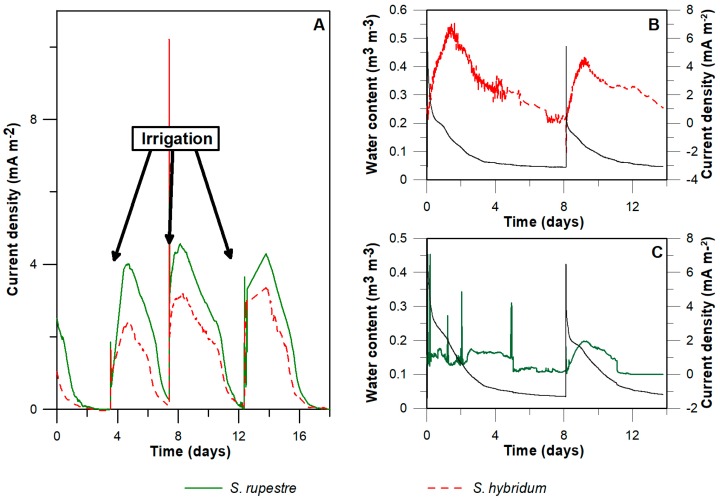
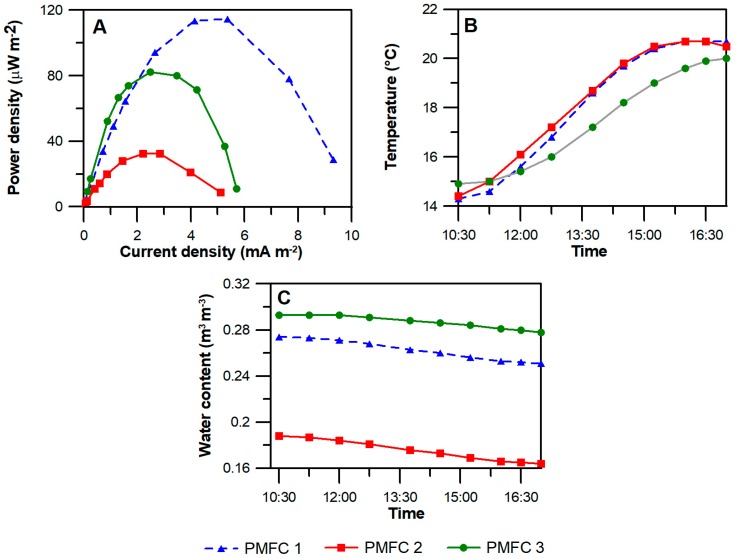
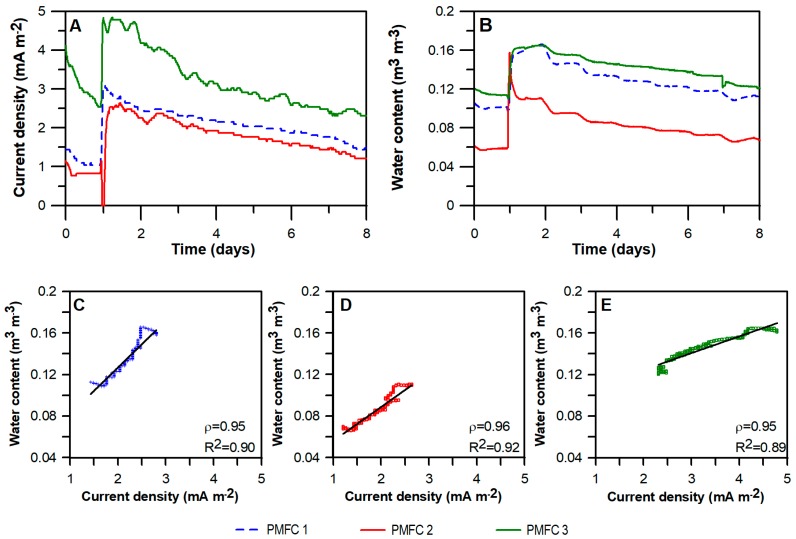
Green roofs have many benefits, but in countries with semiarid climates the amount of water needed for irrigation is a limiting factor for their maintenance. The use of drought-tolerant plants such as species, reduces the water requirements in the dry season, but, even so, in semiarid environments these can reach up to 60 L m per day. Continuous substrate/soil water content monitoring would facilitate the efficient use of this critical resource. In this context, the use of plant microbial fuel cells (PMFCs) emerges as a suitable and more sustainable alternative for monitoring water content in green roofs in semiarid climates. In this study, bench and pilot-scale experiments using seven species showed a positive relationship between current generation and water content in the substrate. PMFC reactors with higher water content (around 27% vs. 17.5% /) showed larger power density (114.6 and 82.3 μW m vs. 32.5 μW m). Moreover, a correlation coefficient of 0.95 (±0.01) between current density and water content was observed. The results of this research represent the first effort of using PMFCs as low-cost water content biosensors for green roofs.
绿色屋顶有很多好处,但在半干旱气候的国家,灌溉所需的水量是维持它们的一个限制因素。使用耐旱植物,如 物种,可以减少旱季的用水需求,但即便如此,在半干旱环境中,这些植物每天的耗水量可达 60 升/平方米。持续监测基质/土壤的含水量将有助于有效利用这一关键资源。在这种情况下,植物微生物燃料电池 (PMFC) 的使用为监测半干旱气候下绿色屋顶的含水量提供了一种合适且更可持续的替代方案。在这项研究中,使用七种 物种进行了台架和中试规模的实验,结果表明电流产生与基质含水量之间存在正相关关系。具有较高含水量(约 27% 对 17.5%)的 PMFC 反应器显示出更大的功率密度(114.6 和 82.3 μW m 对 32.5 μW m)。此外,观察到电流密度和含水量之间的相关系数为 0.95(±0.01)。这项研究的结果代表了首次将 PMFC 用作绿色屋顶低成本含水量生物传感器的努力。