de Aquino Xavier Regina Maria, Azevedo Vitor Manuel Pereira, Godoy Paulo Henrique, Migowski Arn, Ribeiro Antonio Luiz Pinho, Chaves Rogério Brant Martins, Correia Marcelo Goulart, de Aquino Xavier Carolina, de Aquino Hashimoto Lucas, Weksler Clara, Silva Nelson Albuquerque Souza E
Hospital School, National Institute of Cardiology (INC), Ministry of Health, Rua das Laranjeiras 374, Laranjeiras, Rio de Janeiro, RJ, Brazil.
Hospital Naval Marcílio Dias, Rio de Janeiro, Brazil.
BMC Cardiovasc Disord. 2017 Dec 28;17(1):302. doi: 10.1186/s12872-017-0725-9.
Heart valve surgery outcomes are unknown in middle-income countries and thus cannot be used in health system decision making processes. This study estimated in-hospital mortality and medium and long-term survival.
This was a retrospective study of 78,806 patients who underwent heart valve surgery between 2001 and 2007 in Brazil. Two national databases were used, the Hospital Information System and the Mortality Information System. Kaplan-Meier survival analysis and log-rank tests were performed. Maximum and median follow-up was 7.7 and 2.8 years, respectively (0.002-7.707).
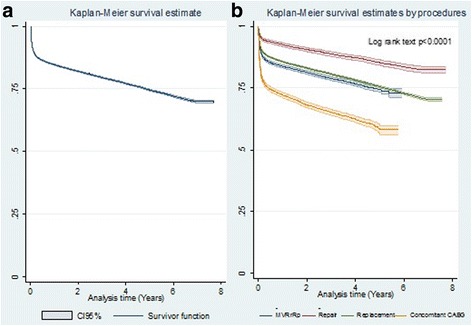
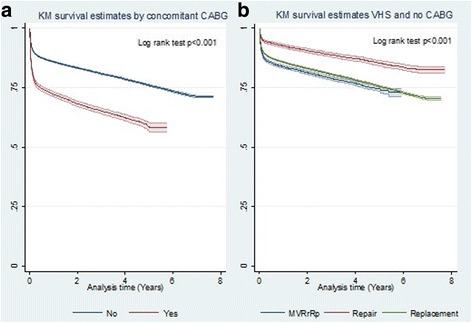
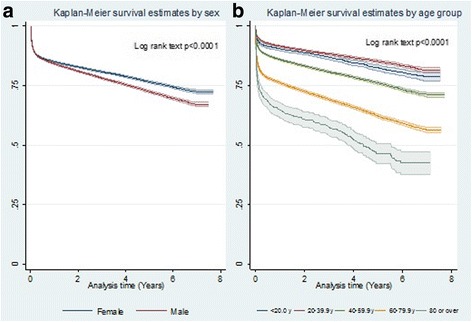
Valve replacement accounted for 69.1% of procedures performed. Mitral stenosis, the most common valve injury, represented 38.9% of the total. In 94.7% of mitral stenosis patients, aetiology was rheumatic heart disease. In-hospital mortality was 7.6% and was higher for women, for patients who had undergone concomitant coronary artery bypass grafting (CABG) and for the elderly. Overall survival was 69.9% at the end of follow-up. Survival was worst among elderly, male and concomitant CABG patients (P<0.001).
Rheumatic heart disease is still a major public health problem in Brazil. In-hospital mortality and global survival rates of patients who have undergone heart valve surgery were less satisfactory than those reported in high-income countries. The findings of this study can contribute to guiding decision making processes in middle-income countries similar to Brazil and others concerned with improving the quality of care.
在中等收入国家,心脏瓣膜手术的结果尚不清楚,因此无法用于卫生系统的决策过程。本研究估计了住院死亡率以及中长期生存率。
这是一项对2001年至2007年期间在巴西接受心脏瓣膜手术的78806例患者进行的回顾性研究。使用了两个国家数据库,即医院信息系统和死亡率信息系统。进行了Kaplan-Meier生存分析和对数秩检验。最大随访时间和中位随访时间分别为7.7年和2.8年(0.002 - 7.707)。
瓣膜置换占所施行手术的69.1%。二尖瓣狭窄是最常见的瓣膜损伤,占总数的38.9%。在94.7%的二尖瓣狭窄患者中,病因是风湿性心脏病。住院死亡率为7.6%,女性、接受同期冠状动脉旁路移植术(CABG)的患者和老年人的死亡率更高。随访结束时总体生存率为69.9%。老年人、男性和接受同期CABG的患者生存率最差(P<0.001)。
风湿性心脏病在巴西仍然是一个主要的公共卫生问题。心脏瓣膜手术患者的住院死亡率和总体生存率不如高收入国家报告的结果理想。本研究结果有助于指导类似于巴西及其他关注改善医疗质量的中等收入国家的决策过程。