Department of Otolaryngology-Head and Neck Surgery, College of Medicine, The Catholic University of Korea, Seoul, Republic of Korea.
Department of Otorhinolaryngology-Head and Neck Surgery, Ilsong Memorial Institute of Head and Neck Cancer, Hallym University, College of Medicine, Seoul, Republic of Korea.
BMC Cancer. 2017 Dec 29;17(1):904. doi: 10.1186/s12885-017-3880-6.
The purpose of this study was to determine prognostic factors influencing outcomes of surgical treatment in patients with T4a hypopharyngeal cancer.
The present study enrolled 93 patients diagnosed with T4a hypopharyngeal cancer who underwent primary surgery between January 2005 and December 2015 at six medical centers in Korea. Primary tumor sites included pyriform sinus in 71 patients, posterior pharyngeal wall in 14 patients, and postcricoid region in 8 patients. Seventy-two patients received postoperative radio(chemo)therapy.
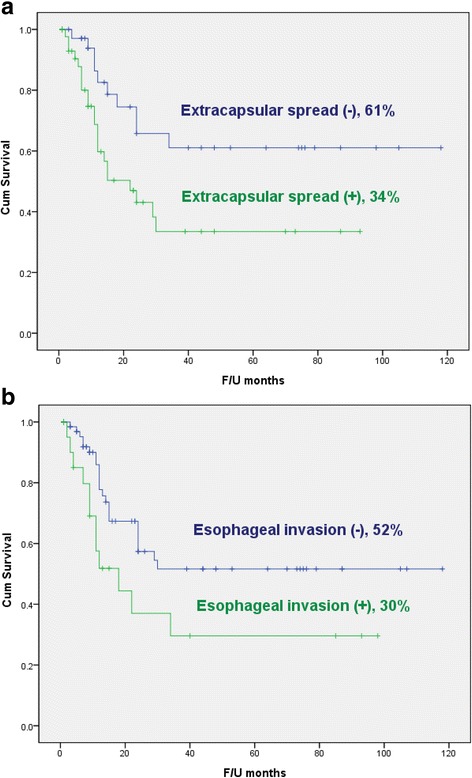
Five-year disease-free survival (DFS) and disease-specific survival (DSS) rates were 38% and 45%, respectively. In univariate analysis, 5-year DFS was found to have significant and positive correlations with margin involvement (p < 0.001) and extracapsular spread (p = 0.025). Multivariate analysis confirmed that margin involvement (hazard ratio (HR): 2.81; 95% confidence interval (CI): 1.49-5.30; p = 0.001) and extracapsular spread (HR: 2.08; 95% CI: 1.08-3.99; p = 0.028) were significant factors associated with 5-year DFS. In univariate analysis, cervical lymph node metastasis (p = 0.048), lymphovascular invasion (p = 0.041), extracapsular spread (p = 0.015), and esophageal invasion (p = 0.033) were significant factors associated with 5-year DSS. In multivariate analysis, extracapsular spread (HR: 2.98; 95% CI: 1.39-6.42; p = 0.005) and esophageal invasion (HR: 2.87; 95% CI: 1.38-5.98; p = 0.005) remained significant factors associated with 5-year DSS.
Margin involvement and extracapsular spread are factors influencing recurrence while extracapsular spread and esophageal invasion are factors affecting survival in patients with T4a hypopharyngeal cancer treated by primary surgery.
本研究旨在确定影响 T4a 下咽癌手术治疗结果的预后因素。
本研究纳入了 93 例在韩国 6 家医疗中心于 2005 年 1 月至 2015 年 12 月期间接受原发手术治疗的 T4a 下咽癌患者。原发肿瘤部位包括梨状窦 71 例,咽后壁 14 例,环后区 8 例。72 例患者接受术后放化疗。
5 年无病生存率(DFS)和疾病特异性生存率(DSS)分别为 38%和 45%。单因素分析显示,5 年 DFS 与切缘累及(p<0.001)和囊外扩散(p=0.025)显著正相关。多因素分析证实,切缘累及(HR:2.81;95%CI:1.49-5.30;p=0.001)和囊外扩散(HR:2.08;95%CI:1.08-3.99;p=0.028)是与 5 年 DFS 相关的显著因素。单因素分析显示,颈部淋巴结转移(p=0.048)、淋巴血管侵犯(p=0.041)、囊外扩散(p=0.015)和食管侵犯(p=0.033)与 5 年 DSS 显著相关。多因素分析显示,囊外扩散(HR:2.98;95%CI:1.39-6.42;p=0.005)和食管侵犯(HR:2.87;95%CI:1.38-5.98;p=0.005)仍然是与 5 年 DSS 相关的显著因素。
切缘累及和囊外扩散是影响复发的因素,而囊外扩散和食管侵犯是影响 T4a 下咽癌患者原发手术后生存的因素。