Novocure Ltd, 31905, Haifa, Israel.
Department of Oncology-Pathology, Karolinska Institutet, SE-171 76, Stockholm, Sweden.
Radiat Oncol. 2017 Dec 29;12(1):206. doi: 10.1186/s13014-017-0941-6.
Tumor Treating Fields (TTFields) are an anti-neoplastic treatment modality delivered via application of alternating electric fields using insulated transducer arrays placed directly on the skin in the region surrounding the tumor. A Phase 3 clinical trial has demonstrated the effectiveness of continuous TTFields application in patients with glioblastoma during maintenance treatment with Temozolomide. The goal of this study was to evaluate the efficacy of combining TTFields with radiation treatment (RT) in glioma cells. We also examined the effect of TTFields transducer arrays on RT distribution in a phantom model and the impact on rat skin toxicity.
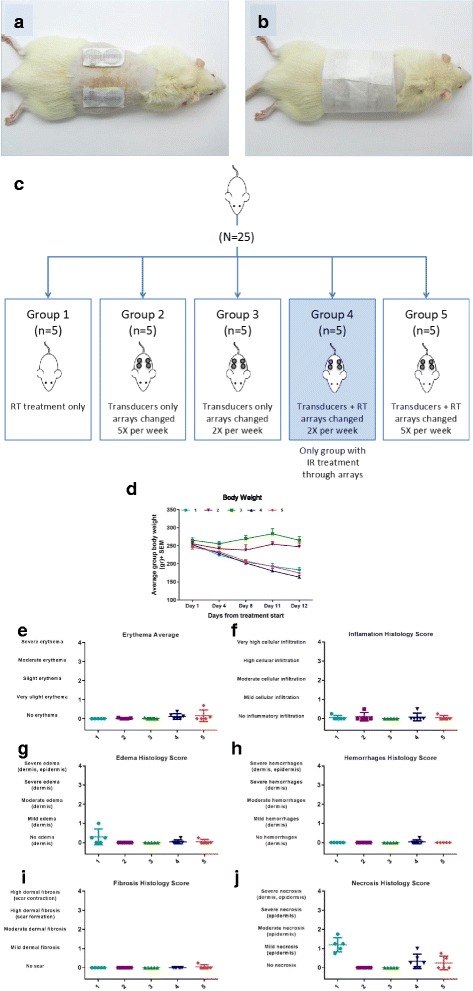
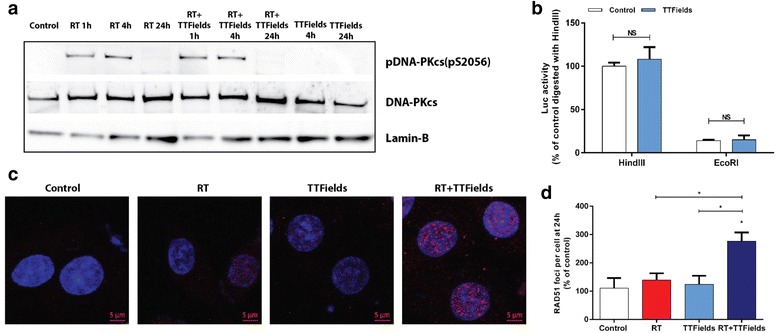
The efficacy of TTFields application after induction of DNA damage by RT or bleomycin was tested in U-118 MG and LN-18 glioma cells. The alkaline comet assay was used to measure repair of DNA lesions. Repair of DNA double strand breaks (DSBs) were assessed by analyzing γH2AX or Rad51 foci. DNA damage and repair signaled by the activation pattern of phospho-ATM (pS1981) and phospho-DNA-PKcs (pS2056) was evaluated by immunoblotting. The absorption of the RT energy by transducer arrays was measured by applying RT through arrays placed on a solid-state phantom. Skin toxicities were tested in rats irradiated daily through the arrays with 2Gy (total dose of 20Gy).
TTFields synergistically enhanced the efficacy of RT in glioma cells. Application of TTFields to irradiated cells impaired repair of irradiation- or chemically-induced DNA damage, possibly by blocking homologous recombination repair. Transducer arrays presence caused a minor reduction in RT intensity at 20 mm and 60 mm below the arrays, but led to a significant increase in RT dosage at the phantom surface jeopardizing the "skin sparing effect". Nevertheless, transducer arrays placed on the rat skin during RT did not lead to additional skin reactions.
Administration of TTFields after RT increases glioma cells treatment efficacy possibly by inhibition of DNA damage repair. These preclinical results support the application of TTFields therapy immediately after RT as a viable regimen to enhance RT outcome. Phantom measurements and animal models imply that it may be possible to leave the transducer arrays in place during RT without increasing skin toxicities.
肿瘤治疗电场(TTFields)是一种通过将绝缘换能器阵列直接放置在肿瘤周围皮肤区域来施加交变电场的抗肿瘤治疗方式。一项 3 期临床试验已经证明了在替莫唑胺维持治疗期间连续应用 TTFields 对胶质母细胞瘤患者的有效性。本研究的目的是评估 TTFields 与放射治疗(RT)联合应用于胶质瘤细胞的疗效。我们还研究了 TTFields 换能器阵列对体模中 RT 分布的影响及其对大鼠皮肤毒性的影响。
在 U-118 MG 和 LN-18 神经胶质瘤细胞中,通过 RT 或博来霉素诱导 DNA 损伤后,测试 TTFields 应用的疗效。碱性彗星试验用于测量 DNA 损伤的修复。通过分析 γH2AX 或 Rad51 焦点来评估 DNA 双链断裂(DSBs)的修复。通过免疫印迹评估磷酸-ATM(pS1981)和磷酸-DNA-PKcs(pS2056)的激活模式所指示的 DNA 损伤和修复。通过将 RT 施加到放置在固态体模上的换能器阵列上来测量换能器阵列对 RT 能量的吸收。通过在数组下每天辐照大鼠 2Gy(总剂量 20Gy)来测试皮肤毒性。
TTFields 与 RT 联合应用协同增强了神经胶质瘤细胞的疗效。将 TTFields 应用于辐照细胞会损害辐照或化学诱导的 DNA 损伤的修复,这可能是通过阻断同源重组修复来实现的。换能器阵列的存在会导致在阵列下方 20mm 和 60mm 处的 RT 强度略有降低,但会导致在体模表面的 RT 剂量显著增加,从而危及“皮肤保护效应”。然而,在 RT 期间放置在大鼠皮肤上的换能器阵列不会导致额外的皮肤反应。
在 RT 后给予 TTFields 可增加神经胶质瘤细胞的治疗效果,可能是通过抑制 DNA 损伤修复。这些临床前结果支持在 RT 后立即应用 TTFields 治疗作为增强 RT 疗效的可行方案。体模测量和动物模型表明,在不增加皮肤毒性的情况下,在 RT 期间将换能器阵列留在原位可能是可行的。