Choudhry Hani, Zamzami Mazin A, Omran Ziad, Wu Wei, Mousli Marc, Bronner Christian, Alhosin Mahmoud
Department of Biochemistry, Faculty of Science, King Abdulaziz University, Jeddah 21589, Saudi Arabia.
Cancer Metabolism and Epigenetic Unit, King Abdulaziz University, Jeddah 21589, Saudi Arabia.
Oncol Lett. 2018 Jan;15(1):3-10. doi: 10.3892/ol.2017.7290. Epub 2017 Oct 30.
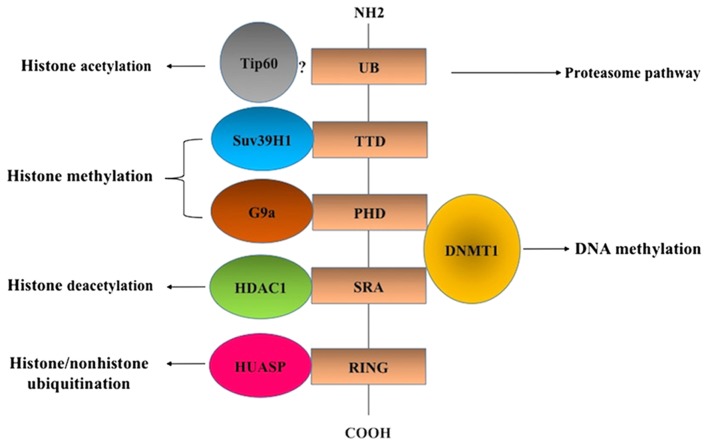
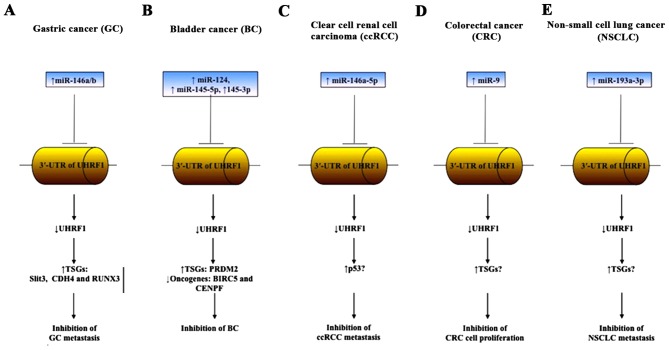
Ubiquitin-like containing plant homeodomain and RING finger domains 1 (UHRF1) is an anti-apoptotic protein involved in the silencing of several tumor suppressor genes (TSGs) through epigenetic modifications including DNA methylation and histone post-translational alterations, and also epigenetic-independent mechanisms. UHRF1 overexpression is observed in a number of solid tumors and hematological malignancies, and is considered a primary mechanism in inhibiting apoptosis. UHRF1 exerts its inhibitory activity on TSGs by binding to functional domains and therefore influences several epigenetic actors including DNA methyltransferase, histone deacetylase 1, histone acetyltransferase Tat-interacting protein 60 and histone methyltransferases G9a and Suv39H1. UHRF1 is considered to control a large macromolecular protein complex termed epigenetic code replication machinery, in order to maintain epigenetic silencing of TSGs during cell division, thus enabling cancer cells to escape apoptosis. MicroRNAs (miRNAs) are able to regulate the expression of its target gene by functioning as either an oncogene or a tumor suppressor. In the present review, the role of tumor suppressive miRNAs in the regulation of UHRF1, and the importance of targeting the microRNA/UHRF1 pathways in order to induce the reactivation of silenced TSGs and subsequent apoptosis are discussed.
含泛素样植物同源结构域和RING指结构域1(UHRF1)是一种抗凋亡蛋白,通过包括DNA甲基化和组蛋白翻译后修饰在内的表观遗传修饰以及表观遗传非依赖机制参与多种肿瘤抑制基因(TSG)的沉默。在许多实体瘤和血液系统恶性肿瘤中均观察到UHRF1过表达,并且它被认为是抑制细胞凋亡的主要机制。UHRF1通过与功能域结合对TSG发挥抑制活性,因此影响包括DNA甲基转移酶、组蛋白去乙酰化酶1、组蛋白乙酰转移酶Tat相互作用蛋白60以及组蛋白甲基转移酶G9a和Suv39H1在内的多种表观遗传因子。UHRF1被认为控制着一种称为表观遗传密码复制机制的大型大分子蛋白复合物,以便在细胞分裂过程中维持TSG的表观遗传沉默,从而使癌细胞能够逃避凋亡。微小RNA(miRNA)能够通过作为癌基因或肿瘤抑制因子发挥作用来调节其靶基因的表达。在本综述中,讨论了肿瘤抑制性miRNA在UHRF1调节中的作用,以及靶向微小RNA/UHRF1途径以诱导沉默的TSG重新激活并随后诱导凋亡的重要性。