a Faculty of Medicine and Pharmaceutical Sciences , University of Douala , Douala , Cameroon.
b Department of Internal Medicine , Douala General Hospital , Douala , Cameroon.
Ren Fail. 2018 Nov;40(1):30-37. doi: 10.1080/0886022X.2017.1419970.
There are limited data on AKI in sub-Saharan Africa. We aim to determine the incidence, characteristics and prognosis of AKI in Cameroon.
A prospective study including all consenting acute admissions in the internal medicine and the ICU of a tertiary referral hospital in Cameroon from January 2015 to June 2016. Serum creatinine assay was done on admission, days 2 and 7 to diagnose AKI. For patients with AKI, serum creatinine was done on discharge, days 30, 60 and 90. AKI was defined according to the modified KDIGO 2012 criteria as an increase or decrease in serum creatinine of 3 mg/l or greater, or an increase of 50% or more from the reference value obtained at admission or the known baseline value. AKI severity was graded using KDIGO2012 criteria. Outcome measures were renal recovery, mortality and causes of death. Renal recovery was complete if serum creatinine between the first 90 days was less than baseline or reference, partial if less than diagnosis but not baseline or reference, no-recovery if creatinine did not decrease or if the patient remained on dialysis.
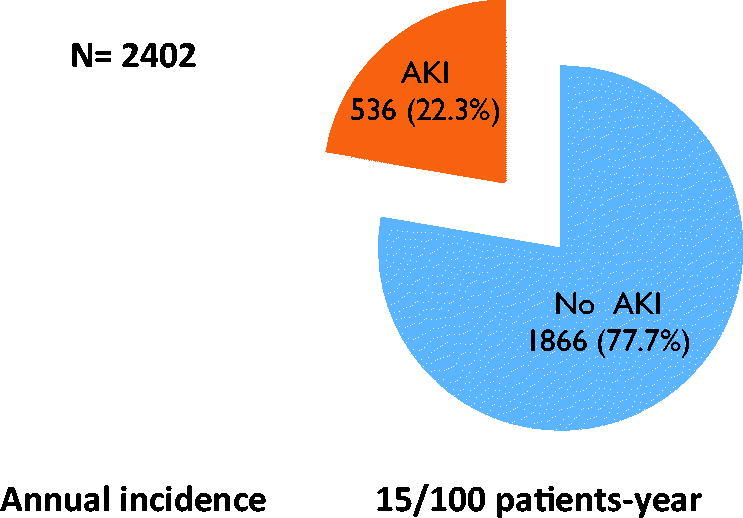
Of the 2402 patients included, 536 developed AKI giving a global incidence of 22.3% and annual incidence of 15 per 100 patients-years. Of the 536 patients with AKI, 43.3% were at stage 3, 54.7% were males, median age was 56 years. Pre-renal AKI (61.4%) and acute tubular necrosis (28.9%) were the most frequent forms. Main etiologies were sepsis (50.4%) and volume depletion (31.6%). Renal outcome was unknown in 34% of patients. Of the 354 patients with known renal function at 3 months, 84.2% recovered completely, 14.7% partially and 1.1% progressed to CKD. Global mortality rate was 36.9% mainly due to sepsis.
AKI is frequent in our setting, mainly due to sepsis and hypovolemia. It carries a poor prognosis.
撒哈拉以南非洲地区关于急性肾损伤(AKI)的数据有限。本研究旨在确定喀麦隆 AKI 的发病率、特征和预后。
这是一项前瞻性研究,纳入了 2015 年 1 月至 2016 年 6 月期间喀麦隆一家三级转诊医院内科和重症监护病房所有同意入组的急性住院患者。入院时、第 2 天和第 7 天进行血清肌酐检测以诊断 AKI。对于 AKI 患者,在出院时、第 30 天、第 60 天和第 90 天进行血清肌酐检测。根据改良 KDIGO 2012 标准,AKI 定义为血清肌酐升高或降低 3mg/dl 或以上,或入院时获得的参考值或已知基线值升高 50%或以上。AKI 严重程度根据 KDIGO2012 标准分级。主要观察指标为肾脏恢复情况、死亡率和死亡原因。如果患者在第 90 天内的血清肌酐值低于基线或参考值,则认为肾脏完全恢复;如果低于诊断标准但高于基线或参考值,则为部分恢复;如果肌酐值未降低或患者仍需透析,则为无恢复。
在 2402 例患者中,536 例发生 AKI,总发病率为 22.3%,年发病率为 15 例/100 患者年。536 例 AKI 患者中,3 期 AKI 占 43.3%,男性占 54.7%,中位年龄为 56 岁。肾前性 AKI(61.4%)和急性肾小管坏死(28.9%)是最常见的类型。主要病因是脓毒症(50.4%)和血容量不足(31.6%)。34%的患者肾功能结果未知。在 3 个月时已知肾功能的 354 例患者中,84.2%完全恢复,14.7%部分恢复,1.1%进展为慢性肾脏病。总死亡率为 36.9%,主要原因是脓毒症。
在我们的研究环境中,AKI 很常见,主要由脓毒症和血容量不足引起,预后不良。