Liu Yong-Biao, Yang Xiangbing, Masuda Tiffany
Crop Improvement and Protection Unit, USDA-ARS;
The University of California Davis.
J Vis Exp. 2017 Nov 24(129):56309. doi: 10.3791/56309.
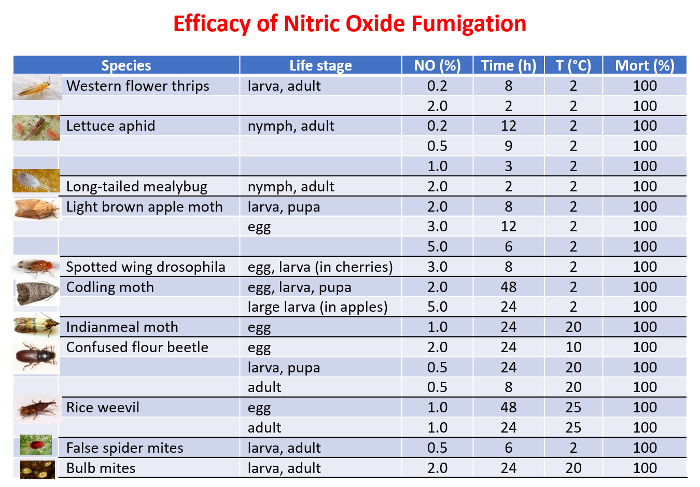
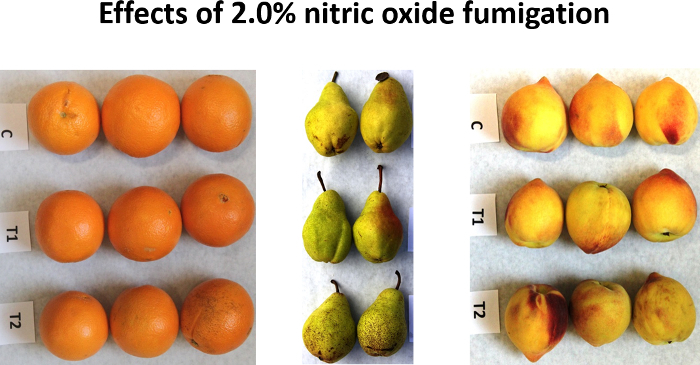
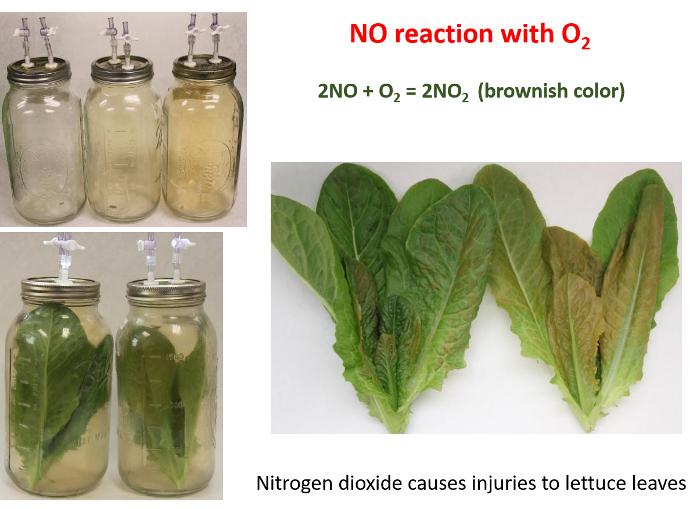
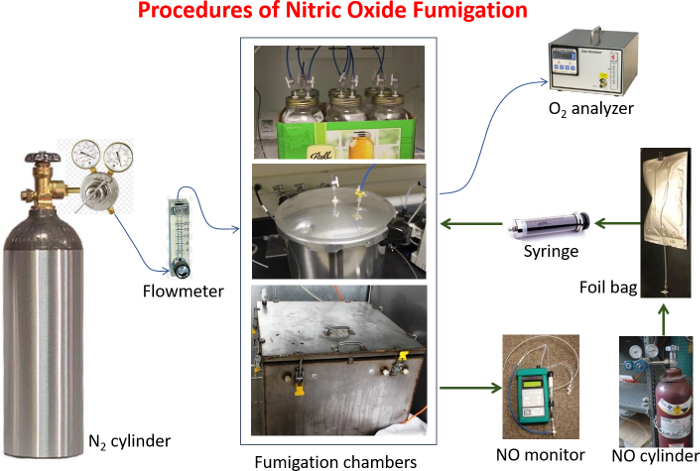
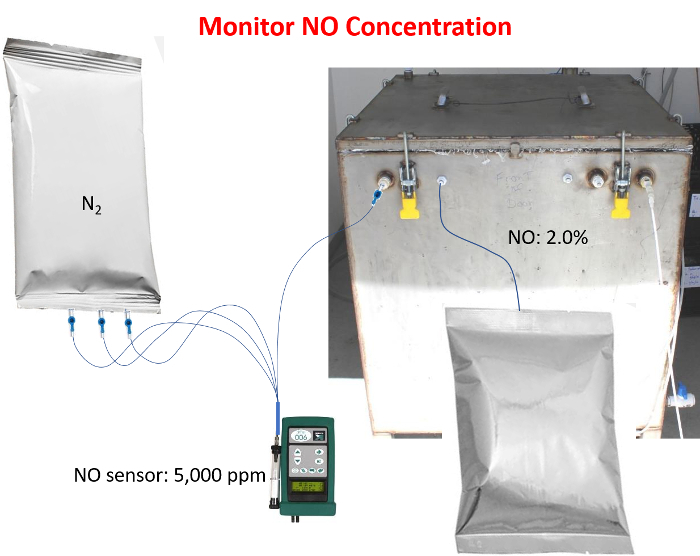
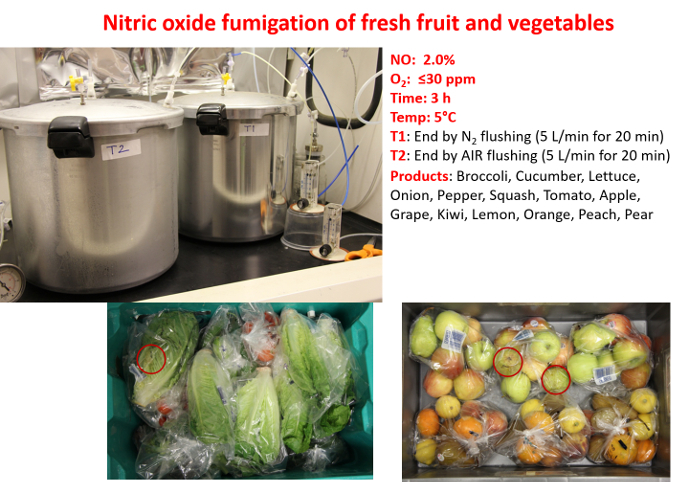
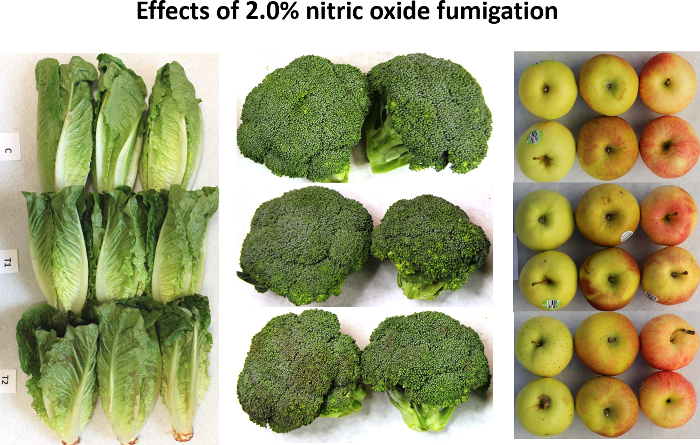
Nitric oxide (NO) is a newly discovered fumigant for postharvest pest control. This paper provides detailed protocols for conducting NO fumigation on fresh products and procedures for residue analysis and product quality evaluation. An airtight fumigation chamber containing fresh fruit and vegetables is first flushed with nitrogen (N2) to establish an ultralow oxygen (ULO) environment followed by injection of NO. The fumigation chamber is then kept at a low temperature of 2 - 5 °C for a specified time period necessary to kill a target pest to complete a fumigation treatment. At the end of a fumigation treatment, the fumigation chamber is flushed with N2 to dilute NO prior to opening the chamber to ambient air to prevent the reaction between NO and O2, which produces NO2 and may damage delicate fresh products. At different times after NO fumigation, NO2 in headspace and nitrate and nitrite in liquid samples were measured as residues. Product quality was evaluated after 2 weeks of post-treatment cold storage to determine effects of NO fumigation on product quality. Keeping O2 from reacting with NO is critical to NO fumigation and is an important part of the protocols. Measuring NO levels is challenging and a practical solution is provided. Possible protocol modifications are also suggested for measuring NO levels in the fumigation chambers as well as residues. NO fumigation has the potential to be a practical alternative to methyl bromide fumigation for postharvest pest control on fresh and stored products. This publication is intended to assist other researchers in conducting NO fumigation research for postharvest pest control and accelerating the development of NO fumigation for practical applications.
一氧化氮(NO)是一种新发现的用于采后害虫防治的熏蒸剂。本文提供了对新鲜产品进行NO熏蒸的详细方案以及残留分析和产品质量评估的程序。首先用氮气(N₂)冲洗装有新鲜水果和蔬菜的气密熏蒸室,以建立超低氧(ULO)环境,然后注入NO。然后将熏蒸室保持在2 - 5°C的低温下一段特定时间,以杀死目标害虫,从而完成熏蒸处理。在熏蒸处理结束时,在打开熏蒸室使其与环境空气相通之前,先用N₂冲洗熏蒸室以稀释NO,以防止NO与O₂反应生成NO₂,而NO₂可能会损害娇嫩的新鲜产品。在NO熏蒸后的不同时间,测量顶空中的NO₂以及液体样品中的硝酸盐和亚硝酸盐作为残留量。在处理后的冷藏2周后评估产品质量,以确定NO熏蒸对产品质量的影响。防止O₂与NO反应对于NO熏蒸至关重要,也是方案的重要组成部分。测量NO水平具有挑战性,并提供了一种实际解决方案。还建议对测量熏蒸室内的NO水平以及残留量的方案进行可能的修改。对于新鲜和储存产品的采后害虫防治,NO熏蒸有可能成为溴甲烷熏蒸的一种实用替代方法。本出版物旨在帮助其他研究人员进行采后害虫防治的NO熏蒸研究,并加速NO熏蒸在实际应用中的开发。